









Product Quick Navigation
Get a Quote
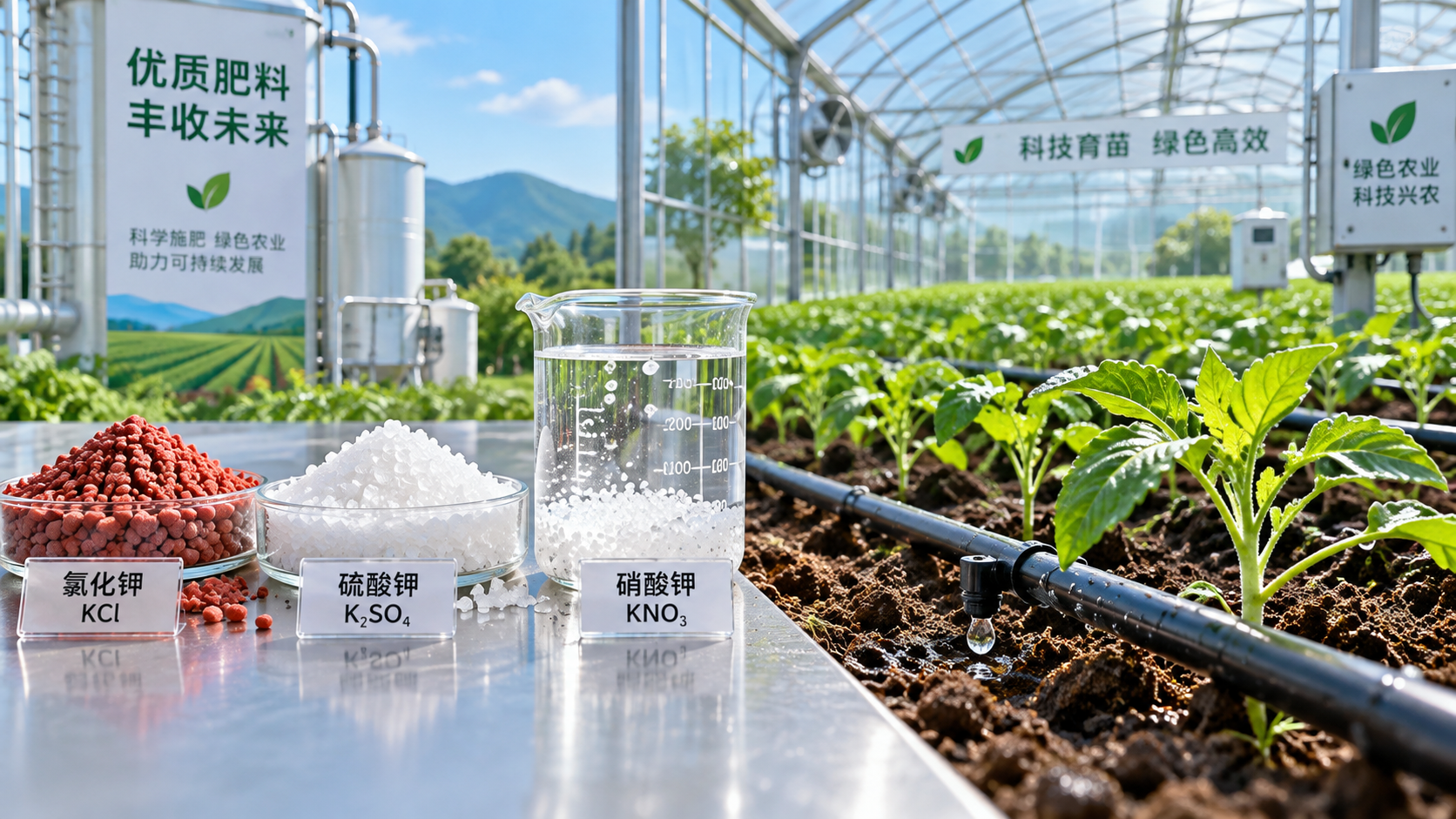
Choosing between muriate of potash (MOP), sulfate of potash (SOP), and potassium nitrate (NOP) is not simply a question of which fertilizer contains the most potassium. The right choice depends on the crop’s chloride tolerance, the soil’s salinity and nutrient balance, the production system, the timing of application, and whether nitrogen or sulfur is also needed.
MOP is often the practical base source for broad-acre crops and chloride-tolerant field production. SOP is chosen when chloride must be limited or sulfur has agronomic value. NOP is most useful where a readily available nitrate-nitrogen and potassium combination fits a precisely managed fertigation or late-season feeding program. Treating these products as interchangeable “potash fertilizers” can lead to avoidable salt stress, nutrient imbalance, unnecessary cost, or poor timing of nutrient supply.
The first distinction: potassium source is not the only nutrient difference
All three products supply potassium, generally expressed on fertilizer labels as K2O. However, the accompanying ion matters as much as the potassium concentration.
The potassium percentage should therefore not be compared in isolation. A lower-K2O product may still be the better operational choice if it avoids chloride damage, supplies sulfur, or delivers nitrate nitrogen at a point when the crop can use it effectively.
MOP: efficient potassium supply where chloride is acceptable
MOP is potassium chloride, commonly recognized by its red, pink, or white granular appearance depending on source and processing. Its high nutrient concentration means fewer kilograms of product are needed to deliver a target potassium rate than with SOP or NOP. For crops with good chloride tolerance, this makes MOP a straightforward option for pre-plant, basal, or broad-acre applications.
Maize, wheat, barley, sorghum, many forage grasses, sugar beet, and several oilseed crops can often use MOP effectively when soil salinity is controlled and potassium demand is correctly calculated. It is also widely suited to soil-incorporated application before planting, particularly where rainfall or irrigation will move dissolved potassium into the active root zone.
The limitation is chloride. Chloride is an essential micronutrient in small quantities, but the chloride delivered with MOP is substantial at normal potassium application rates. In a crop that is chloride-sensitive, or in soil already affected by salinity, the additional salt load can reduce water uptake and interfere with crop performance. The risk is not determined by fertilizer type alone. It is shaped by:
- electrical conductivity and drainage condition of the soil;
- irrigation-water salinity;
- application rate and fertilizer placement;
- rainfall or irrigation after application;
- seedling sensitivity and root-zone volume;
- the crop’s response to chloride during its critical growth stages.
MOP should be handled cautiously in direct seed-row placement. High local salt concentration can injure germinating seed or young roots, especially in dry soil. Broadcasting and incorporation, or banding away from the seed, generally reduces that risk. The allowable distance and rate depend on soil texture, moisture, planting equipment, and crop sensitivity; a fertilizer plan should not assume that a rate safe for one field is safe for another.
A common mistake is to reject MOP for every high-value crop. Crop value alone does not define chloride sensitivity. The relevant question is whether the crop, soil, water, and production schedule can tolerate the chloride introduced at the intended rate. When they can, MOP may remain a technically sound and efficient potassium source.
SOP: the choice when chloride management matters
SOP supplies potassium together with sulfate sulfur and contains no chloride. It is generally preferred for crops known to respond poorly to chloride, including many tobacco, potato, grape, citrus, berry, vegetable, and orchard systems. It is also useful where chloride-sensitive quality characteristics are important, although fertilizer choice should not be credited with quality improvements unless the underlying soil and crop conditions support that response.
The sulfur contribution is often a practical reason to select SOP. Sulfur is required for amino acids and protein synthesis, and a soil with low available sulfur may require supplementation independently of potassium. SOP can address both needs in one material. This does not mean it should replace a sulfur assessment: the amount of sulfur supplied by the intended potassium rate may be insufficient, excessive for the planned nutrient balance, or poorly timed relative to crop demand.
Compared with MOP, SOP generally has a lower salt index per unit of potassium and avoids chloride accumulation. That can be important in greenhouse beds, protected cultivation, light-textured soils, and irrigated areas where salts are not readily leached below the root zone. However, “chloride-free” does not mean “risk-free.” High fertilizer concentration in a restricted root zone can still create osmotic stress, particularly when soil is dry or fertigation events are too concentrated.
Granular SOP is normally used for soil application or as a component in blended fertilizer programs. Soluble SOP grades may be used in fertigation where their dissolution behavior, water quality, and filtration requirements have been checked. Material marketed under the same broad name can differ in particle size, solubility, moisture content, and suitability for blending or water application. The label’s nutrient analysis alone does not confirm operational compatibility.
Operators should also distinguish SOP from fertilizers that merely contain sulfur. Elemental sulfur, ammonium sulfate, gypsum, and SOP play different roles in soil and crop nutrition. SOP supplies immediately plant-available sulfate and potassium, but it is not a general remedy for alkaline soil, poor drainage, or sodium-affected soil. Those conditions require diagnosis beyond selecting a potassium source.
NOP: useful when potassium and nitrate nitrogen are needed together
NOP, or potassium nitrate, supplies potassium and nitrate nitrogen in a highly soluble form. Its main advantage is timing. Nitrate is immediately available to plant roots, and potassium nitrate can be applied through properly designed fertigation systems or used as a soluble feed where fast nutrient delivery is required.
This makes NOP particularly relevant in intensive vegetable, fruit, greenhouse, and soilless systems where nutrient delivery is adjusted by crop stage, irrigation frequency, and solution analysis. It can also be valuable in field production when a late-season potassium application is needed and additional nitrogen remains agronomically appropriate.
Its limitation is equally clear: every NOP application adds nitrogen. When the crop is approaching maturity, when vegetative growth is already excessive, or when nitrogen targets have been met, NOP may be the wrong potassium source even if its solubility is attractive. Excess late nitrogen can delay maturity in some crops, encourage soft growth, or increase the gap between planned and actual nutrient inputs.
NOP should not be selected solely because it is fully soluble. Solubility supports fertigation, but successful fertigation also depends on water quality, injection uniformity, irrigation scheduling, stock-solution concentration, and compatibility with other fertilizers. Calcium-containing fertilizers should not be mixed in the same concentrated stock solution with sulfate- or phosphate-containing materials because precipitation can occur. While potassium nitrate itself is compatible with many fertilizer salts in dilute irrigation water, each tank mix should be evaluated under the actual water chemistry and concentration used.
In open-field systems, NOP may be more costly per unit of potassium than bulk MOP, and its nitrogen contribution may duplicate other planned inputs. Its value is highest when it solves a timing or delivery problem that MOP and SOP cannot solve as well—not merely when a soluble potassium source is desired.
Crop sensitivity should be assessed with the field, not from a simple list
Crop sensitivity lists are useful starting points, but they do not replace field-specific judgment. Potato is often cited as a crop where SOP is favored because excessive chloride can affect quality and specific gravity under some production conditions. Yet the extent of response can vary with cultivar, soil chloride status, irrigation practice, potassium requirement, and local quality specifications. The same principle applies to fruits, vegetables, tobacco, and protected crops.
A more reliable selection process begins with four practical questions:
- Is chloride already present at a level that makes additional chloride undesirable?
- Does the crop have a documented sensitivity to chloride or a quality requirement that limits its use?
- Is sulfur needed at the same time as potassium?
- Is nitrate nitrogen required at the planned application stage?
If chloride is acceptable and no additional sulfur or nitrate nitrogen is needed, MOP is often the logical baseline. If chloride should be minimized and sulfur is useful, SOP has a clear role. If a soluble potassium source is needed during active crop growth and nitrate nitrogen fits the nutrient program, NOP becomes more relevant.
Soil salinity and placement can change the answer
In saline or poorly drained soil, fertilizer choice cannot be separated from salt management. MOP adds chloride and has a stronger salinity concern at the point of application than SOP. NOP also contributes soluble salts, even though it contains no chloride. A switch from MOP to SOP or NOP may reduce one source of stress, but it will not correct inadequate drainage, saline irrigation water, or over-fertilization.
Placement deserves equal attention. A fertilizer placed in a concentrated band near seed or roots behaves differently from the same fertilizer broadcast over a larger area. Dry soil, shallow rooting, low organic matter, and limited irrigation all increase the consequences of poor placement. For fertigation, short and frequent injections may produce a more stable nutrient environment than infrequent, highly concentrated doses, provided the system distributes water uniformly.
Soil testing should include more than exchangeable potassium when potassium-source selection is difficult. Electrical conductivity, pH, texture, cation exchange capacity, sulfate status where relevant, and irrigation-water analysis all provide context. Potassium itself is also influenced by soil mineralogy: clay soils can retain potassium between mineral layers, while sandy soils may have lower reserve capacity and greater leaching-related management challenges. The fertilizer source does not remove the need to match rate and timing to the soil’s ability to supply and retain nutrients.
Product form and handling affect field performance
Granular MOP and SOP are commonly selected for dry spreading and blending, while water-soluble SOP and NOP are used where fertigation or foliar-compatible nutrient programs are intended. The physical grade must match the equipment. Particle-size variation can cause segregation in blends, affecting application uniformity. Excess moisture can lead to caking, poor flow, and uneven metering. Dust generation is also an operational issue when handling dry fertilizer products.
Do not assume that products from a general chemical catalog are interchangeable with agricultural fertilizer grades. Identity, assay, impurity profile, packaging, labeling, and intended use must remain clear through receiving, storage, blending, and application. This is particularly important in facilities handling unrelated materials, such as Linoleic acid CAS#60-33-3, which has no role in potassium fertilization and should be segregated from agricultural nutrient inventories.
For imported material, receiving checks should confirm the product name, nutrient analysis, lot identification, packaging integrity, and applicable safety documentation. A potassium fertilizer that is chemically suitable can still create operational problems if the granule size does not suit spreader settings, the soluble grade leaves insoluble residue in filters, or the package condition suggests moisture exposure during transport or storage.
The decision is usually made by the “extra” nutrient
The most useful way to compare potassium fertilizers is to treat potassium as the shared function and the companion nutrient as the deciding variable. MOP brings chloride. SOP brings sulfate sulfur. NOP brings nitrate nitrogen. Once crop tolerance, soil salinity, irrigation conditions, and the seasonal nutrient plan are known, the choice becomes more disciplined.
MOP is suitable when efficient bulk potassium delivery is needed and chloride fits the system. SOP is justified when chloride avoidance or sulfur supply has clear agronomic value. NOP is most appropriate where its solubility and nitrate nitrogen support a specific feeding window. Selecting on potassium percentage alone overlooks the conditions that determine whether the fertilizer helps the crop or complicates the program.
Send Us Your Inquiry Today
