









Product Quick Navigation
Get a Quote
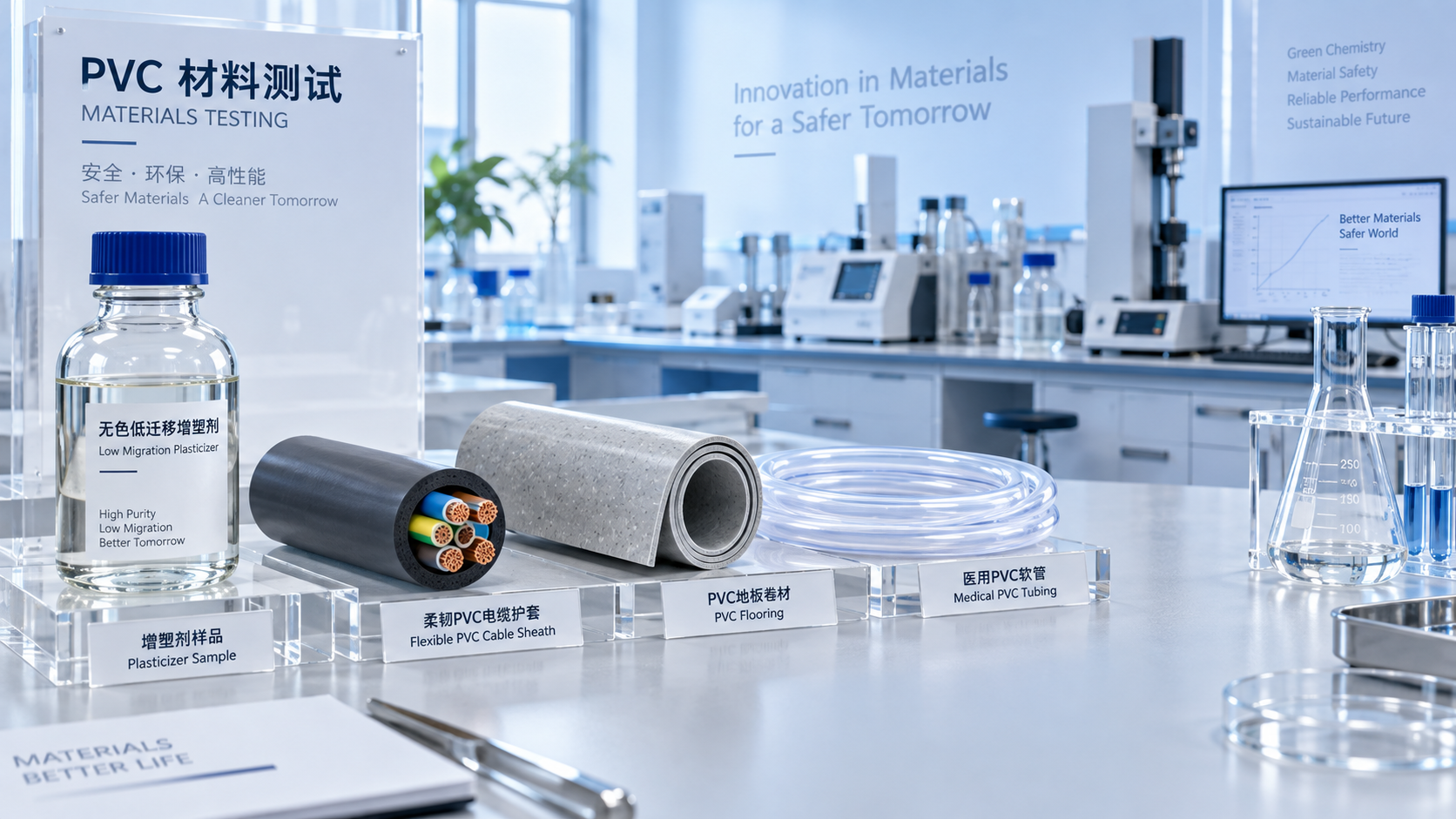
For a project manager, a PVC formulation rarely fails because one ingredient was chosen in isolation. Problems tend to emerge later—after cable insulation has spent months in a warm conduit, after flooring has been cleaned repeatedly, or when a medical component must retain its feel, appearance, and documented compliance through production and use. In these situations, selecting low-migration Plasticizers is not simply a materials decision. It is a project-risk decision involving service life, testing schedules, regulatory expectations, manufacturing consistency, and procurement reliability.
Low migration matters because plasticizer movement can alter far more than surface appearance. It may affect flexibility, hardness, odor, fogging behavior, contact performance, stain resistance, or the composition of adjacent materials. The right approach is therefore not to ask which plasticizer is “best” in general, but which formulation route offers the right balance of permanence, processability, compliance profile, and supply continuity for the specific PVC application.
Migration is a system behavior, not a single-number property
Plasticizer migration is often described as the tendency of an additive to leave flexible PVC over time. That description is useful, but incomplete. In a finished product, migration is influenced by molecular structure, plasticizer molecular weight, polarity, compatibility with PVC, filler loading, polymer grade, processing history, temperature, exposure to oils or detergents, and contact with neighboring substrates.
A flexible PVC compound may look excellent when it leaves the production line and still create trouble later. A cable sheath can become tacky after heat exposure. Resilient flooring may show discoloration where it contacts rubber-backed mats, adhesives, or furniture feet. A medical tubing assembly may require closer review of extractables and leachables, especially where fluid contact, sterilization, or patient-contact requirements are involved.
For this reason, “low migration” should be treated as a performance target verified in the intended system, rather than a label attached to a raw material. Higher-molecular-weight plasticizer families, polymeric plasticizers, trimellitate-type options, and certain specialty alternatives are commonly evaluated where permanence is important. Yet each route brings its own trade-offs in low-temperature flexibility, fusion behavior, viscosity, cost, regulatory status, and processing window.
Start with the end-use exposure map
Before comparing candidate Plasticizers, define what the PVC product will face after installation or use. This early step can prevent costly reformulation after qualification has already begun. A practical exposure map should cover thermal conditions, contact materials, cleaning agents, mechanical stress, expected service duration, and the regulatory framework that applies in the destination market.
- Temperature: Will the product operate near heat sources, inside vehicle interiors, in electrical enclosures, or under steam or sterilization conditions?
- Contact media: Could it encounter oils, fuels, plastic substrates, coatings, adhesives, sweat, cleaning liquids, pharmaceuticals, or medical fluids?
- Physical demands: Is the main concern flex life, abrasion, compression set, tensile retention, low-temperature bend performance, or dimensional stability?
- Visual and sensory requirements: Are fogging, odor, staining, color change, gloss transfer, or surface tack unacceptable?
- Compliance pathway: Which regional chemical restrictions, sector-specific standards, customer specifications, and documentation obligations need to be addressed?
This framework turns an ambiguous request—“we need a safer, more permanent plasticizer”—into an engineering brief that compounders, suppliers, converters, and project teams can actually work with.
Cable compounds: permanence must coexist with electrical and thermal performance
In wire and cable projects, plasticizer selection is closely connected to heat aging, insulation resistance, dielectric properties, flame-retardant package compatibility, and long-term flexibility. A material used in a static indoor cable may need a very different balance from one designed for automotive harnesses, flexible industrial cable, or communication systems installed in confined spaces.
Migration can become visible as exudation, surface changes, or interaction with adjacent layers. It can also be less obvious: a shift in hardness after aging, altered compatibility with printing inks, or reduced reliability in multi-layer constructions. When cables include jackets, insulation, fillers, tapes, inks, or adhesive components, the formulation must be reviewed as an assembled system rather than as separate purchased parts.
Project teams should ask the compounder to compare candidates through relevant aging and contact tests, not only initial mechanical data. Heat aging, volatility loss, extraction resistance, low-temperature flexibility, and electrical testing should be aligned with the cable’s actual specification. If the project uses multiple production sites, process robustness deserves equal attention. A plasticizer that performs well in a narrow laboratory window but is sensitive to mixing sequence or fusion conditions may create avoidable variation at scale.
Flooring: the migration question is usually hiding in the interface
For PVC flooring, migration concerns often appear at interfaces: flooring and adhesive, flooring and backing, flooring and protective coating, or flooring and rubber articles placed on the finished surface. A project may meet its initial appearance target but later face staining, discoloration, or plasticizer exchange caused by contact with mats, castors, furniture feet, or cleaning chemistry.
Low-migration Plasticizers can support better long-term surface stability, but they are only one part of the answer. The topcoat, wear layer, printing system, adhesive chemistry, and maintenance recommendations all influence the final result. Flooring teams should consider contact-stain testing early, particularly when specifying products for healthcare, education, retail, transportation, or other environments where the surface will be cleaned frequently and subjected to varied footwear, equipment, and furnishings.
There is also a commercial dimension. Flooring projects often involve long approval cycles and phased installation. A formulation change halfway through may introduce color-matching issues or force a new validation sequence. Building a controlled, traceable raw-material plan from the beginning helps protect both project timing and finished-floor consistency.
Medical PVC calls for a more disciplined qualification route
Medical PVC applications demand careful language and careful evidence. “Low migration” does not automatically mean suitable for medical use, and a favorable general chemical profile does not replace application-specific evaluation. The intended use matters: a non-patient-contact component, a device housing, a fluid-contact tube, a blood-contact application, and a sterilized disposable device will each have different technical and regulatory expectations.
For medical projects, the evaluation process commonly extends beyond mechanical properties. Teams may need to consider extractables and leachables, odor, particulate control, sterilization compatibility, biological evaluation strategy, chemical characterization, and the documentation required by the device manufacturer or market. Material traceability, change notification practices, and lot consistency can be as consequential as the selected plasticizer chemistry.
A sound sourcing conversation should therefore begin with the precise application, geographical market, processing method, and expected contact conditions. Suppliers can then help identify viable material families and provide the appropriate technical and commercial documentation, while the final compound and device remain subject to validation by the responsible manufacturer.
A practical selection matrix for project decisions
When several plasticizer options appear technically plausible, a weighted decision matrix can bring clarity. Rather than ranking materials solely by purchase price, score them against the risks that could delay launch, create rework, or affect lifecycle performance.
The matrix should remain application-specific. A cable manufacturer may assign the greatest weight to heat aging and electrical performance, while a flooring producer may prioritize contact staining and surface stability. For medical PVC, traceability and qualification documentation may carry the highest weighting.
Do not overlook auxiliaries used around the PVC process
Plasticizer performance can also be affected indirectly by the solvents, cleaning agents, inks, adhesives, and coating systems used during conversion. These materials are not interchangeable with Plasticizers, and they should never be assumed to be compatible with flexible PVC without review. However, controlled use of suitable auxiliary chemicals can support clean processing, coating operations, or adhesive preparation where the wider manufacturing system requires it.
For example, Ethyl acetate CAS#141-78-6 is an organic solvent used in coatings, inks, adhesives, electronic cleaning, and organic synthesis. Its fast, even evaporation and good dissolving power make it relevant to certain adjacent conversion processes. It is not a low-migration plasticizer and should not be selected as one. Because it is highly flammable and may be incompatible with various plastics, handling, ventilation, storage, and compatibility testing must be managed carefully within the specific process.
This distinction is important for project control: an additive package, a process solvent, and a cleaning chemical can all influence the finished product, but they must be evaluated according to their separate roles.
From laboratory shortlist to dependable supply
Once a shortlist is created, qualification should progress in stages. Begin with formulation trials that confirm fusion behavior, appearance, hardness, tensile properties, and immediate processing stability. Then move to accelerated aging and application-relevant contact tests. For higher-risk projects, include pilot-scale conversion and finished-product evaluation before locking the bill of materials.
At the same time, procurement should validate more than the technical data sheet. Ask about batch documentation, available packaging formats, storage requirements, shipping classification where relevant, lead-time planning, and procedures for notifying customers of material or manufacturing changes. These details can appear administrative until a project is under schedule pressure; then they become central to avoiding a disruption.
Huafeng Chemical supports overseas chemical buyers through a broad product portfolio and coordinated export services from Shandong, one of China’s key chemical manufacturing regions. For project managers, the value of this approach lies in connecting technical sourcing with practical trade execution: clearer product communication, responsive coordination, and attention to supply-chain details that affect qualification and delivery planning.
The best low-migration choice is the one that stays reliable after launch
Low-migration PVC design is ultimately about protecting the finished product from slow, costly surprises. The preferred plasticizer is not necessarily the material with the strongest marketing claim or the lowest initial price. It is the option that fits the PVC resin and full additive package, survives the actual exposure environment, supports the required compliance pathway, and can be sourced consistently throughout the project lifecycle.
For cables, that may mean preserving flexibility and electrical performance after thermal stress. For flooring, it may mean preventing stains and surface changes at critical contact points. For medical PVC, it means following a disciplined, documented route that respects the demands of the intended application. When these questions are addressed early, Plasticizers become not just formulation ingredients, but a controllable part of long-term project performance.
Send Us Your Inquiry Today
