









Product Quick Navigation
Get a Quote
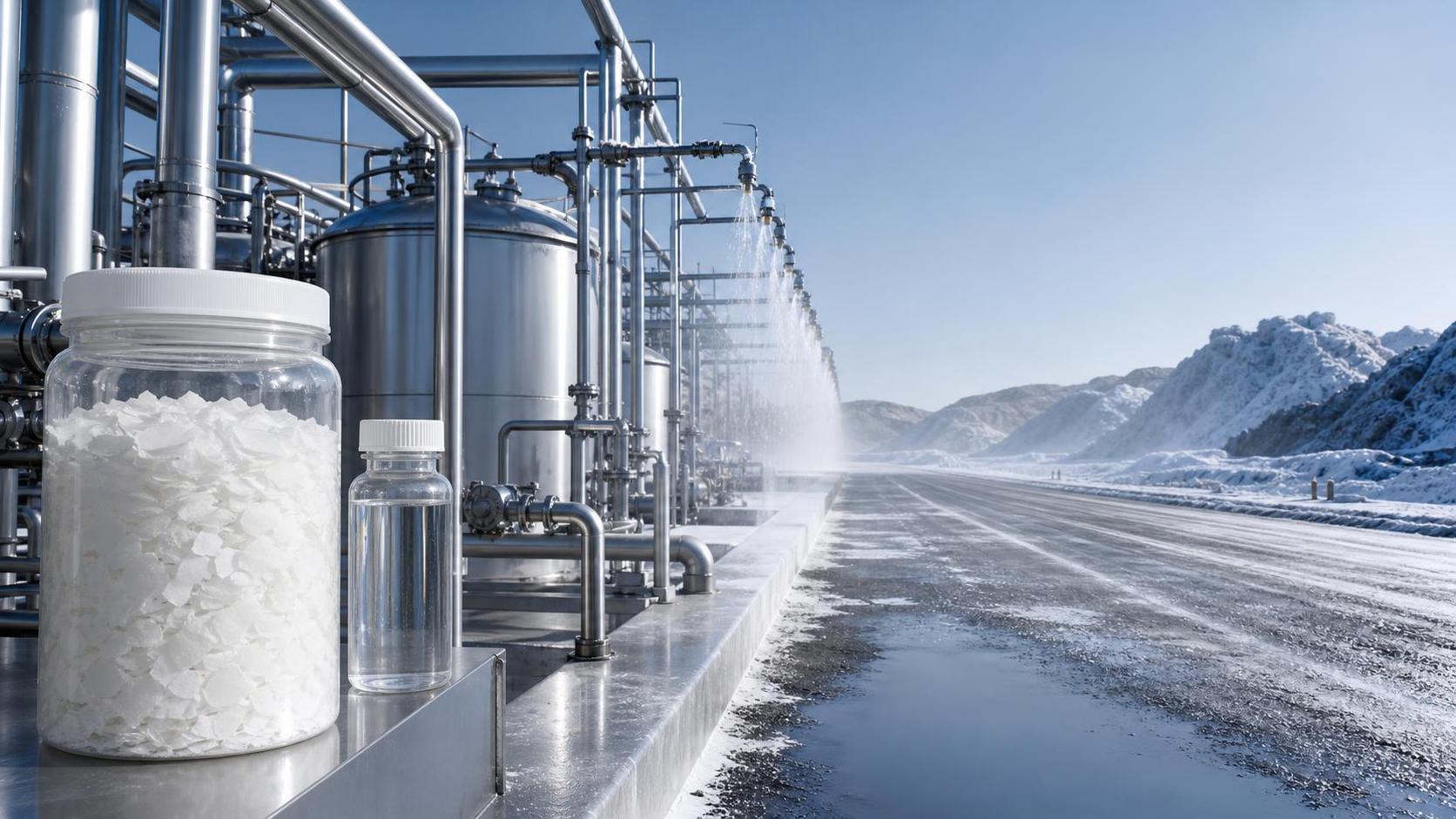
For a project manager, Magnesium Chloride is rarely a simple commodity purchase. It may be specified for dust suppression on haul roads, winter maintenance on access routes, moisture control in industrial operations, or as a process input. In each case, the material is expected to do more than arrive on site at a competitive price. It must perform within a defined temperature range, work with available application equipment, satisfy environmental and transport requirements, and remain available through the operating season.
That is why grade selection deserves attention early in the project. A product described only as “magnesium chloride” leaves too many variables unresolved: concentration, hydration state, insoluble matter, impurity profile, particle size, packaging integrity, and documentation can all change field results. The most suitable grade is not necessarily the highest-purity material. It is the grade whose specifications match the application, site conditions, risk controls, and delivery model.
Start With the Operating Problem, Not the Chemical Name
The same chemical can serve very different purposes because magnesium chloride is highly soluble and hygroscopic. It attracts and retains moisture, which makes it useful for binding fine particles on unpaved surfaces and for lowering the freezing point of water. Those properties also create constraints: excessive application can leave surfaces slick, increase chloride loading in runoff, or accelerate corrosion where sensitive metals are exposed.
Before requesting quotations, the project team should define the job in operational terms. For dust control, that means road traffic volume, vehicle speed, aggregate gradation, rainfall pattern, drainage, ambient humidity, and the desired treatment interval. For deicing, it means pavement temperature rather than only air temperature, expected storm timing, traffic level, storage conditions, and whether the material will be used as a pre-wet, anti-icing brine, or post-storm deicer. In industrial processing, the key questions may instead concern reaction chemistry, allowable contaminants, water balance, material compatibility, and product-specific regulatory requirements.
A vague requirement often produces a false comparison. One supplier may quote dry flakes, another pellets, and a third a liquid solution with a different active concentration. Comparing prices by delivered tonne alone can then lead to the wrong purchasing decision. The relevant comparison is usually cost per unit of active magnesium chloride delivered, applied, and retained in the intended application.
Dust Control: Retention Matters More Than a Low Initial Price
On mine roads, construction access routes, quarry yards, port areas, and rural unpaved roads, Magnesium Chloride suppresses dust by drawing moisture into the road surface and helping fine particles remain bound to the aggregate matrix. It can be effective where the surface has adequate fines and the road structure can hold the treatment. It is less effective when the road is badly segregated, heavily rutted, poorly drained, or regularly stripped by grading.
For these projects, liquid products are often operationally convenient because they can be applied directly through calibrated distributors. Dry flakes or pellets may be appropriate when a site has water and mixing capacity, needs to manage freight economics, or must prepare solution on demand. But dry material introduces additional handling steps, and its apparent freight advantage can disappear when dissolution time, tank capacity, water quality, labor, and uneven mixing are included.
Key purchasing controls for dust-control grade include:
- Active concentration: Confirm the magnesium chloride content of the delivered solution, not just its density or generic product name.
- Insoluble matter: Excess solids can block nozzles, strainers, pumps, and spray bars, especially on projects using fine-orifice equipment.
- Calcium, sodium, and other salts: These may be acceptable in some road applications, but their presence affects moisture behavior, corrosion risk, and consistency of dose calculations.
- Application water: Dilution water can alter concentration, affect storage stability, and introduce contaminants that compromise equipment or application results.
- Packaging and storage: Hygroscopic dry material needs moisture-resistant packaging and covered storage. A damaged pallet of flakes can become difficult to handle long before it reaches the mixing tank.
A useful field approach is to treat a short road section before committing to seasonal volume. Establish baseline dust observations, traffic counts, application rate, moisture conditions, blade frequency, and reapplication interval. The trial should be run under representative conditions, not immediately after rain or on an unusually quiet section of road. The purpose is not merely to demonstrate that the road looks better on day one; it is to measure whether the treatment reduces water use, maintenance cycles, visibility risk, and complaints over the expected operating period.
Project teams should also avoid assuming that more material always gives better suppression. Over-application may create a visibly damp surface while increasing tracking onto paved areas, slipperiness, chloride migration, and public concern. The practical target is a stable surface condition at the lowest dose that meets the site’s dust and safety objectives.
Deicing: Temperature, Timing, and Corrosion Change the Grade Decision
Magnesium chloride is used in winter operations because it can be applied as a liquid brine or used to pre-wet solid deicing materials. Its performance is linked to concentration, pavement temperature, dilution from snow or rain, traffic action, and the time allowed for the product to work. Procurement documents that specify only “deicer grade” leave these variables open to interpretation.
For anti-icing, product consistency is especially important. A brine must be prepared or delivered at a controlled concentration so that spreading equipment applies the intended amount. Density measurement can provide a practical field check, but a project should agree in advance on the accepted test method, sampling point, temperature correction, and batch documentation. Density alone is not a complete quality indicator; a contaminated solution may still meet a density target.
The commonly repeated claim that chloride deicers are universally “safer” or “less corrosive” than alternatives should be treated carefully. Corrosion outcomes depend on the chemical formulation, exposure duration, temperature, wash-off frequency, metal type, protective coatings, and inhibitor package where used. A material that works well on a low-speed parking area can create a different risk profile around bridge components, fleet vehicles, electrical cabinets, rail infrastructure, or concrete with embedded steel.
For infrastructure projects, the deicing specification should distinguish between performance requirements and corrosion-management requirements. It may be appropriate to request corrosion test information, inhibitor disclosure within commercial limits, chloride content, insoluble matter, and compatibility data for the specific equipment and asset environment. Any claim of compliance with a local road authority specification or environmental condition should be verified against the current document rather than accepted from a generic data sheet.
Industrial Grades Need a Tighter Specification Than “High Purity”
Industrial processing creates a different purchasing problem. Magnesium chloride may be used in chemical manufacture, water treatment, textiles, construction materials, magnesium-related processes, or other formulations where even minor impurities can affect yield, color, precipitation behavior, equipment fouling, or downstream compliance. In these settings, “high purity” is not a sufficient technical requirement unless the buyer defines which impurities matter and at what limits.
For example, insoluble matter may be a minor concern for a road treatment but unacceptable in a process involving filters, spray systems, catalysts, or precision dosing. Iron content may matter where product color or staining is sensitive. Sulfate, sodium, calcium, heavy metals, and moisture can each be significant depending on the chemistry. The right specification should be written from the process backward: identify the process tolerance, then set measurable incoming-material limits and a release method.
It is also important to separate analytical compliance from usable form. A chemically acceptable magnesium chloride flake may still be unsuitable if particle size causes slow dissolution, bridging in hoppers, or inconsistent feeding. Conversely, a solution that meets an assay target can be impractical if its viscosity, crystallization behavior, or storage temperature range does not fit the plant’s tanks and transfer lines.
Where magnesium chloride is handled alongside plastics, coatings, electrical assemblies, or packaged finished goods, material selection should be considered across the whole system. For example, transparent or impact-resistant guards, sight components, and equipment housings may require a separate engineering-plastic review for heat, chemical exposure, and electrical performance. In those cases, project teams may evaluate materials such as Polycarbonate Resin (PC Pellets, PC Granules) CAS 25037-45-0 for a different but related equipment-design decision. The resin choice does not replace a corrosion review of magnesium chloride exposure; it simply illustrates why chemical projects should avoid treating bulk chemical selection and equipment material selection as isolated tasks.
Documentation Is Part of the Product
For cross-border procurement, paperwork failures can be as disruptive as a quality failure. The supplier’s commercial offer should be supported by a current technical data sheet, safety data sheet appropriate to the destination market, certificate of analysis format, packing details, origin information where required, transport classification, and a clear statement of the product’s intended grade. Requirements vary by jurisdiction, application, and customer policy, so regulatory status should be checked against the importing country’s current rules and the project’s contractual obligations.
Do not assume that one certificate proves suitability for every market or end use. A road-maintenance product, a food-contact application, and a process chemical can each demand different evidence. REACH-related obligations, local chemical inventories, labeling rules, port restrictions, and customer supplier-qualification procedures may all be relevant. Where a project includes sensitive environmental receptors, municipal discharge requirements or site-specific approvals may also apply. These points should be validated with local regulatory and environmental specialists before award.
A robust procurement package normally includes agreed acceptance criteria, lot traceability, sampling instructions, notification requirements for process or source changes, and a defined response if a shipment is off specification. These details are particularly valuable for seasonal deicing contracts, where replacing a rejected load during a winter event may be operationally impossible.
Evaluate Supply Reliability Beyond Nominal Production Capacity
Magnesium chloride supply can be influenced by feedstock availability, production route, seasonal demand, inland transport, port congestion, packaging availability, and weather. A supplier’s stated capacity matters, but it does not establish whether the supplier can maintain a defined concentration, packaging configuration, shipment schedule, and document set throughout the contract period.
For a project manager, the most useful questions are practical:
- Can the supplier provide representative pre-shipment samples from the actual production line?
- What quality checks are performed per lot, and which results appear on the certificate of analysis?
- How is liquid concentration protected during storage and loading?
- What is the contingency plan for peak winter demand, vessel delays, or damaged packaging?
- Can deliveries be sequenced to the project’s storage capacity rather than delivered as a single large volume?
- Who owns the technical response when field performance differs from the agreed specification?
Shandong Huafeng Chemical operates from Shandong Province, an established Chinese chemical-production region, and positions its export service around product coverage, foreign-trade coordination, and access to major shipping routes. For overseas buyers, that type of supplier capability should be assessed through evidence: export documentation quality, response time during technical clarification, packing control, batch traceability, and the ability to coordinate realistic lead times. A broad portfolio can simplify sourcing, but each chemical grade should still be qualified on its own technical and regulatory merits.
Build the Specification Around the Cost of Failure
There is no single best Magnesium Chloride grade across dust control, deicing, and industrial processing. The correct choice depends on what failure looks like in the project. On a temporary construction road, the key consequence may be lost productivity and visibility hazards. On a bridge network, corrosion exposure and public safety may dominate. In a manufacturing process, a small impurity deviation may create rejected output or a plant shutdown.
That perspective should shape the specification, inspection level, contract terms, and inventory strategy. Low-risk uses may justify a simpler acceptance plan and local field trials. High-consequence applications need clearer impurity limits, independent verification where appropriate, traceable lots, and a supplier that can respond when conditions change. The practical value of grade selection is not in buying a more elaborate product than necessary. It is in removing the uncertainty that causes avoidable operational cost after the material has already reached the site.
Send Us Your Inquiry Today
