









Product Quick Navigation
Get a Quote
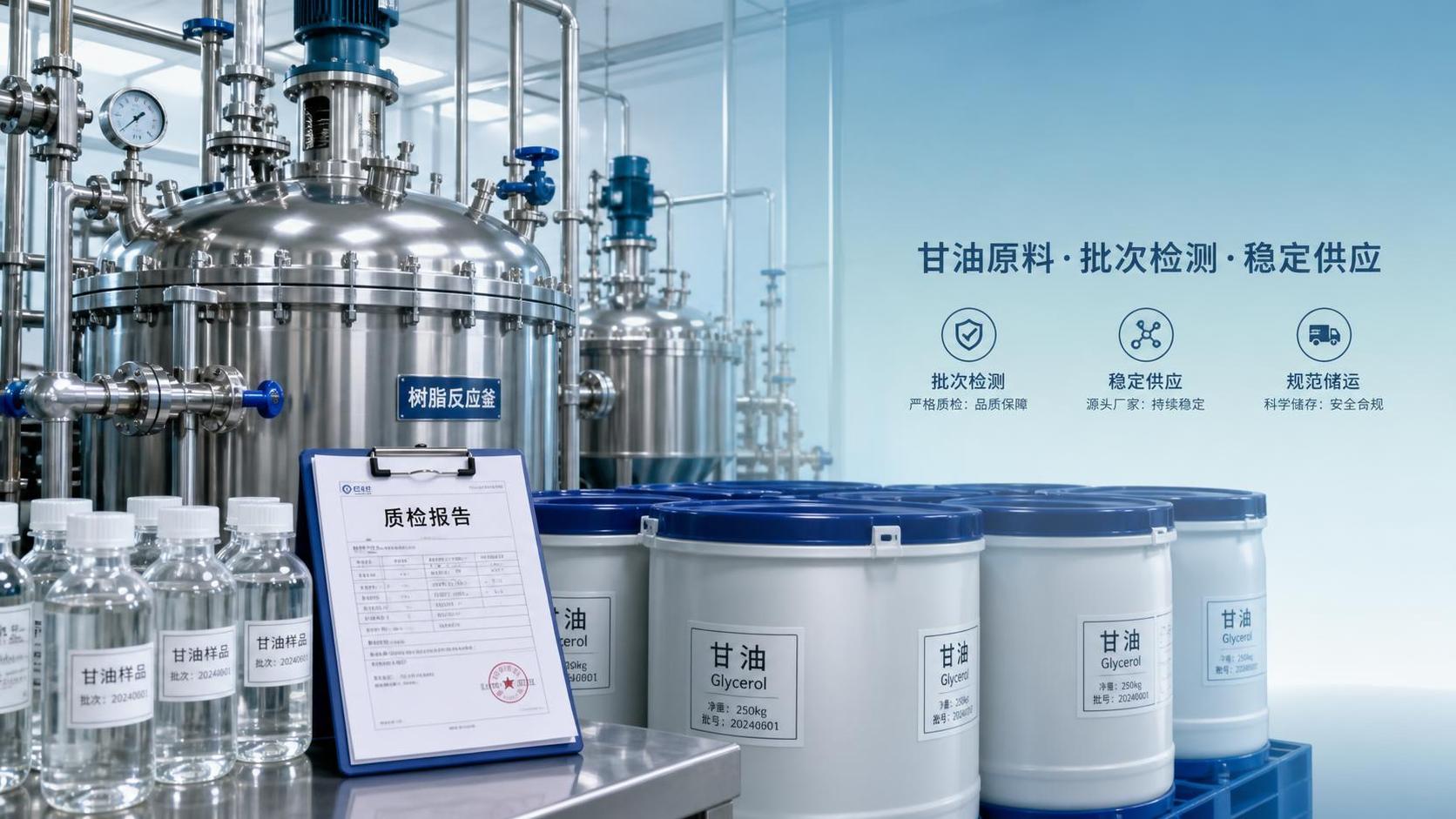
A resin batch can become difficult to control long before it reaches the reactor. A drum arrives with acceptable-looking liquid, the delivery note seems routine, and the material is released because production is waiting. Later, viscosity shifts, water balance changes, or the expected reaction behavior is no longer as predictable as it was with the previous lot. In antifreeze or intermediate production, the disruption may appear differently: blending takes longer, concentration calculations need adjustment, or a shipment delay leaves a plant relying on emergency substitutions.
These situations are frustrating because Glycerol is often treated as a familiar, low-risk input. It is widely used, available from multiple origins, and commonly described by a short purity figure. Yet a sourcing decision based only on a headline assay and a quoted unit price can overlook the details that affect process consistency, landed cost, documentation, and continuity of supply. The more practical question is not simply “Which offer is cheapest?” but “Which material and supply arrangement can be used repeatedly without creating hidden work?”
Start with the job the material must perform
Before comparing offers, define the actual role of Glycerol in the formulation or process. In resin production, it may function as a polyol or reactant, so water content, concentration, color, and trace impurities can matter to reaction control and finished-product appearance. For antifreeze-related blending, the relevant concern may be compatibility with the rest of the formulation, concentration accuracy, low-temperature performance of the complete blend, and the ease of handling a viscous liquid. In chemical intermediate production, requirements are often tied more directly to reaction pathways, catalyst sensitivity, by-product control, or downstream purification.
These are different purchasing situations even when the material name is the same. A grade acceptable for a less sensitive industrial use may not be appropriate for a process where color, ionic impurities, or water variation influence yield or quality. Conversely, specifying a grade beyond what the application requires can add cost without reducing a meaningful risk.
A useful internal discussion begins with process personnel rather than with a generic market specification. Ask which properties have caused trouble in the past, which limits are genuinely critical, and whether a change in incoming material can be accommodated through normal operating adjustments. The aim is to turn a broad request into a use-based requirement.
Separate critical limits from preferred characteristics
Not every line on a specification sheet deserves the same attention. Some values are release-critical because they affect safety, reaction behavior, finished-product quality, or legal use in a destination market. Others are preferred because they improve handling or reduce routine adjustments. Keeping these categories separate prevents an inquiry from becoming either too vague or unnecessarily restrictive.
- Assay or concentration: confirm the basis used for reporting and the acceptable range for the intended process.
- Water content: assess it in relation to formulation balance, reaction stoichiometry, storage conditions, and transport temperature.
- Color and appearance: define an acceptable method and limit where visual quality or color-sensitive chemistry is involved.
- Residue, ash, salts, or specific trace components: request only the parameters relevant to catalysts, corrosion concerns, purification, or downstream use.
- Packaging and delivery form: decide whether drums, intermediate bulk containers, flexitanks, or bulk delivery suit unloading capability, consumption rate, and contamination control.
The result should be a concise purchasing specification that can be issued to several suppliers without interpretation. If the internal requirement says only “industrial grade,” quotations may look comparable while covering materially different products.
The common mistake: comparing purity figures as if they tell the whole story
A high purity figure is important, but it is not a complete measure of suitability. Two offers can list similar assay values while differing in moisture limits, color reporting, test methods, origin, packaging condition, batch documentation, or practical delivery arrangements. A number without a method, tolerance, and certificate basis may not provide the control expected during receiving.
For this reason, request a current technical data sheet and a representative certificate of analysis before relying on a quotation. Review whether the values are presented as typical data or guaranteed limits. A typical value describes what may often be achieved; it is not automatically a release commitment for every shipment. Where a parameter matters to production, it should be addressed in the agreed specification and verified in shipment documentation.
It is also worth confirming whether the sample, the quoted grade, and the export shipment will come from the same manufacturing route. Material can be commercially described in similar terms while differing because of feedstock route, refining practice, or storage history. There is no need to assume that one route is always superior. The correct choice depends on the process requirement and on whether the supplier can consistently document the agreed grade.
Use a trial as a decision tool, not a formality
When a new source is being considered for a sensitive application, a laboratory evaluation should reflect the actual decision. Testing only identity and assay may be insufficient if the concern is reaction performance, appearance, odor, filtration behavior, or blend stability. Small-scale work can compare the candidate material against an approved reference using the conditions that matter most in production.
For resin applications, that may mean observing reaction progression, color development, viscosity trend, acid value development, or the behavior of the finished resin under the normal internal method. For antifreeze formulations, the evaluation may focus on clarity, mixing behavior, compatibility with other ingredients, and the properties normally controlled for the finished formulation. For an intermediate route, it may involve assessing conversion, impurity profile, workup behavior, or the loading of a sensitive catalyst.
A trial does not need to promise a production outcome. Its value is narrower and more useful: it identifies whether the proposed material performs comparably under the conditions that are already understood. Record the lot number, test method, preparation steps, and observations so the approval decision can be traced later.
Cost control begins after the quoted price
Low unit price can lose its advantage if the material creates extra process corrections, higher storage loss, costly handling, or frequent expedited freight. A more realistic comparison uses landed cost and operational cost together. This is especially important for Glycerol because it is commonly transported in packaging formats that affect unloading time, residue, warehouse space, and exposure to contamination.
Consider the commercial terms in the same way that the production site will experience them. Is the quoted quantity net weight or package-inclusive weight? Is the packing new, clean, and appropriate for the intended storage period? Who bears responsibility for export formalities, port handling, insurance, and destination charges under the agreed Incoterm? Can the receiving site safely heat or condition viscous material if ambient temperatures make unloading difficult? These questions may sound operational, but they often determine the true cost of a shipment.
When comparing suppliers, build the cost model around the delivered usable quantity rather than the invoice figure alone. Include packaging, freight, import-related charges where applicable, sampling and testing effort, storage constraints, expected loss during transfer, and the cost of holding safety stock. It is not necessary to force every item into a precise number; identifying the likely cost drivers often reveals why an apparently cheap offer is not the least expensive option.
Make export documentation part of material qualification
Cross-border chemical purchasing often fails at the handover between commercial and technical work. A material may be technically acceptable, but the shipment cannot move smoothly if product descriptions, shipping papers, packing information, or safety documentation are incomplete or inconsistent. The issue becomes more visible when a buyer is sourcing several chemicals with different transport profiles.
For example, an alkaline powder used in plant cleaning or surface-preparation work may require transport information quite different from that of Glycerol. If a facility is also reviewing Trisodium Phosphate CAS#7601-54-9, its classification as UN 3262, Class 8, Packing Group III highlights why documentation should be checked product by product rather than copied across a mixed chemical order. Its supplied technical information also identifies it as a hygroscopic white powder that is soluble in water and used in applications such as industrial cleaning, water softening, boiler water treatment, and metal surface treatment.
The lesson is not that every product requires the same paperwork. It is that the supplier should be able to provide documents appropriate to the material, destination, and transport arrangement. For Glycerol, clarify in advance the required safety data sheet format, certificate of analysis, packing list, commercial invoice, country-of-origin documentation if needed, and any destination-specific declarations requested by the importer. The receiving party should review these requirements before the cargo is packed, not after it reaches a port.
A practical way to assess supply reliability
Supply continuity is easier to evaluate when it is broken into observable behaviors. Instead of asking a supplier to promise reliability, ask for information that supports planning. Can they explain normal order processing steps? Do they identify the manufacturing location or sourcing basis relevant to the quoted material? Is the lead time divided between availability, packaging, booking, and transit? Can they provide lot-specific documents before dispatch? Are technical questions answered by someone who understands the specification rather than only the sales description?
Responsiveness matters most when something changes: a document must be corrected, a vessel schedule moves, a batch result needs clarification, or a receiving site requests additional information. During qualification, notice whether replies are specific and whether they remain consistent across commercial, technical, and logistics contacts. A vague answer may be manageable before an order; during a production shortage, it becomes a planning risk.
For recurring consumption, avoid depending entirely on a single shipment timing assumption. Establish a reorder point based on consumption, realistic lead time, possible transport variation, and internal approval time for incoming material. The appropriate buffer will differ by site, but the logic is consistent: safety stock should protect the process from predictable uncertainty, not compensate for an undefined supply plan.
When a lower-grade or alternative offer deserves extra scrutiny
Sometimes an offer is described as equivalent but has a different concentration, broader color range, unclear impurity profile, or a packaging arrangement that does not fit existing operations. Such an offer may still be useful, particularly where the process has tolerance and the total cost is favorable. The correct response is not automatic rejection; it is controlled comparison.
First, determine whether the difference changes the formulation or reaction calculation. Next, identify whether the receiving site can segregate the material until approval. Then ask whether a trial lot can be documented and traced separately from approved stock. If the material will be used only after blending with other components, confirm that the relevant finished-product controls remain valid. A substitute becomes risky when it enters production by assumption rather than through a documented technical decision.
There is also a distinction between a short-term contingency source and a long-term approved source. A contingency may be appropriate for limited use under controlled conditions, while a regular source should demonstrate repeatability in specifications, documentation, packaging, and communication. Keeping those approval levels separate helps avoid treating an emergency purchase as a permanent qualification.
Put the decision into an order document that can be executed
Once the chosen grade and source are clear, the purchase order should translate the decision into usable instructions. Include the agreed product description, required specification or reference document, packaging format, net weight basis, lot identification requirement, document list, delivery term, destination details, and the process for notifying any deviation before shipment. If a parameter is critical, do not leave it buried in an email exchange.
The receiving procedure should mirror the same discipline. Verify package condition, labels, lot numbers, quantity, and documents before release. Retain a sample when internal practice requires it, and compare the certificate with the agreed limits rather than only confirming that a certificate exists. If a discrepancy appears, isolate the material while the facts are reviewed. Quick release without traceability may save a few hours but can create a much longer investigation later.
A sound Glycerol sourcing decision is therefore built from several connected choices: the grade must fit the chemistry, the documents must fit the trade route, the packaging must fit the site, and the delivery plan must fit actual consumption. When those elements are reviewed together, price discussions become more meaningful and supply interruptions are less likely to become production problems.
Send Us Your Inquiry Today
