









Product Quick Navigation
Get a Quote
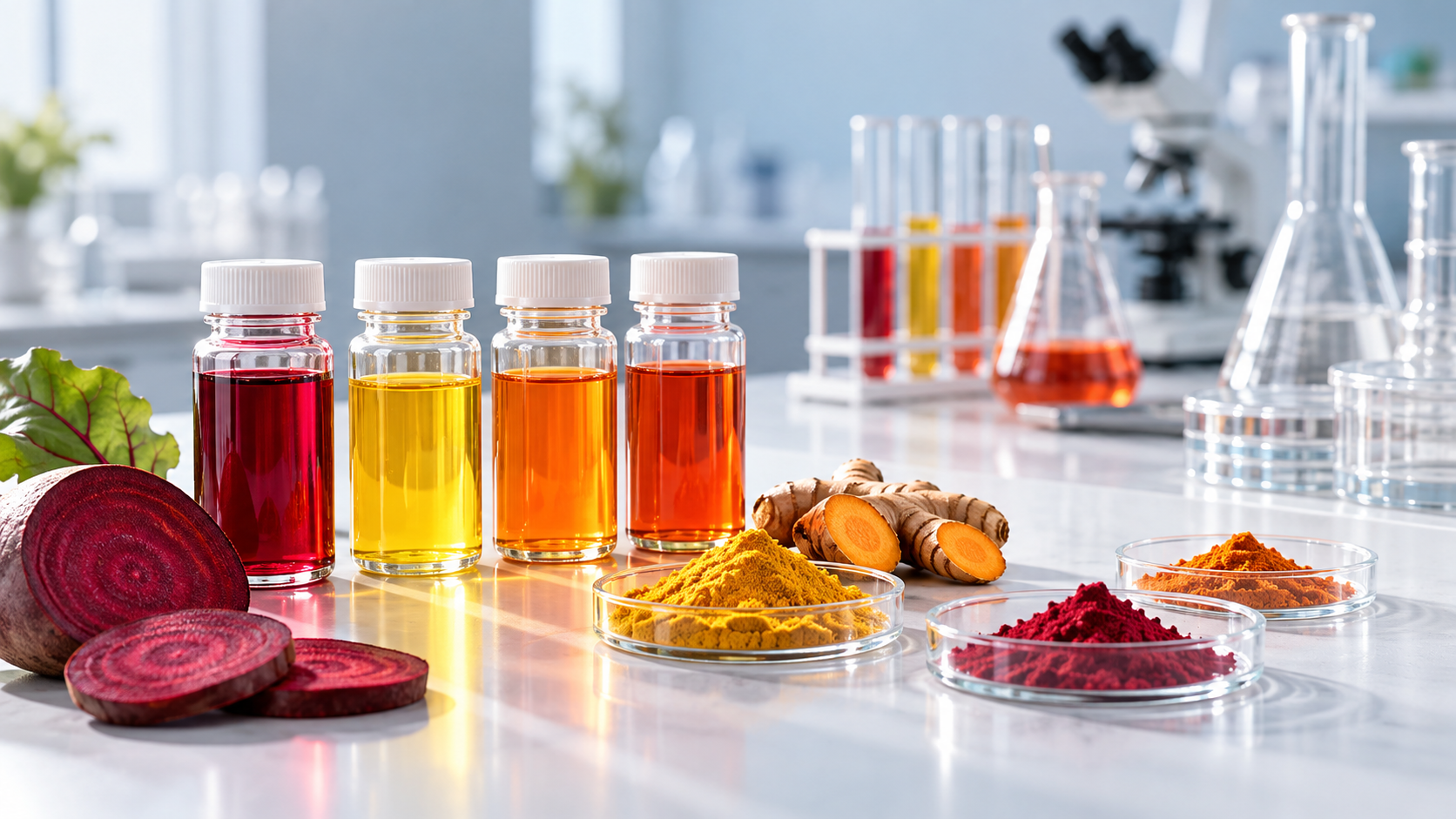
How do natural and synthetic food colorants compare? For technical evaluators, the answer depends on more than visual appeal. Stability under heat, light and changing pH can determine whether a color survives processing and shelf life, while sourcing, formulation and dosage influence its true cost. Labeling requirements and permitted uses also vary by market. The most useful comparison starts with a specific food, its manufacturing conditions and the markets in which it will be sold.
A vivid laboratory sample can be persuasive, but it is only a starting point. A colorant must also disperse consistently, withstand the intended process and deliver an acceptable appearance when the product reaches the consumer. Those requirements often reveal differences that a simple natural-versus-synthetic comparison misses.
What the two categories mean in practice
Natural food colorants are generally derived from sources such as plants, algae, animals or minerals. Common examples include anthocyanins from fruit and vegetables, beet pigments, carotenoids, curcumin and chlorophyll-derived colors. Extraction, purification and formulation can substantially alter how the finished ingredient behaves, so two products based on the same pigment family are not necessarily interchangeable.
Synthetic food colorants are manufactured through chemical synthesis. Depending on the jurisdiction, permitted examples include certain azo dyes and other certified or approved colors. They are available in different forms, including water-soluble dyes and insoluble lakes, which disperse rather than dissolve. A lake may be useful in a fat-based coating or dry mix where a water-soluble dye is unsuitable.
These descriptions are useful for sourcing discussions, but they are not universal legal classifications. A material described commercially as “natural” may be subject to a particular additive classification, specification or labeling rule in the destination market. Nor does a natural source automatically make a colorant suitable for every application.
Stability is a property of the complete system
When a color fades, the cause is not always the pigment alone. Heat exposure, dissolved oxygen, metal ions, light, water activity, packaging and interactions with other ingredients can all contribute. Screening a colorant in water may help establish a baseline, but it cannot replace testing in the final recipe.
Heat and processing time
Consider both peak temperature and the duration of exposure. A colorant added before a long cooking step faces a different challenge from one added after heat treatment. Beet-derived pigments, for example, can be sensitive to heat, while some carotenoid preparations may offer better thermal performance in certain systems. Formulation, pH and oxygen exposure still matter, so those observations should not be treated as guarantees.
For baked goods, evaluate the crust and interior separately: moisture loss, browning reactions and uneven temperatures can change the apparent shade. In beverages, examine the effects of pasteurization or other thermal treatments, then follow the product through storage.
pH, light and oxygen
Anthocyanins illustrate why pH is a selection variable rather than a minor specification. Their color can shift with acidity, making a pigment that produces an attractive red in an acidic drink less predictable in a higher-pH food. Curcumin can provide yellow shades but may be vulnerable to light and to unfavorable pH conditions. Chlorophyll-derived colors also require careful evaluation because processing conditions can alter their appearance.
Synthetic colors are not exempt from compatibility testing. Some may degrade under light, react with reducing agents or behave differently in the presence of other formulation components. A clear bottle on a brightly lit shelf is a more demanding test than a sample stored in the dark. Compare products in their intended packaging and include realistic distribution and display conditions in the study design.
Solubility and distribution
A pigment that is stable on paper can still fail if it does not distribute evenly. Check whether the product is water-soluble, oil-dispersible or supplied as a suspension, emulsion, powder or lake. Particle size, mixing energy and the order of addition can affect speckling, settling and shade consistency.
For emulsified foods, pay attention to where the color sits: in the water phase, oil phase or at the interface. Encapsulated and emulsified color preparations can improve handling or protection in some applications, but their carriers and processing requirements also become part of the formulation review.
Cost per kilogram is not cost per finished product
A lower ingredient price does not necessarily produce a lower formulation cost. The relevant comparison is the amount required to meet the same color target, multiplied by the delivered price, with allowances for processing loss and normal manufacturing variation.
A practical starting calculation is:
Colorant cost per unit of finished food = delivered colorant cost × validated dosage per unit.
Then add the effects that a price quotation does not capture: additional mixing, filtration losses, reformulation, rejected batches, inventory holding, packaging changes and shelf-life risk. If a natural pigment needs a higher initial dose to remain within the acceptable color range at the end of shelf life, that overage belongs in the comparison. So does the cost of qualifying an alternative supplier.
Make the comparison at equivalent performance, not at equal dosage. Define the target shade, the allowable variation and the point in shelf life at which the product must still meet that target. A cheaper option that repeatedly falls outside the specification can be expensive in practice; conversely, a higher-priced preparation may be worthwhile if it reduces handling or improves consistency.
Labeling and approvals: verify the market before committing
Food color regulations are jurisdiction-specific. A color permitted for one product category or country may be restricted, subject to a maximum use level, or not permitted elsewhere. Begin with the exact food category, intended use level and destination market rather than relying on a supplier’s general statement that an ingredient is “food grade.”
In the United States, color additives require authorization for their intended uses, and certain synthetic colors are subject to batch certification. The applicable identity and labeling requirements depend on the additive and use. In the European Union, approved food additives are identified under the relevant rules, often by name or E number; certain colors also require an additional warning on foods. Check current legislation and official guidance for each market, since rules and product classifications can change.
Also review the full preparation, not just its principal pigment. Carriers, emulsifiers, preservatives and solvents may affect regulatory suitability and ingredient declarations. Claims such as “natural color” or “no artificial colors” should be assessed against local rules and the product’s actual composition. Obtain the supplier’s specification, composition information and supporting documents early enough to avoid redesigning packaging late in development.
A screening plan that produces useful decisions
Technical teams can narrow the field quickly by agreeing on a small set of pass-or-fail requirements before requesting samples. These should include the target shade, permitted color variation, process conditions, expected shelf life, packaging format and destination markets. Without those boundaries, a tasting panel may select an attractive sample that cannot survive commercial production.
- Shortlist by legal fit and color space. Confirm intended-use eligibility and select candidates capable of reaching the required hue in the actual food category.
- Screen in the real matrix. Use the planned pH, fat content, sweeteners, preservatives and processing sequence. Compare samples at an equivalent initial appearance.
- Challenge the process. Run representative heat, shear and holding-time trials, including realistic variation between batches.
- Assess storage and packaging. Measure color at agreed intervals under relevant light and temperature conditions. Accelerated tests can support screening, but should not automatically replace real-time shelf-life data.
- Evaluate manufacturability. Check dispersion, dusting, settling, staining, cleaning, dosing accuracy and the need for special storage or handling.
- Compare commercial risk. Calculate cost at the validated dosage and review lead times, minimum order quantities, documentation and alternate sources.
Instrumental color measurements, such as L*, a* and b* values, can make comparisons more repeatable when the sampling and measurement method are controlled. Set an acceptable color-difference limit with the product team rather than assuming that one numerical threshold suits every food. Visual assessment remains valuable, especially when opacity, gloss or uneven distribution changes consumer perception.
Supplier documents matter beyond the colorant itself
In a globally sourced formulation, supporting ingredients can affect both processing and the final declaration. For example, fatty-acid-based materials may be relevant as formulation ingredients or as raw materials for certain emulsifiers, depending on the application. Stearic acid CAS#57-11-4 is supplied with a stated purity of at least 99% and is practically insoluble in water. It is not a food colorant and should not be treated as a substitute for one. Any intended food use requires confirmation of the specific grade, applicable specifications and local regulatory status.
For colorants and supporting ingredients alike, request a current certificate of analysis, a detailed specification, storage guidance and information on batch variability. Where traceability or source claims matter, ask what evidence can be provided for the particular material and shipment. Huafeng Chemical’s export-service focus makes this documentation and supply discussion relevant for overseas buyers evaluating chemical ingredients; suitability must still be established for the individual food application.
Which option should a technical evaluator choose?
Choose a natural colorant when its verified labeling position supports the product brief and it can meet the required shade, stability and cost in the finished food. Choose a permitted synthetic colorant when its performance, consistency and economics align with the formulation and the intended market’s labeling requirements. Neither category wins in every matrix.
The strongest decision is supported by three pieces of evidence: legal suitability for each destination, performance data from a representative process and shelf-life study, and a cost model based on the validated dosage. When all three point in the same direction, the color is no longer just attractive in a sample cup—it is a defensible ingredient choice.
Send Us Your Inquiry Today
