









Product Quick Navigation
Get a Quote
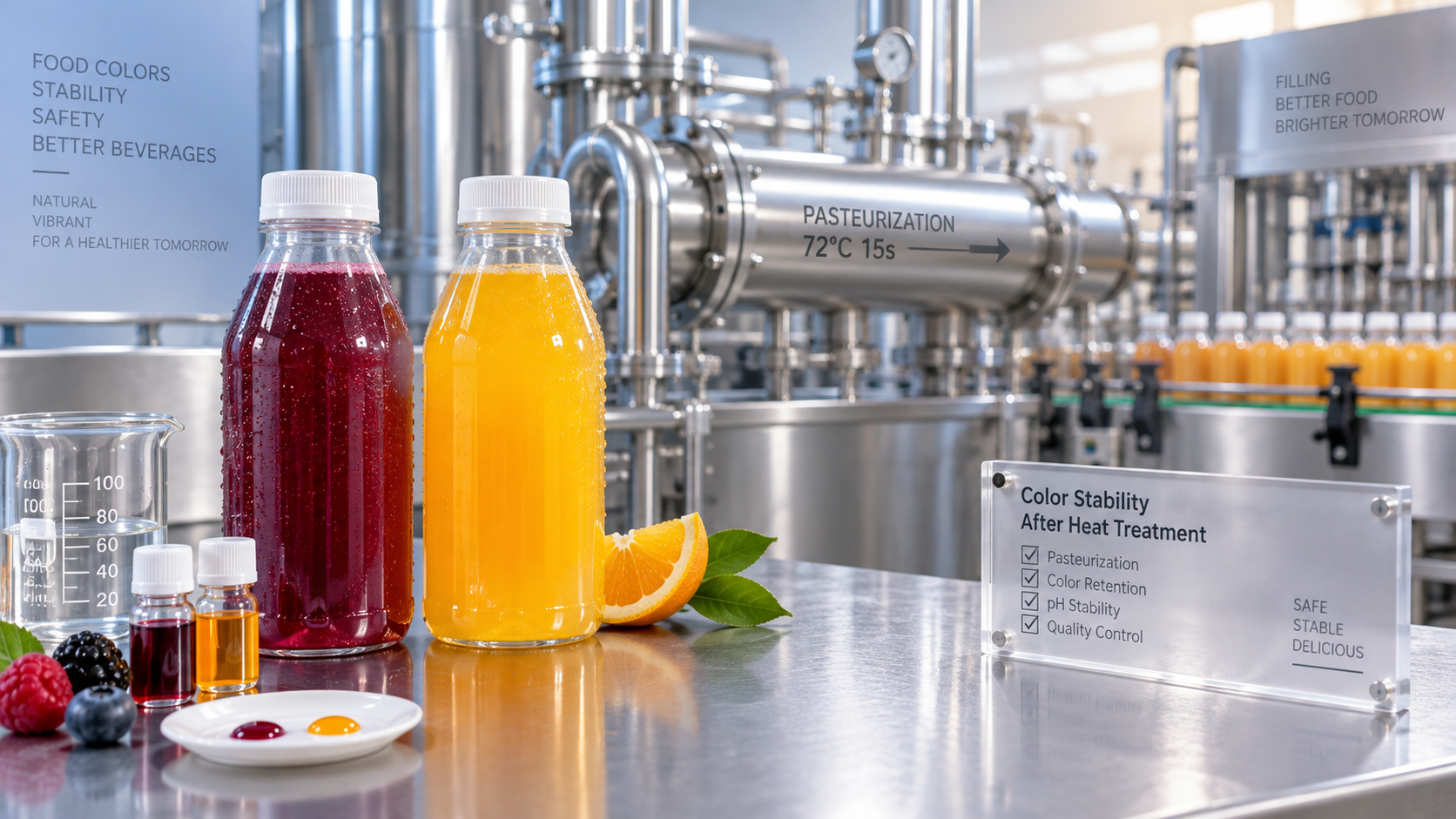
Natural vs Synthetic Food Colorants for Heat-Treated Beverage Formulations
For a heat-treated beverage, color is not merely a branding choice. It is a process-sensitive quality attribute that must remain acceptable after blending, homogenization where applicable, pasteurization or UHT treatment, filling, distribution, and storage. A beverage may leave the line with the intended shade yet fade, brown, precipitate, or shift hue weeks later. For quality control and food safety teams, this turns the selection of Food Colorants into a formulation, validation, and compliance decision rather than a simple purchasing exercise.
The central comparison between natural and synthetic colorants is often presented as “clean label versus stability.” That is directionally useful, but incomplete. Thermal resistance depends on the individual pigment or dye, the beverage matrix, dissolved oxygen, light exposure, pH, metal ions, packaging barrier, and the real thermal profile of the production line. A sound choice starts with the finished beverage and process conditions, not with a broad claim that one category is always better.
Why Heat Treatment Changes the Decision
Pasteurization and UHT processing protect microbiological quality, but they can also accelerate color degradation pathways. Heat can break down sensitive chromophores, alter pigment aggregation, increase oxidation reactions, or change how a colorant interacts with proteins and hydrocolloids. The effect may be immediate, but delayed instability is common. A color system that looks satisfactory in a freshly prepared laboratory sample may fail after thermal exposure followed by ambient storage.
The process must be described precisely. “Pasteurized” may involve substantially different time-temperature combinations, while UHT systems vary in direct or indirect heating, holding time, deaeration, and downstream oxygen pickup. A short, high-temperature exposure does not necessarily produce the same result as a longer, lower-temperature process. Validation should therefore use the actual pilot or commercial profile, including filling conditions and anticipated shelf-life storage.
pH is equally important. Many fruit beverages operate in an acidic range, whereas dairy, plant-protein, nutritional, and coffee-based drinks may be closer to neutral. Some natural pigments are strongly pH-responsive; others lose intensity through oxidation rather than pH alone. Synthetic dyes are often more predictable across routine beverage conditions, but their permitted use, maximum levels, declaration requirements, and market acceptance must be checked for the destination country and product category.
Natural Color Systems: Useful, but Matrix-Dependent
Natural Food Colorants cover a wide technical range. They may be obtained from fruits, vegetables, algae, insects, minerals, or other natural-source materials, but “natural” does not indicate a uniform level of heat or light stability. Anthocyanin-based colors, for example, can provide attractive red-to-purple tones in acidic beverages, yet their shade is notably influenced by pH and can be vulnerable to heat, oxygen, sulfites, and light. A red beverage may gradually move toward a duller or browner tone even when microbial and sensory specifications remain acceptable.
Carotenoid systems can deliver yellow through orange shades and may perform well in suitable applications, but they are generally susceptible to oxidation. Their low water solubility also means dispersion quality matters. In a beverage with protein, oil, emulsifiers, or clouding agents, the selected delivery system can be as important as the pigment itself. Poor dispersion may lead to sediment, ring formation, shade inconsistency, or higher color variability between batches.
Betalains offer vivid red and yellow shades but are typically considered heat-sensitive relative to more robust systems. Chlorophyll-derived materials may be useful for particular green applications, yet they can be affected by acidity and processing. Spirulina-derived blue color is attractive for clean-label positioning, but beverage developers should not assume it will tolerate all thermal and pH conditions. A blue system that works in a refrigerated, mildly processed drink may not be appropriate for a shelf-stable UHT beverage.
Natural colors also require closer attention to agricultural and extraction variability. Source materials can vary in pigment concentration, co-extracted compounds, odor contribution, and seasonal availability. Strong supplier specifications, lot-to-lot color strength controls, and retained samples become especially valuable. The correct question is not whether a natural color is “stable” in general; it is whether its specified form is stable in the exact beverage formula, package, and shelf-life condition.
Synthetic Colorants: Process Consistency with Regulatory Boundaries
Synthetic dyes are frequently chosen where strong tinctorial strength, precise shade adjustment, solubility, and reproducibility are priorities. In many beverage systems, they can tolerate thermal processing and storage more consistently than sensitive botanical pigments. This can simplify batch correction, reduce the dosage needed to achieve a target shade, and support narrow color tolerances when production is scaled across multiple sites.
However, technical robustness does not remove regulatory constraints. Permitted synthetic colors differ by jurisdiction, and authorization may depend on beverage type, intended consumer group, additive identity, and maximum use level. A color permitted in one export market may be restricted, prohibited, or subject to a particular label statement in another. Color names, additive numbers, purity requirements, and labeling language also need review against the applicable local framework. Quality teams should not rely on a supplier’s general statement of suitability as a substitute for market-specific compliance verification.
Consumer perception can complicate the otherwise straightforward technical case. A beverage brand pursuing a short ingredient list may reject certain synthetic options even if they offer the best thermal stability. Conversely, a product positioned around long shelf life, high color uniformity, or intense visual impact may prioritize a regulated synthetic dye where allowed. Neither decision is inherently superior; the issue is whether commercial claims, formulation performance, and legal status align.
A Practical Comparison for Thermal Beverage Development
What Quality and Safety Teams Should Validate
Color approval should be incorporated into the product validation plan rather than handled as a last-stage visual check. At minimum, assess the colorant in the complete formula after the intended thermal process. Measure instrumental color values where the facility uses a defined method, while also checking visual appearance under controlled lighting. A small shift in instrumental values may be acceptable for one brand shade and unacceptable for another; acceptance criteria should be established before routine production.
Storage testing should reflect foreseeable exposure. For shelf-stable beverages, this commonly means observing color development over the intended shelf life and, where appropriate, under elevated temperature or light conditions as part of an internal stability protocol. The purpose is not to force a colorant to fail under unrealistic abuse, but to identify whether the formula has an avoidable sensitivity to oxygen, light, or temperature variation in distribution.
Review the interaction with other ingredients. Ascorbic acid, metal ions, fruit concentrates, tea extracts, protein systems, preservatives, flavors, and emulsions can all affect color behavior. A chelating approach, oxygen management, opaque packaging, or a change in colorant format may improve stability, but each adjustment must be evaluated for regulatory status and sensory consequences. It is usually more efficient to investigate incompatibility early than to repeatedly increase color dosage after a failed shelf-life review.
Documentation should include identity, specification, allergen and origin information where relevant, certificate of analysis, lot traceability, intended use level, and confirmation that the colorant is authorized for the target beverage and market. For global supply chains, these records should travel with the ingredient decision. A technically acceptable color that cannot be supported with complete import or customer documentation can still delay release.
Keep Food and Industrial Chemical Supply Chains Clearly Separated
Beverage sites and ingredient groups sometimes procure both food-grade materials and industrial chemicals through broader chemical supply networks. This makes segregation essential. A chemical’s presence in an edible-oil extraction supply chain, for example, does not make it a beverage additive or a suitable component of a Food Colorants formulation. Materials must be assessed by their specific legal status, grade, intended use, handling controls, and contamination risk.
This distinction matters when reviewing portfolios from chemical export partners. Tert-Butyl hydroperoxide CAS#75-91-2 is an industrial chemical used in applications such as organic synthesis and extraction processes; it is not a food colorant for beverage formulation. Its flammability and hazardous handling profile underscore why food-ingredient approval, industrial-material storage, and supplier qualification should be managed through separate controls. A broad supplier catalogue can be operationally useful, but it should never blur food safety boundaries.
As international trade becomes more interconnected, buyers increasingly need dependable documentation, responsive communication, and stable delivery planning alongside product quality. Based in Shandong, a major chemical-industry region in China, Huafeng Chemical supports overseas customers through comprehensive foreign-trade capabilities and a broad product portfolio. For food and beverage-related procurement, the practical value lies in being able to identify the correct material category, request the appropriate technical and compliance documents, and prevent industrial products from entering food-use evaluation pathways by mistake.
A Better Selection Rule Than “Natural or Synthetic”
The most reliable selection rule is to choose the color system that meets the required shade, survives the verified process, remains compliant in every intended market, and can be controlled through its full shelf life. Natural-source colors may be entirely workable in heat-treated beverages when the pigment, pH, oxygen exposure, and package are compatible. Synthetic alternatives may offer a more stable technical route, but only where authorization and brand strategy permit their use.
Before final approval, confirm the actual heat profile, finished-product pH, target color tolerance, package light barrier, storage environment, export destinations, and ingredient documentation requirements. That disciplined review is more valuable than a blanket preference for either category, and it gives quality and safety teams a defensible basis for release decisions.
Send Us Your Inquiry Today
