









Product Quick Navigation
Get a Quote
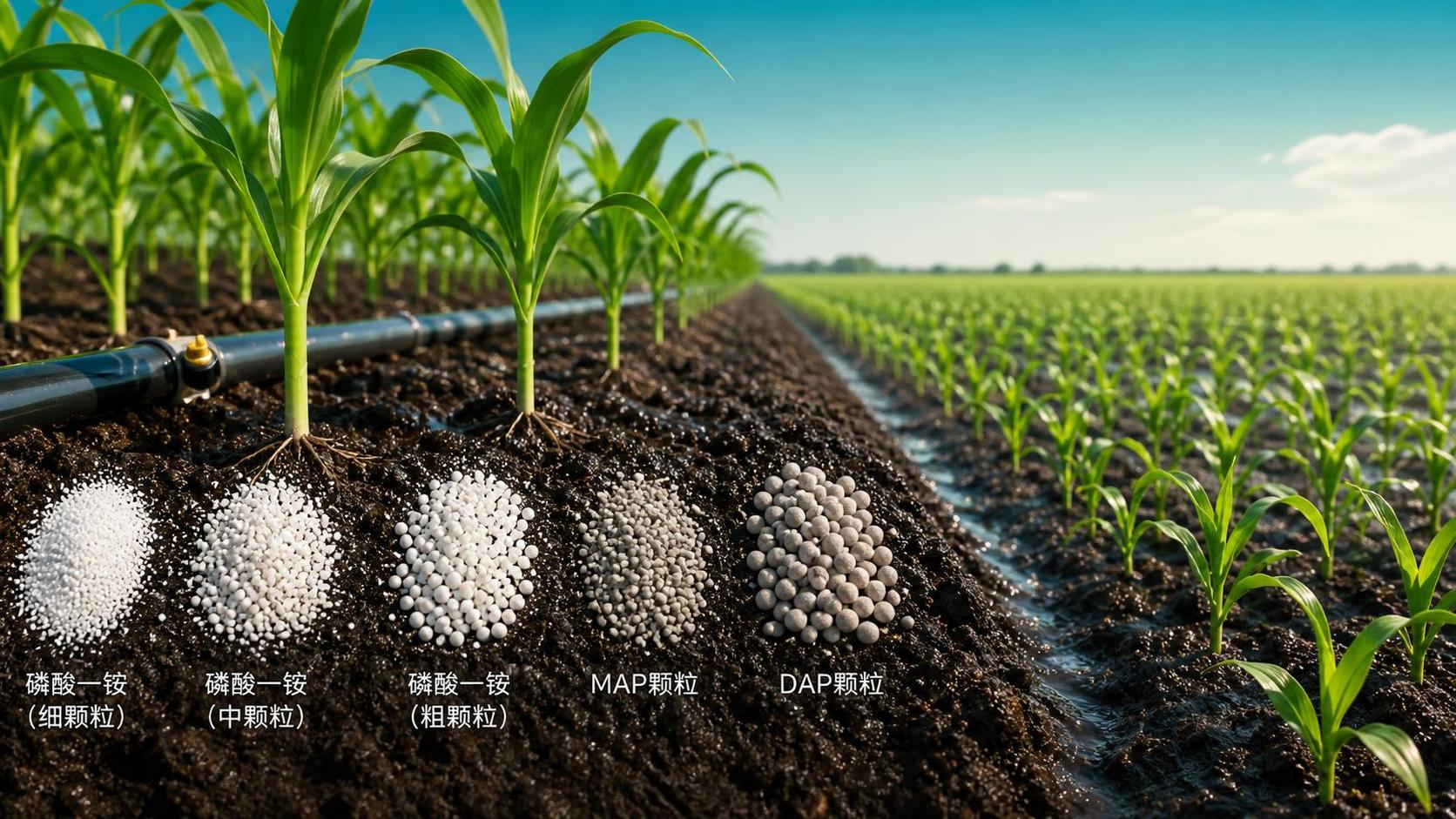
Grade selection for phosphate fertilizers should begin with the soil reaction, the likely phosphorus retention mechanism, and the timing of crop demand. A product with a high declared phosphate analysis can still perform poorly when its dissolution behavior, placement method, or accompanying nutrients are mismatched to the field. The useful comparison is therefore between the phosphorus source and the soil-crop system, rather than between nutrient percentages alone.
Phosphorus is relatively immobile after application. It commonly reacts near the point of placement, so soil pH, calcium carbonate content, iron and aluminum oxides, moisture, texture, and tillage depth all influence the amount available to roots. A grade decision should document the fertilizer's nutrient form, water solubility where applicable, particle characteristics, secondary nutrient contribution, impurity limits, and compatibility with the intended application equipment.
Start with the soil phosphorus environment
Acid soils and alkaline or calcareous soils can restrict phosphorus availability through different pathways. In strongly acidic soils, soluble phosphate may be retained by iron and aluminum-bearing minerals. In calcareous conditions, phosphate can react with calcium and become less accessible over time. These reactions do not occur identically in every field; clay mineralogy, organic matter, moisture regime, and prior fertilizer history affect the outcome. Recent soil test data should therefore be read together with pH and buffer-pH information, rather than treating an extractable phosphorus result as a standalone grade-selection instruction.
Water-soluble phosphate sources generally provide rapid availability close to the fertilizer band or granule, provided there is sufficient soil moisture for dissolution and roots can access the treated zone. This can be useful at establishment, when young plants have limited root volume and localized phosphorus concentration matters. In soils with high fixation potential, concentrated placement can reduce the volume of soil contacting the applied phosphate, although the best placement geometry depends on the crop, row spacing, soil moisture, and the equipment's ability to maintain consistent depth.
Partly water-soluble or citrate-soluble materials require closer evaluation. Their value depends on the chemical form of phosphorus, soil acidity, particle size, and the period available for dissolution. Finely ground reactive phosphate rock may be considered under suitably acidic conditions and where a slower nutrient release profile is acceptable. It is generally a weak substitute for a highly available starter source in neutral to alkaline soil, especially where early growth depends on prompt phosphorus uptake.
Compare the principal grade families
Monoammonium phosphate (MAP) and diammonium phosphate (DAP) are common granular choices because they combine nitrogen and phosphorus in concentrated, transport-efficient products. Their behavior near a granule is not identical. MAP produces a more acidic local reaction during dissolution, while DAP initially creates an alkaline microsite as ammonium is released. The significance of this difference depends on soil buffering capacity, placement, and local pH. It should not be reduced to a universal rule that one grade is always better in a particular soil class.
MAP is often considered where a starter application requires both available phosphorus and ammonium nitrogen, particularly when the fertilizer will be placed near, but not in excessive concentration with, seed. DAP may fit broadacre programs or blends where its analysis and handling properties suit the nutrient plan. Seed safety must be assessed against total salt exposure, row spacing, soil moisture, and the complete fertilizer blend. Ammonium-containing phosphate products can cause emergence problems when placed too close to seed under dry conditions or at high localized rates.
Triple superphosphate (TSP) supplies phosphorus and calcium without adding nitrogen. It can suit programs in which nitrogen timing is managed separately, where ammonium phosphate is not desired, or where the blend formulation requires a nitrogen-free phosphorus source. Single superphosphate supplies phosphorus along with calcium and sulfur, but its lower phosphate concentration changes freight, storage, and application-rate calculations. The sulfur contribution can be relevant where crop removal and soil testing indicate a need, but it should be quantified rather than treated as an incidental benefit.
Ammonium polyphosphate liquids may be selected for fluid fertilizer systems. Polyphosphate forms can hydrolyze to orthophosphate after application, and the rate of conversion is affected by soil conditions. Compatibility with water source, micronutrient additions, suspension concentrates, and application hardware needs verification before large-scale use. Liquid appearance alone is not a sufficient quality indicator; density, clear solution stability, nutrient analysis, crystallization behavior at expected storage temperatures, and insoluble content all affect field reliability.
Match nutrient form to crop timing and placement
Crop demand is not uniform through the season. Many annual crops require accessible phosphorus early because root growth, tiller formation, branching, or reproductive development may be limited by early deficiency. A banded starter source can be appropriate where cool soil delays root activity or where low soil-test phosphorus indicates that diffusion alone may not supply the root zone quickly enough. The placement should be separated from seed when the product and application rate create a material risk of salt or ammonia injury.
Perennial crops require a different view. In orchards, vineyards, forage systems, and established plantations, the active root distribution may be deeper or outside the immediate trunk zone. Surface-applied phosphate can remain near the soil surface, particularly without incorporation. Fertigation may place soluble phosphorus more precisely in wetted root zones, but precipitation with calcium, magnesium, iron, or alkaline irrigation water can reduce delivery. Injection-water chemistry, filtration, acidification practice where permitted, and flushing procedures should be assessed as a single operating system.
Phosphate fertilizer selection also has to account for accompanying nutrients. MAP and DAP contribute ammonium nitrogen; ammonium uptake can influence rhizosphere pH, while nitrification later alters nitrogen form and soil reaction. TSP and superphosphate contribute calcium, and single superphosphate adds sulfur. A grade that corrects phosphorus while unnecessarily increasing another nutrient can complicate the broader fertility program. The appropriate basis is the full nutrient budget, including crop removal, soil reserves, irrigation-water contribution where relevant, manure history, and planned micronutrient additions.
Specifications that affect field performance
Declared nutrient content should identify whether phosphorus is reported as P or as P2O5, since the two conventions are not interchangeable. Product documentation should distinguish total phosphate from water-soluble phosphate and, where relevant, neutral ammonium citrate-soluble phosphate. For rapidly available fertilizer programs, the water-soluble portion is often material to the agronomic decision. A total-phosphate figure without solubility information may conceal meaningful differences among products.
Physical quality determines whether the applied field rate resembles the planned rate. For granular material, evaluate size distribution, crush strength, moisture, free-flowing behavior, dust, caking tendency, and the proportion of fines or oversize particles. Similar nominal granule diameters do not guarantee similar spreading behavior. A blend containing materials with different size, density, or shape may segregate during loading, transport, or pneumatic conveyance, causing uneven nutrient distribution across the field.
For bulk blends, compatibility must be tested under actual storage duration and humidity exposure. Hygroscopic materials can transfer moisture between components, resulting in caking or reduced flow. Certain combinations can create chemical reactions, soften granules, or generate dust. A small retained sample stored under representative conditions can expose instability before a full shipment is committed. The test should include the intended micronutrient source because zinc, boron, and other additions can alter blend behavior or create localized concentration risks.
Impurity assessment needs to be aligned with the destination market and crop use. Relevant controls may include limits for contaminants, fluorine where applicable, moisture, insolubles, and trace elements. The applicable legal framework differs by jurisdiction and product classification, so the current destination requirements should be confirmed before contract release. A certificate of analysis is useful only when its test methods, lot identity, and stated limits match the agreed specification. Sampling and retention procedures should be defined for disputed deliveries, particularly when material will be repacked or blended after arrival.
Storage, shipping, and receiving controls
Phosphate fertilizers are often transported in bags, big bags, or bulk form. Packaging choice should reflect climate exposure, unloading equipment, storage duration, and the likelihood of multiple handling points. Moisture ingress can affect flowability and particle integrity even when nutrient assay remains within tolerance. Bag markings should identify product grade, lot or batch reference, net mass, handling requirements, and any destination-specific information required for the product classification.
Before loading, confirm that the transport unit is dry, clean, odor-free, and free of residues that could contaminate fertilizer. Bulk holds and containers need protection from condensation and water intrusion. At receipt, inspect packaging condition, verify seals where used, record lot references, collect representative samples under an agreed protocol, and compare physical appearance with the approved reference. White or pale granular products can appear visually similar despite different nutrient forms; appearance is a screening observation, not confirmation of grade.
Where phosphate programs are managed alongside water-treatment or processing chemicals, documentation should keep agricultural fertilizer streams separate from unrelated chemical inventories. For example, Sodium Acetate (Acetic Acid Sodium Salt) CAS 127-09-3 (Anhydrous); 6131-90-4 (Trihydrate) has distinct storage, application, and specification requirements and should never be treated as interchangeable with a nutrient input merely because both materials may be handled at the same facility. Segregated labeling, dedicated transfer equipment where practical, and clear material identification prevent avoidable cross-use errors.
A practical evaluation sequence
First, define the agronomic requirement from soil analysis, crop stage, expected yield target where a validated nutrient-removal basis exists, and planned placement. Then narrow the candidate grades by phosphorus solubility and accompanying nutrients. Only after that should physical properties, packaging, delivery window, and commercial terms be compared. Reversing this sequence can produce a convenient product that does not match the field requirement.
- For acidic soils with strong iron or aluminum phosphate retention, prioritize available phosphorus near the rooting zone and examine whether band placement, liming history, and soil moisture change the response expected from the grade.
- In calcareous fields, assess soluble-source placement carefully; broad surface application may increase contact with reactive soil, while localized placement can be more defensible where equipment and crop geometry permit it.
- When using a low-solubility source, establish that soil acidity, particle fineness, and the crop cycle allow sufficient dissolution. Do not assume that a total phosphorus analysis predicts early-season availability.
- For fluid systems, conduct jar compatibility and temperature-stability tests using the actual water source and intended additives before filling tanks or injection lines.
The final specification should state the selected fertilizer form, nutrient guarantee, relevant solubility requirement, acceptable moisture and particle-size range, packaging format, sampling method, documentation, and destination compliance conditions. This converts an agronomic preference into a procurement-ready requirement and reduces the chance that an apparently equivalent phosphate grade produces different storage, spreading, or crop-response behavior.
Send Us Your Inquiry Today
