









Product Quick Navigation
Get a Quote
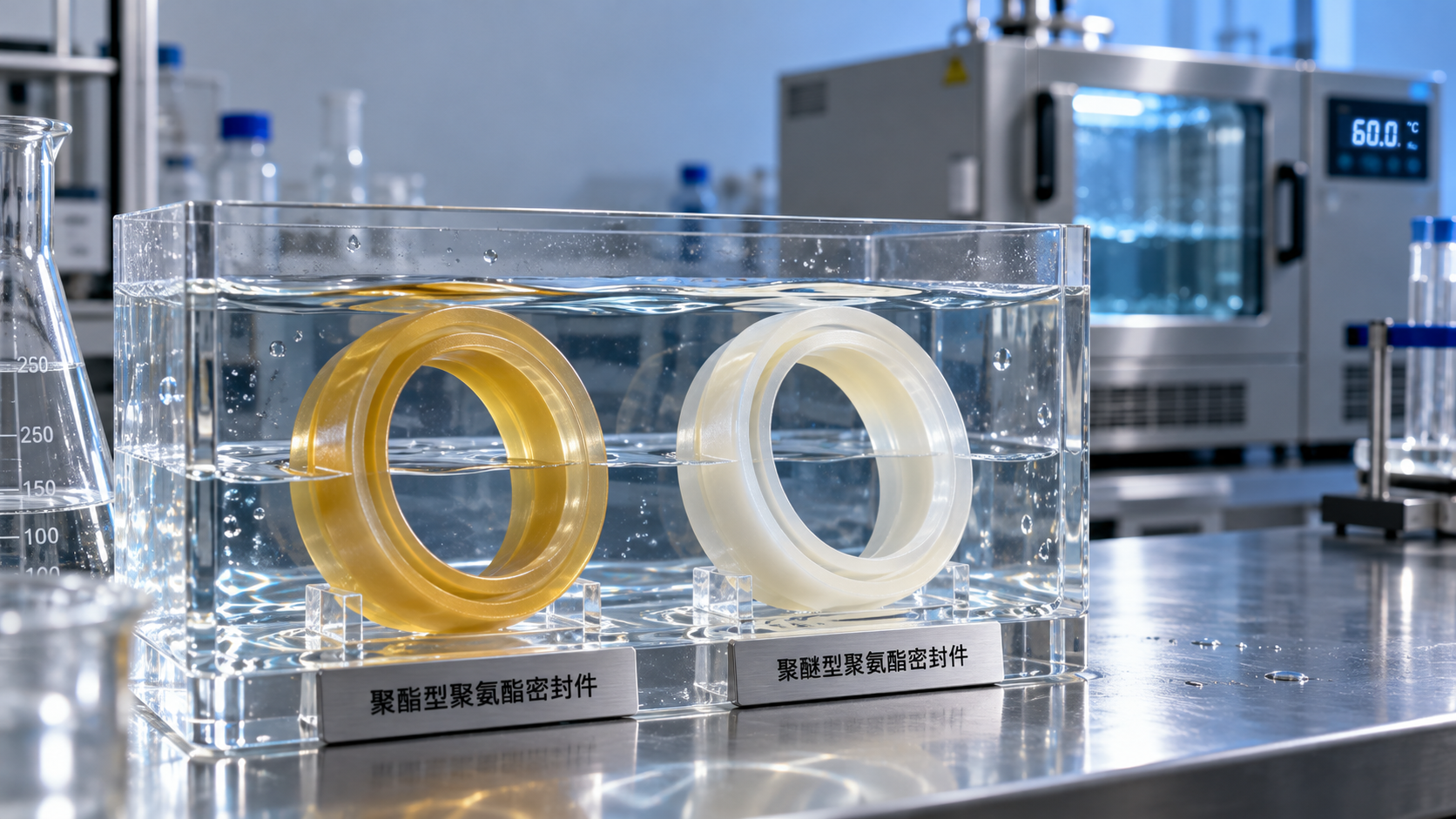
Polyester vs. Polyether Polyurethane for Seals in Wet Environments
In wet sealing applications, the wrong polyurethane chemistry can cause premature degradation, leakage, and downtime. Polyester and polyether polyurethane may look similar on a datasheet, particularly when hardness and tensile strength are close. Their behavior after prolonged contact with warm water, however, can be very different.
For sustained water exposure, polyether polyurethane is generally the better starting point because of its superior hydrolysis resistance. Polyester polyurethane remains worth evaluating when oil resistance, mechanical strength, and wear performance dominate, with moisture exposure limited or controlled. Neither statement replaces testing of the actual compound in the actual fluid.
The difference that matters is inside the polymer
The polyester or polyether designation usually identifies the polyol-derived soft segments of the polyurethane. Polyester segments contain ester bonds that are susceptible to hydrolysis: water can break these bonds, reducing molecular weight and eventually compromising mechanical properties. Higher temperature and acidic or alkaline conditions can accelerate the process.
Polyether soft segments are generally more resistant to hydrolytic breakdown. That makes them attractive for seals exposed to water, persistent humidity, and many water-based fluids. It does not make the complete polyurethane immune to chemical attack. Oxidizers, aggressive cleaning agents, excessive temperature, and unsuitable solvents can still rule out an otherwise promising grade.
Formulation also matters. Hydrolysis stabilizers can improve polyester performance, while curing chemistry, processing, and post-curing influence either family. Thermoplastic polyurethane and cast thermoset polyurethane should not be treated as interchangeable merely because both are described as polyether-based. Request the exact grade and processing route, not just a polymer-family label.
Define “wet” before comparing materials
An external rod wiper exposed to occasional rain presents a different problem from a piston seal continuously immersed in warm process water. A third case—a seal that operates dry but undergoes hot washdown—may be governed by the cleaning cycle rather than normal production conditions.
Record exposure duration, bulk-fluid temperature, cleaning peaks, pressure, movement, and idle conditions. Include trapped liquid behind the seal. Equipment that drains between batches may still leave a seal groove wet throughout the shutdown period. Likewise, a cool fluid does not guarantee a cool sealing interface when friction generates local heat.
There is no defensible universal temperature limit for either family. A supplier’s dry-service temperature rating does not establish suitability for continuous hot-water immersion. Ask specifically for aqueous-service evidence at the proposed temperature and exposure duration.
Do not trade hydrolysis resistance for an assumed wear advantage
Polyester grades often offer strong mechanical properties and useful resistance to oils and greases. Those advantages can justify their selection in suitable service. But “polyester wears better” is too broad to serve as a specification. Abrasion resistance depends on formulation, test method, counterface, lubrication, and the condition of the material after aging.
In a slurry pump, an initially tough seal can lose its advantage if hydrolysis reduces tear strength. Particles then damage the weakened sealing edge. Conversely, a hydrolysis-resistant grade can still fail rapidly if poor lubrication causes frictional heating or the groove permits extrusion.
Compare aged properties rather than only as-supplied values. For reciprocating seals, examine friction, leakage, lip wear, and behavior after restart. For static seals, compression set and retained sealing force deserve more attention. Identical Shore hardness does not imply identical modulus, stress relaxation, or extrusion resistance.
Evaluate the complete process fluid, including cleaning residues
“Water-based” is not a compatibility description. Dissolved salts, surfactants, corrosion inhibitors, biocides, oils, and cleaning residues may change the result. Record concentration ranges and identify whether evaporation or recycling can concentrate the fluid during service.
Consider a buffer preparation line handling Sodium phosphate monobasic CAS#7558-80-7. This water-soluble salt is used as a reagent and buffer component. The supplied product information lists a pH of 4.0–4.5 for a 50 g/L aqueous solution at 25°C. That is a useful screening condition, not proof that either polyurethane family is compatible.
The finished solution may contain other ingredients, operate at another temperature, or be followed by alkaline cleaning. Test that sequence rather than extrapolating from the salt alone. Its powder properties also say little about seal performance once dissolved; fluid composition and operating conditions are the relevant inputs.
Similarly, water-glycol hydraulic fluids require grade-specific confirmation. Compatibility with water and compatibility with glycol considered separately do not establish performance in a formulated mixture. If the equipment sees several fluids, assess each one and their realistic carryover combinations.
A useful validation program goes beyond swelling
A short immersion test can eliminate clearly unsuitable materials, but low swelling alone is not a pass. Chain degradation may reduce strength before dimensional change becomes obvious. Build the test around the likely failure mechanism and the equipment’s allowable leakage.
- Establish a baseline. Record dimensions, mass, hardness, tensile properties, and elongation using specimens representative of the proposed production material.
- Age in representative fluids. Include normal process liquid, credible concentration extremes, and cleaning exposure. Control evaporation so the test fluid does not drift unintentionally.
- Measure retained performance. Check volume change, hardness, tensile and elongation retention, and visible cracking or surface deterioration. Use consistent conditioning before measurement.
- Test loaded seals. Reproduce pressure, movement, counterface finish, extrusion clearance, and start-stop cycles. Include wet storage followed by restart where relevant.
ISO 1817 and ASTM D471 provide established approaches for evaluating the effects of liquids on rubber materials. Confirm their applicability to the particular polyurethane and specimen format. These methods help organize testing; they do not supply a universal acceptance limit or predict seal life automatically.
Set acceptance criteria before reviewing results. Otherwise, a small hardness change can distract from a serious loss of elongation. Accelerated hot-water aging can support comparison, but avoid converting test hours directly into field life without a validated model. Excessive acceleration can introduce a different degradation mechanism.
Turn the selection into a specification that survives sourcing changes
A purchase description reading “polyurethane seal, specified hardness” leaves too much open. Identify the approved compound, polyester or polyether chemistry, manufacturing route, dimensional tolerances, and applicable conditioning requirements. Include the service-fluid definition and the qualification report supporting approval.
Require notification before changes to resin grade, formulation, production site, or processing conditions that could affect performance. A replacement with matching hardness and color is not necessarily equivalent. Where food contact or other regulated use applies, obtain documentation for the exact compound and intended conditions; general chemical resistance is not regulatory compliance.
For cross-border sourcing, separate chemical documentation from seal qualification. Shandong Huafeng Chemical Co., Ltd., based in Shandong, operates as a chemical export service provider with a broad product portfolio. In that supply-chain role, clear grade identification, current safety data, and agreed documentation help define the process chemicals being evaluated. They do not replace the seal manufacturer’s material evidence.
Keep approved alternatives documented before an urgent replenishment is needed. Supply continuity is easier to manage when an alternate has passed the same fluid-aging and functional tests, rather than being accepted during a shutdown because its datasheet looks similar.
The practical selection boundary
Choose polyether polyurethane as the initial candidate when persistent moisture or water immersion drives the risk. Keep polyester in contention when oil-dominant service and mechanical demands justify it, provided its wet-aging performance is demonstrated. For hot water, steam, aggressive cleaners, or mixed chemical exposure, widen the material shortlist instead of forcing a choice between these two families.
Before releasing the specification, ask one question: has this exact compound retained adequate sealing performance after representative exposure? If the answer rests only on initial hardness or a generic compatibility chart, the selection is not yet qualified.
Send Us Your Inquiry Today
