









Product Quick Navigation
Get a Quote
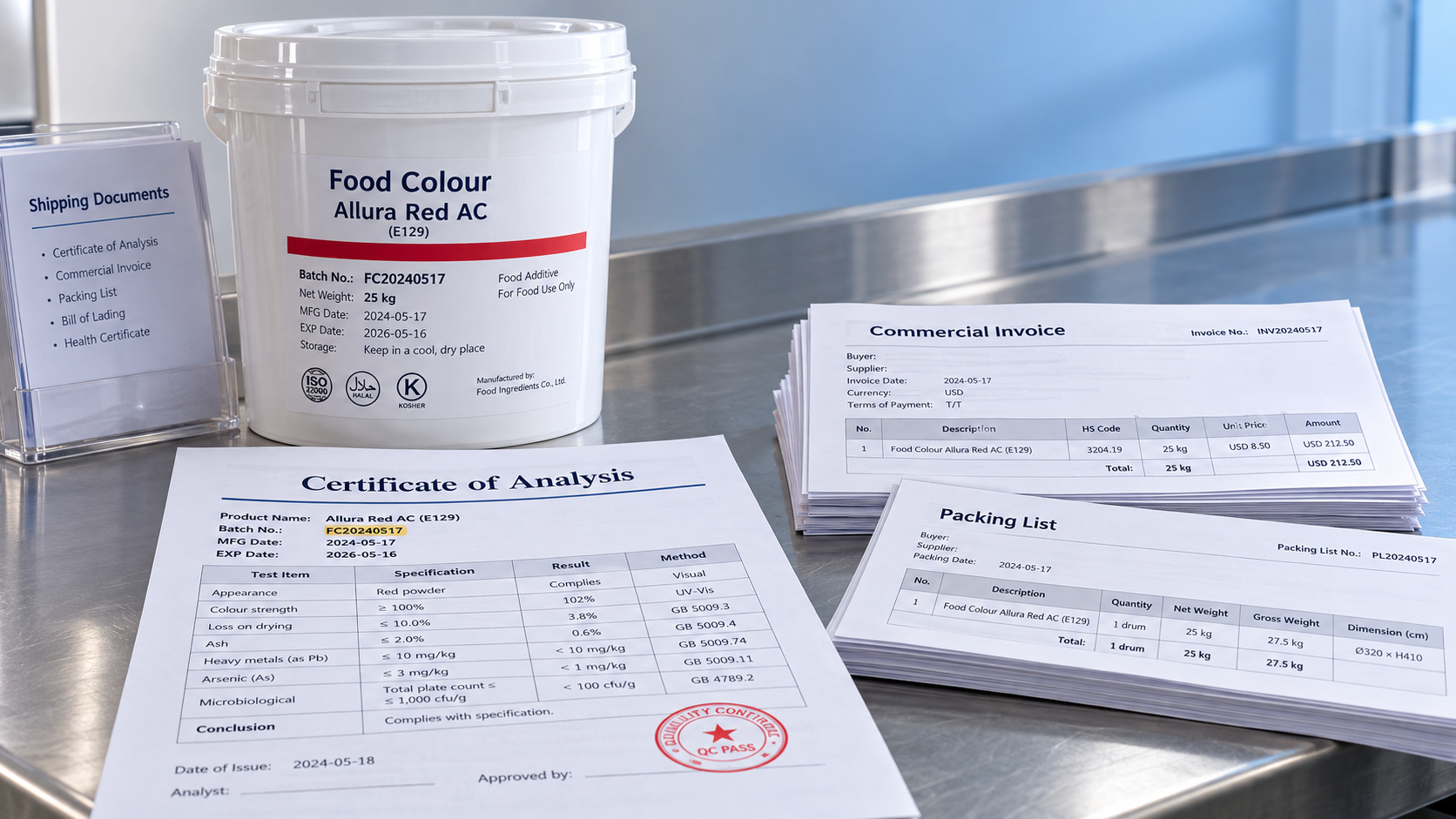
A food colorant delivery can arrive with intact packaging and still be unsuitable for release into production. A missing batch certificate, an unclear product identity, or conflicting storage instructions can leave receiving staff unable to verify what arrived. The practical starting point is a commercial invoice, packing list, transport document, and batch-specific certificate of analysis, supported by the current product specification and handling instructions. Add origin, safety, and destination-specific compliance documents where required.
Not every document needs to be a paper original inside every shipment. Some records travel through the carrier or customs broker; others belong in an approved supplier file. What matters is that the importer and receiving site can retrieve the correct versions, connect them to the delivered lots, and resolve discrepancies before use.
Separate shipment records from standing product documents
A useful document package has three layers: records identifying the consignment, evidence describing the supplied batches, and current documents establishing product suitability. Treating these as separate layers prevents two common mistakes: accepting a generic specification instead of a batch result, and requesting fresh copies of unchanged technical documents without checking their revision status.
The final list should be agreed before dispatch. Requirements depend on the colorant’s identity, formulation, origin, destination, intended food application, and transport classification—not simply on its description as “food grade.”
Make the batch certificate useful for release decisions
The CoA is the main bridge between the delivered material and the agreed quality specification. A product brochure describes typical properties; a CoA should identify the supplied batch and report the quality evidence relevant to its release.
Check the product name and grade, manufacturer or responsible issuer, batch number, certificate reference, and relevant dates. Manufacturing, expiry, or retest dates should be available in the agreed records and consistent with the packaging. A retest date is not automatically an expiry date, so the receiver needs the supplier’s documented meaning of each.
The test panel must suit the material. Depending on the colorant, relevant items may include identity, coloring strength or assay, moisture, insoluble matter, specified impurities, elemental contaminants, or microbiological criteria. A liquid preparation may also need pH, density, or other formulation controls. Do not apply one universal panel to every powder, dispersion, extract, or blend.
- Compare results against the approved specification. A value has little release value without its acceptance criterion and unit.
- Check the reporting basis. Dry-basis results, as-supplied results, and measurements made at different dilutions may not be directly comparable.
- Look for traceable methods. Method references should be clear enough to investigate a disagreement with incoming testing.
- Understand “conforms.” Pass/fail reporting may be acceptable for some attributes, but critical quantitative parameters may require numerical results under the purchase agreement.
A CoA does not necessarily mean every listed attribute was tested on that batch. Where release relies on periodic testing or another justified control, the supplier’s reporting practice should be understood and accepted. Avoid assuming that a certificate is an independent laboratory report unless it explicitly identifies that arrangement.
Verify legal suitability separately from analytical quality
A batch can meet its analytical specification yet be unsuitable for a particular food category or destination. Compliance documentation should therefore address the exact colorant and intended use, rather than offer only a broad statement that the product is suitable for food.
Request an identity and composition statement that allows the responsible compliance team to assess the supplied material. For preparations, this should cover carriers, diluents, preservatives, or other components relevant to legality, labeling, and customer restrictions. A trade name alone may conceal a formulation difference that matters at the receiving plant.
The destination-market statement should identify its scope and the applicable requirements it addresses. Authorization can depend on food category, use level, labeling conditions, and purity criteria. Suppliers may not know the finished food application unless the buyer specifies it; the importer or food manufacturer must verify that the proposed use is permitted.
Additional documents may include allergen information, declarations addressing genetically modified sources, or evidence supporting dietary and religious claims. Request these when relevant to the formulation, customer specification, or market. A declaration and a third-party certificate are not interchangeable: check the issuer, covered product, manufacturing site, and validity period.
Some destinations or product categories require official certificates, permits, registrations, or color-additive batch certification. These are not universal requirements for all food colorants. Confirm the applicable documents with the importer and customs broker before loading, particularly when an original or authority-issued record must be available for clearance.
Use shipping records to reconcile the physical delivery
Commercial records should tell one consistent story. The invoice, packing list, transport document, and package labels may use different formats, but they must not create uncertainty about the goods, quantities, or responsible parties.
For a shipment containing several lots, ask for a lot-to-package breakdown. The receiver should be able to determine which drums, bags, or cartons belong to each CoA. A single invoice line for the total quantity is not enough for batch traceability unless another record supplies that mapping.
Check the customs description and tariff classification with the broker rather than relying only on a supplier’s generic wording. Differences in formulation or presentation can affect classification. Country-of-origin evidence may also be necessary, especially when preferential tariff treatment is claimed; the required format depends on the applicable trade arrangement.
Transport safety requires a separate assessment. Food use does not establish whether a product is regulated as dangerous goods. Classification must reflect the actual formulation and applicable transport rules. Where relevant, obtain the dangerous goods documentation and confirm that packaging, marks, and transport details match the assessed classification.
Storage instructions must cover the opened container
The receiving team may have a shelf-life statement for sealed packaging but no instructions for partial use. That gap becomes important when production opens a container and returns the remainder to storage. How should food colorants be stored after opening? The answer should come from product-specific written instructions, not from a generic instruction to keep the material “cool and dry.”
Request the storage information with the technical document package, including:
- The permitted temperature conditions and whether refrigeration or freezing is prohibited, optional, or required.
- Protection needed against moisture, light, air exposure, and nearby sources of contamination.
- Resealing instructions and whether transfer to another container is permitted.
- Any validated period of use after opening, together with conditions or checks attached to that period.
- Handling requirements such as mixing before use or precautions against introducing moisture into the container.
Powders may absorb moisture or cake, while liquid preparations may have different microbial or physical stability concerns. These possibilities do not justify inventing a universal storage temperature or opened-container lifetime. Refrigeration can also create condensation during handling, so it should not be introduced as an automatic precaution.
Ask whether the stated shelf life applies only to unopened original packaging. Opening a container does not restart its expiry period. Where no supported after-opening period is available, the site needs a documented assessment based on supplier information, packaging, handling conditions, and its food safety controls. Record the opening date and retain the original lot identity on any permitted secondary container.
Resolve document gaps before they become receiving delays
The most efficient review starts before shipment. Send the supplier a document schedule showing which records are required, their language, who must issue them, and when drafts and final copies are due. Distinguish customs requirements from quality-release requirements: a shipment can clear the border while remaining unsuitable for production release.
- Approve the product file. Confirm the specification, composition information, applicable compliance statements, and storage instructions before ordering.
- Review shipment drafts. Check product descriptions, quantities, consignee details, lot allocation, and any certificate format that needs advance approval.
- Obtain batch evidence before arrival. Review the CoAs early enough to investigate missing results or inconsistencies without pressure to consume the goods.
- Reconcile at receipt. Match labels and package counts against the documents, inspect packaging condition, and record discrepancies in the receiving system.
- Release through the designated quality process. Complete any required sampling, testing, and document approval before making the material available to production.
A mismatch should lead to a defined hold, not an informal correction. When the CoA batch number differs from the label, segregate the affected material and obtain a controlled clarification or corrected certificate from the responsible issuer. Receiving staff should not edit supplier records to make them match.
Conflicting instructions deserve the same discipline. A refrigerated-storage label and an ambient-storage technical sheet may indicate an outdated document, a different formulation, or a labeling error. Request a written resolution identifying the governing instruction and assess the shipment’s actual transport history against it. Correct paperwork alone cannot reverse a temperature excursion.
Finally, retain the approved records so they can be retrieved by both consignment and batch. Link the supplier’s lot to the internal receiving reference and subsequent production use. When a specification, formulation, storage instruction, or compliance statement changes, establish which delivered lots the revision covers; replacing an old file without preserving that history can make a later traceability investigation much harder.
Send Us Your Inquiry Today
