









Product Quick Navigation
Get a Quote
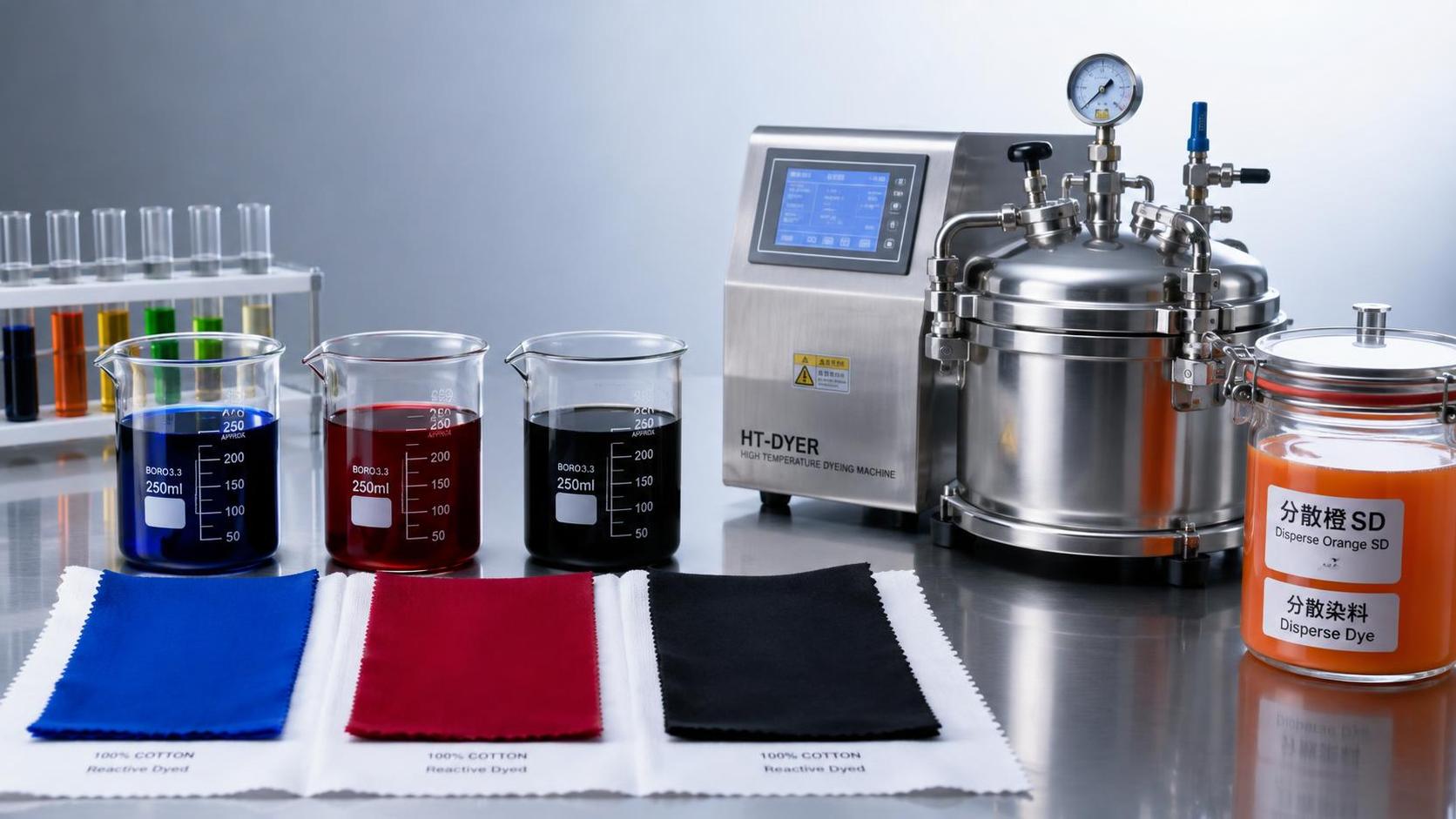
Reactive Dye vs. Disperse Dye: Which Is Better for Cotton Exports?
For a cotton exporter, dye selection is not a narrow technical decision made only in the dyehouse. It affects the shade approval process, wet-fastness performance, wastewater treatment burden, documentation requirements, production timing, and ultimately whether an overseas buyer receives fabric that matches the approved standard.
Reactive dyes and disperse dyes are often discussed together because both are widely used in textile coloration. Yet for 100% cotton, they are not interchangeable options. Reactive dyes are generally the appropriate class because they are designed to react with cellulose fibers. Disperse dyes were developed primarily for hydrophobic synthetic fibers, especially polyester. Choosing between them is therefore less about finding a universally “better” dye and more about understanding the fiber composition, fabric construction, processing route, expected end use, and export constraints.
That distinction becomes more important when orders cross borders. A buyer may ask for deep shades with reliable wash fastness, a specific restricted-substances declaration, or delivery in several shipment windows rather than one large consignment. In that setting, the question is not simply which dye colors cotton. It is whether the chosen dye system and the chemical supply chain can support the commercial promise made to the buyer.
Why Reactive Dyes Are the Normal Choice for Cotton
Cotton is composed mainly of cellulose, a hydrophilic material with reactive hydroxyl groups. During reactive dyeing, the dye is first absorbed onto the fiber, usually with the help of electrolyte, and then fixed under alkaline conditions. When processing is properly controlled, the reactive group forms a covalent bond with the cellulose. This chemical attachment is the central reason reactive dyes are widely used for cotton, viscose, linen, and other cellulosic fibers.
The practical benefit is good durability for many apparel, home-textile, and fabric applications. Reactive dyeing can offer bright shades and broad color possibilities, from pale pastels to demanding navy, black, red, and turquoise shades. It is especially common where buyers expect good resistance to laundering and where shade reproducibility matters across repeat orders.
However, “reactive” does not automatically mean “problem-free.” Reactive dyes can also react with water, a process known as hydrolysis. Hydrolyzed dye no longer forms a useful bond with cotton and must be removed during wash-off. If fixation, soaping, rinsing, water quality, temperature, or pH control is weak, unfixed dye can remain on the fabric. The visible result may be poor wet rubbing fastness, staining during washing, or shade variation. For exporters, this is why dye selection must be considered together with the mill’s process discipline rather than judged from a laboratory color card alone.
What Disperse Dyes Are Designed to Do
Disperse dyes are sparingly soluble in water and are formulated as fine dispersions. Their principal application is polyester and, in certain processes, other hydrophobic synthetic fibers. Under suitable heat conditions, disperse dye molecules diffuse into the polymer structure of the fiber. The mechanism is fundamentally different from the covalent bonding associated with reactive dyes on cotton.
Because cotton is hydrophilic and does not provide the same environment for disperse dye diffusion, disperse dyes generally show poor affinity and poor retention on untreated cotton. Using a disperse dye as the primary coloration route for 100% cotton would normally create avoidable fastness and consistency risks. It may appear to give some temporary color under certain conditions, but that is not equivalent to a durable, production-ready cotton dyeing result.
Disperse dyes become relevant to cotton exporters when the exported textile is not actually pure cotton. Cotton-polyester blends, polyester sewing threads, transfer-printed components, and garments containing synthetic panels can require a combined coloration strategy. In those cases, a mill may use reactive dyes for the cellulosic portion and disperse dyes for polyester, either in separate stages or through a process designed for the specific blend. The right approach depends on blend ratio, target shade, equipment, production capacity, and the buyer’s fastness requirements.
The Export Risks Hidden Behind a Dye Name
A dye class may be technically suitable and still be commercially wrong for an export order. The first risk is shade continuity. A shade approved under one light source may look different under daylight, store lighting, or a buyer’s specified illumination. Dark shades and certain bright tones can be particularly sensitive to process variation. Exporters should make sure the approval procedure identifies the substrate, dyeing method, finish, light source, and tolerance standard rather than relying on a loose visual comparison.
The second risk is fastness mismatch. “Good fastness” is not a complete specification. A fashion T-shirt, hotel sheet, children’s garment, workwear fabric, and upholstery material may be tested against different buyer expectations. Washing, water, perspiration, dry rubbing, wet rubbing, light, and chlorinated-water performance may all matter depending on the intended use. The applicable test method and pass/fail threshold should be confirmed in the order documentation. A dye supplier can advise on dye selection, but the final result also depends on fabric preparation, recipe design, machinery, auxiliaries, and finishing.
The third is chemical compliance. Overseas buyers may request safety data sheets, technical data sheets, colorant composition information, or declarations related to their own restricted-substance programs. Requirements vary by market, brand, product category, and destination. It is unwise to assume that a document accepted in one market is sufficient in another. For a sensitive project, the purchaser should provide the current buyer specification early, allowing the dye supplier and textile mill to check feasibility before bulk production begins.
There is also an environmental dimension. Reactive dyeing often requires salt, alkali, and substantial wash-off, so the dyehouse must account for effluent load and water treatment capability. This does not make reactive dyes inappropriate for cotton; it means the process should be selected with realistic attention to fixation efficiency, rinse optimization, and the mill’s wastewater controls. A low apparent dye price can become expensive if it increases rework, wash-off time, or compliance uncertainty.
For Blends, Start With Fiber Content Rather Than the Sales Description
Many export disputes begin with an imprecise description such as “cotton-rich fabric.” That phrase does not tell a dyer enough. A 60/40 cotton-polyester fleece, a 95/5 cotton-elastane jersey, and a cotton fabric sewn with polyester thread behave very differently in coloration and finishing. Even a small synthetic component may affect the visual appearance of a pale shade, the behavior of a print, or the appearance of seam areas after laundering.
For cotton-polyester blends, reactive and disperse dyes may both be necessary. The challenge is not merely applying two dye classes; it is achieving a unified shade across two fibers with different dyeing kinetics and different responses to heat. The mill should assess whether the required shade can be built consistently, whether the process sequence fits available equipment, and whether finishing will alter the color balance. Lab dips and bulk trials are particularly valuable before committing to large export quantities.
If the product is genuinely 100% cotton, the conclusion is usually clearer: reactive dyes are the technically logical starting point. The remaining decision is which reactive dye series and process route best fit the target shade, required performance, and the mill’s operating conditions.
Can a Chemical Exporter Provide Flexible Shipping Schedules?
This question has become more common as textile buyers reduce inventory, split production among factories, and place repeat orders closer to retail deadlines. The short answer is yes, a chemical exporter can provide flexible shipping schedules, but flexibility needs to be defined in operational terms. It may mean staggered deliveries against a confirmed forecast, partial container loads, consolidated shipments, release of stock in stages, or coordination around the mill’s dyeing plan. It should not be interpreted as an unconditional promise that any product can be dispatched at any moment.
Several variables determine what is realistic: product availability, production lead time, batch consistency needs, packaging format, destination, shipping route, export documentation, and the transport classification stated in the safety data sheet. Chemical goods must be handled according to their actual classification and applicable transport rules. A buyer should therefore discuss shipping requirements before placing the order, not when the vessel cutoff is already approaching.
For color-sensitive orders, logistics planning also has a quality aspect. Releasing material from different batches without prior agreement can complicate shade control. A practical exporter should be able to explain batch identification, retained-sample practice where applicable, packaging labels, shelf-life information, and the documents available for customs and receiving inspection. Flexible delivery is valuable only if it preserves traceability.
Amid deepening globalization, chemical trade is being judged more closely on supply-chain stability, regulatory readiness, and responsiveness. Based in Shandong Province, a major Chinese chemical-industry hub, Shandong Huafeng Chemical Co., Ltd. operates in this environment as a chemical export service provider with comprehensive foreign-trade capabilities and an extensive product portfolio. For textile buyers, the useful question is not whether an exporter makes broad claims about service, but whether it can discuss dye suitability, required documents, packaging, batch arrangements, and shipment timing in the same conversation.
A Better Purchase Brief Prevents Late-Stage Problems
Before requesting a reactive dye quotation for cotton exports, provide more than a color name. The most useful brief identifies the fiber composition, fabric weight and construction, dyeing method, target shade or standard, end use, required fastness tests, destination market, buyer compliance documents, expected annual or seasonal volume, and preferred shipping pattern. If a polyester component is present, state the percentage clearly.
It is also sensible to ask whether the proposed dye system needs a specific salt level, alkali profile, temperature range, wash-off procedure, or auxiliary package. These details affect both the dyehouse’s actual cost and its ability to repeat the result. For a first order, laboratory evaluation and a controlled bulk trial often reveal more than an attractive quotation can.
For most 100% cotton export fabrics, reactive dyes remain the sounder choice because their chemistry is aligned with the fiber. Disperse dyes belong in the decision when polyester or another suitable synthetic component is part of the textile system. Once that foundation is clear, the more demanding work begins: matching the dye to the mill’s process, the buyer’s performance standard, and a delivery plan that can withstand changing export schedules.
Send Us Your Inquiry Today
