









Product Quick Navigation
Get a Quote
Which Thermoplastic Elastomers Can Replace Soft PVC?
Soft PVC has been a familiar material in cable insulation, flexible tubing, seals, grips, flooring, toys, and countless molded parts for decades. It is inexpensive, easy to process, and available in a broad hardness range. Yet it also brings questions that many manufacturers can no longer treat as secondary: plasticizer migration, chlorine-containing chemistry, odor, restricted-substance requirements, end-of-life handling, and changing customer expectations around recyclable materials.
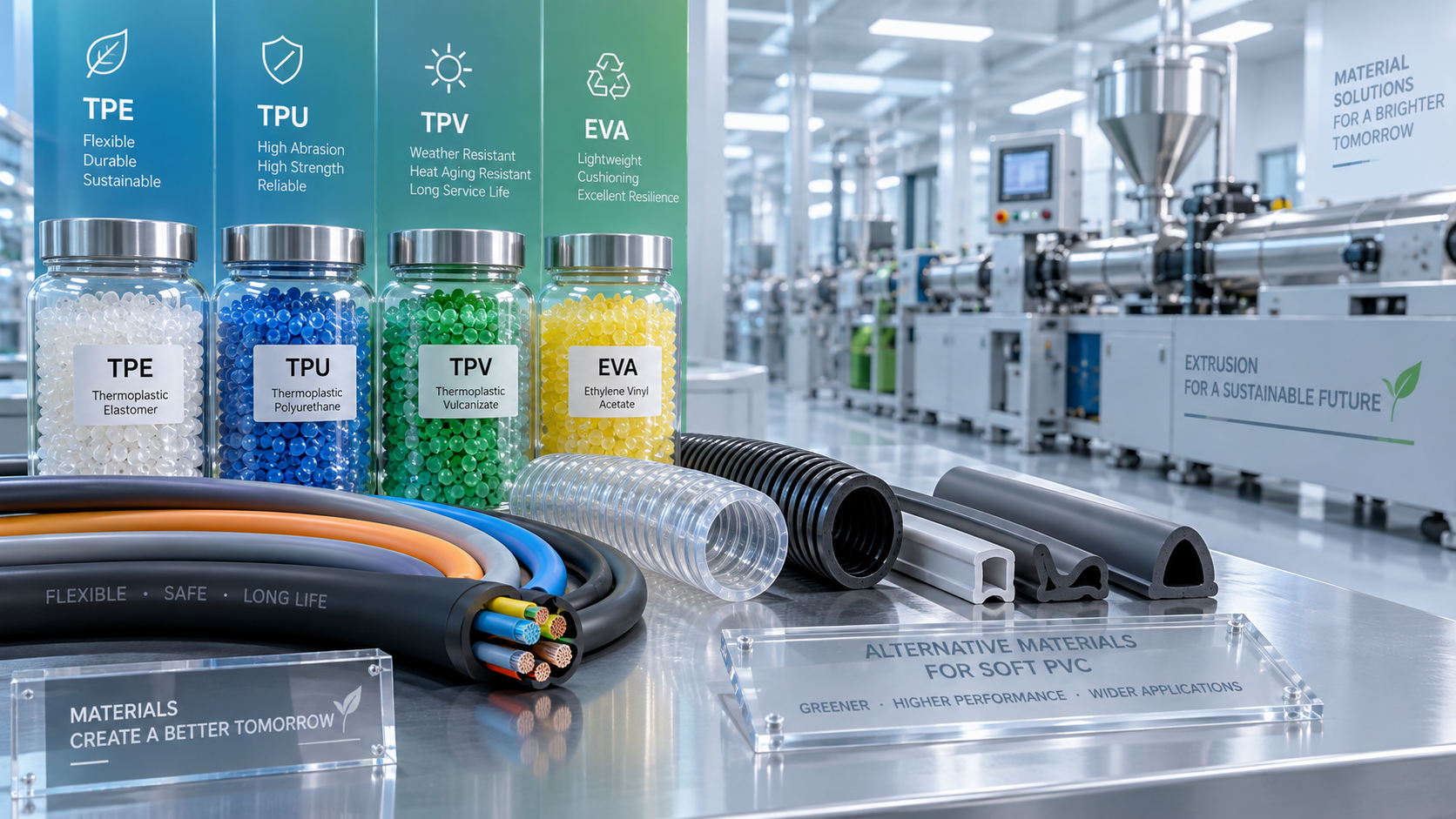
So, which thermoplastic elastomer can replace soft PVC? There is no universal one-for-one answer. Thermoplastic elastomers, or TPEs, cover several material families with very different behavior. A compound that works well for a soft-touch appliance handle may fail in an automotive weather seal; a cable compound that meets flexibility requirements may not survive sterilization or contact with oils. The practical alternatives are usually TPE, TPU, TPV, and EVA, with material selection driven by the actual service environment rather than by the label “PVC-free.”
For global buyers, the decision is also a supply-chain issue. Replacing a material can change processing windows, tooling behavior, additive packages, test methods, documentation needs, and lead-time exposure. A technically promising resin is not necessarily a stable commercial solution unless its formulation, regional compliance status, and export handling can be confirmed before production approval.
Why Manufacturers Are Looking Beyond Flexible PVC
The motivation differs by application. In medical and consumer products, manufacturers may want to reduce concerns related to certain plasticizers, odor, or extractables. In wire and cable, halogen-free requirements and smoke behavior may be central. Automotive suppliers often focus on heat aging, weathering, scratch resistance, and low fogging. Packaging and household-goods producers may be more concerned with recyclability claims, color consistency, tactile feel, and the ability to process scrap internally.
Soft PVC is not inherently unsuitable in every market or use case. The point is that compliance and performance expectations have become more segmented. A formulation acceptable for one customer, country, or application may be rejected by another. Material substitution therefore starts with a clear question: what specific limitation of soft PVC needs to be solved?
If the issue is flexibility at low cost, EVA may be enough. If the issue is durability under abrasion and oil exposure, TPU may be more appropriate. If the part is an outdoor seal exposed to heat and weather, TPV deserves serious consideration. Standard styrenic TPE may be the most efficient route where soft touch, colorability, and straightforward injection molding matter more than long-term high-temperature performance.
The Main Thermoplastic Elastomer Alternatives
Styrenic TPEs: practical for soft-touch and general-purpose molded parts
Styrenic block copolymer-based TPEs, often simply called TPE or TPR in commercial discussions, are common alternatives for soft PVC in consumer goods, grips, overmolded handles, mats, footwear components, toys, and selected non-critical seals. They can be formulated across a wide softness range and are generally easy to color. Many grades run well in injection molding and extrusion, which makes them attractive when a manufacturer wants to avoid a complete processing redesign.
Their limitations should be taken seriously. General-purpose styrenic TPEs may have lower resistance to heat, oils, fuels, and severe outdoor exposure than TPU or TPV. Compression set can also be a concern in parts that must maintain sealing force over time. The phrase “TPE replacement for PVC” can be misleading if it suggests that any TPE grade will match PVC in every flexible application. Compounding choices, including oil extension, fillers, stabilizers, and adhesion modifiers, substantially affect the result.
TPU: when abrasion resistance and mechanical strength matter
Thermoplastic polyurethane, or TPU, is often selected when soft PVC does not provide enough toughness, abrasion resistance, tear strength, or resistance to oils and greases. Typical applications include industrial hoses, cable jackets, protective covers, wearable goods, technical films, casters, and demanding molded components. TPU can provide an excellent balance between elastomeric feel and engineering-level durability.
The trade-off is usually cost and processing discipline. TPU is sensitive to moisture during processing, and inadequate drying can lead to defects or inconsistent mechanical properties. Grade selection also matters: polyester-based and polyether-based TPU systems can differ meaningfully in hydrolysis resistance, microbial resistance, low-temperature behavior, and chemical performance. Buyers should not request “TPU” as a single generic material; they should identify the intended exposure conditions and processing method.
TPV: a strong candidate for weather seals and automotive components
Thermoplastic vulcanizates, or TPVs, combine a thermoplastic matrix with finely dispersed vulcanized rubber. Their structure gives them better elastic recovery and heat-aging potential than many general-purpose TPE compounds. TPV is widely considered for automotive weather strips, glass runs, appliance seals, bellows, gaskets, and exterior components where flexible PVC may struggle with prolonged heat or weather exposure.
TPV is not automatically the lowest-cost replacement, and its surface appearance or feel may differ from soft PVC. It can also require a more deliberate approach to extrusion settings, shrinkage control, bonding, and post-processing. Still, where long-term compression set and outdoor durability are important, TPV can be a more technically credible choice than an inexpensive soft TPE.
EVA: useful where softness, flexibility, and economy are the priority
Ethylene-vinyl acetate, or EVA, is not always described as a TPE in the narrowest technical sense, but it is frequently considered in PVC replacement projects because of its flexibility, relatively simple processing, and broad use in films, sheets, foams, footwear, cable compounds, and consumer products. EVA can be a sensible option where the goal is a softer polyolefin-based material without the complexity of higher-performance elastomers.
Its suitability depends heavily on vinyl acetate content, formulation, and final-use expectations. EVA may not deliver the recovery, heat resistance, oil resistance, or abrasion resistance needed for precision seals and industrial components. It is often more convincing as part of a compound design than as a direct, unmodified substitute for every flexible PVC grade.
A Comparison That Helps Narrow the Choice
Do Not Compare Only Shore Hardness
A frequent sourcing mistake is to match a soft PVC grade with an elastomer that has the same nominal Shore hardness and assume equivalent performance. Hardness is only one part of the material profile. Two compounds at a similar hardness can behave very differently in tensile loading, tear propagation, compression set, bend fatigue, low-temperature flexing, surface tack, migration, and dimensional stability.
For cable and wire applications, evaluate flame-performance requirements, smoke and halogen expectations, dielectric behavior, flexibility after aging, and compatibility with the conductor and adjacent layers. For medical or food-contact-related products, the relevant regulatory framework, extractables concerns, sterilization method, and intended contact conditions need review. For seals, compression set, fluid exposure, temperature cycling, and mating-surface behavior often matter more than initial softness.
Overmolding introduces another complication: adhesion is substrate-specific. A TPE that bonds well to polypropylene may not adhere reliably to ABS, polycarbonate, nylon, or metal without a specialized grade or a mechanical design feature. This should be validated on production-representative parts rather than inferred from a generic data sheet.
Processing Changes Can Decide Whether a Replacement Succeeds
Replacing soft PVC affects more than resin purchasing. PVC plastisols, calendered compounds, and melt-processed flexible PVC each have distinct manufacturing behavior. A replacement material may require different melt temperatures, screw design, cooling conditions, line speed, die geometry, or regrind practices. TPU drying requirements are an obvious example, but even TPE and TPV conversions can expose problems with shrinkage, surface finish, weld lines, or die swell.
Pilot trials should therefore include more than a visual check. Useful validation normally covers process stability, dimensional repeatability, mechanical performance after aging, color behavior, odor where relevant, and the specific compliance documents required by the destination market. If a part is safety-critical or regulated, laboratory screening alone may not replace application-level testing.
It is also wise to clarify whether the selected material is a base resin, a pre-compounded elastomer, or a custom formulation. The answer affects consistency, technical responsibility, packaging, documentation, and how easily the material can be reproduced when production expands to another site.
Compliance Is a Documentation Exercise as Well as a Chemistry Exercise
“PVC-free” does not automatically mean compliant for every market or application. A finished article may still need assessment under customer specifications, substance restrictions, food-contact rules, electrical-product requirements, medical regulations, or sector-specific standards. The relevant obligations depend on where the product is sold, how it is used, and what additives are present in the finished formulation.
Buyers should request the documents that are genuinely relevant to their project and confirm what they cover. A general declaration may not answer questions about a particular color masterbatch, flame-retardant package, recycled-content claim, or end-use condition. The same care applies to terminology such as “halogen-free,” “phthalate-free,” and “recyclable.” These statements need a defined scope, not an assumption.
A More Reliable Way to Source a PVC Alternative
The most efficient material discussions begin with a short but specific application brief: current PVC compound, target hardness, process, operating temperature, chemical exposure, outdoor or indoor use, expected service life, color, required approvals, and destination market. A sample of the existing part or compound can also help identify hidden requirements, such as stiffness gradients, surface friction, or wall-thickness sensitivity.
In global trade, continuity matters alongside material performance. Buyers need clarity on product identification, batch consistency, packaging, shipping conditions, lead times, and the route for resolving technical questions when a trial does not behave as expected. The chemical sector is increasingly judged on these practical details, particularly when material changes affect regulated or high-volume production.
Located in Shandong, one of China’s major chemical-industry regions, Shandong Huafeng Chemical Co., Ltd. works within this broader export environment, where responsiveness, portfolio breadth, and supply-chain coordination are often as relevant as the material name on a specification sheet. For overseas buyers evaluating TPE, TPU, TPV, EVA, or related compounds, a useful supplier conversation should connect product availability with technical documents, application constraints, and delivery realities rather than reducing the decision to a price comparison.
The Best Replacement Is the One That Solves the Actual Failure Risk
Styrenic TPE is often a sensible starting point for general flexible molded goods. TPU is usually stronger where wear, tear, and demanding mechanical use are the concern. TPV is particularly relevant for durable seals and weather-exposed components. EVA can be a practical economic option for selected flexible products, films, foams, and cable-related formulations. None should be treated as a blanket substitute for soft PVC.
Before changing materials, define what the new compound must preserve, what it must improve, and what compromises the design can accept. Confirm performance after processing and aging, verify the required compliance position for the final market, and assess whether the supply route can support repeat production. That approach turns a PVC replacement project from a material swap into a controlled engineering and sourcing decision.
Send Us Your Inquiry Today
