









Product Quick Navigation
Get a Quote
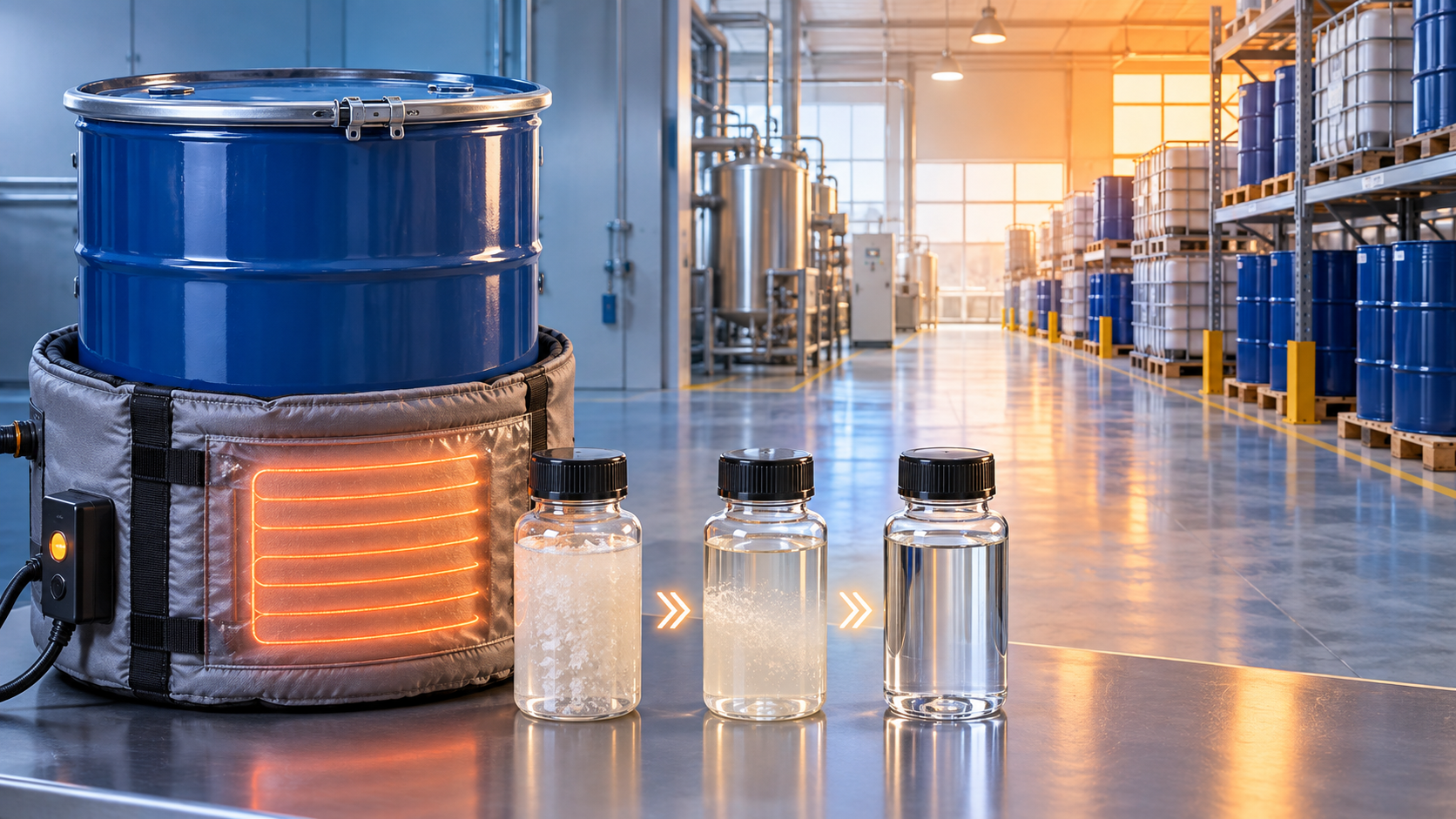
Crystallized Epoxy Resin Should Be Treated as a Recoverable Condition, Not Automatically as a Defect
Epoxy resin that becomes cloudy, grainy, opaque, or partly solid during storage should not be used immediately, but it should not be discarded automatically either. Many liquid epoxy resins, particularly standard bisphenol-A based grades, can crystallize when held at low or fluctuating temperatures. In many cases, the material can be restored by controlled warming and thorough mixing until it becomes clear and uniform again.
The practical question is whether crystallization is the only change. If the resin returns to a clear, homogeneous liquid after heating, with no persistent sediment, phase separation, discoloration, unusual odor, or package damage, it may still be suitable for use. If it does not recover fully, or if the batch has been exposed to moisture, excessive heat, contamination, or extended storage beyond its recommended shelf life, the buyer or processor should hold the material for technical evaluation rather than force it into production.
For distributors, formulators, and users of coatings, adhesives, composites, electrical encapsulation compounds, and flooring systems, handling crystallization correctly matters because an incompletely recovered resin can create misleading viscosity readings, poor metering, inconsistent curing, and avoidable quality disputes.
Why Liquid Epoxy Resin Crystallizes in Storage
Crystallization is a physical change in which part of the resin forms an ordered solid structure. It is different from curing or gelation. A crystallized resin has not necessarily reacted irreversibly; its molecules may simply have arranged into crystals after exposure to favorable storage conditions.
Temperature is usually the main trigger. Some epoxy resins can begin crystallizing after prolonged storage in cool warehouses, containers, unheated transport routes, or locations with significant day-night temperature swings. The exact crystallization tendency depends on resin chemistry, molecular structure, purity, additives, and the presence of nucleation sites. A resin that remains clear in one supply chain may crystallize in another because its storage history is different.
Low temperature alone is not the whole explanation. Repeated cooling and warming can encourage crystal formation, especially when resin is stored for a long period near the temperature range where crystallization begins. Small amounts of pre-existing crystals, residue around a drum opening, or contamination introduced during handling may also act as seeds that promote further crystallization.
Crystallization is therefore not a reliable indicator of poor manufacturing quality by itself. However, it is a handling issue that should be controlled. Assuming that a cloudy resin will “mix out” in production is risky, because solid crystals may remain in the bulk material even when the surface portion appears fluid.
How to Confirm That the Resin Has Crystallized
The most visible sign is a change from a clear or transparent liquid to a hazy, milky, or opaque appearance. Depending on the resin and storage conditions, the material may show fine crystals, wax-like solids, a thick slurry, or a hard mass at the bottom or along the walls of the container. Viscosity may rise sharply, but viscosity alone is not enough to identify the problem.
Before applying heat, inspect the container and the material condition. The distinction between crystallization and chemical deterioration matters:
- Likely crystallization: white or translucent crystals, cloudiness, thickening, or partial solidification without strong discoloration or abnormal odor.
- Possible contamination: localized foreign particles, unexpected sediment, surface films, visible water droplets, or material that differs substantially from the rest of the container.
- Possible degradation or reaction: irreversible gel particles, darkening, persistent phase separation, unusual exotherm, swollen packaging, or a material that remains non-uniform after controlled warming.
For sealed drums or intermediate bulk containers, avoid opening the package in a humid or dusty environment simply to inspect the resin. Moisture and foreign matter can create a larger problem than the original crystallization. Inspection and recovery should follow the handling requirements for the product, including the relevant safety data sheet and the supplier’s technical guidance.
Use Controlled Warming, Not Direct High Heat
The preferred recovery method is gradual, uniform heating. The goal is to melt the crystals throughout the container without creating hot spots or exposing the resin to temperatures that may affect product stability, packaging integrity, or operator safety.
For smaller containers, a temperature-controlled warming cabinet, oven designed for chemical materials, or circulating warm-air system may be appropriate. For drums and larger packages, drum warming blankets, temperature-controlled rooms, or approved heated enclosures are often more practical. Water baths may be used only where the packaging, site procedures, and moisture-control requirements make them suitable.
Direct flame, uncontrolled steam application, improvised heaters, and localized high-temperature devices should be avoided. These methods can overheat the outer layer while the center of the drum remains cold and crystalline. They also increase the chance of package damage, thermal degradation, burns, spills, and fire hazards. A resin may appear clear near a warmed drum wall while substantial crystals remain deeper in the package.
The exact recovery temperature and holding time should come from the resin supplier’s product documentation. There is no single temperature that applies safely to every epoxy resin. Standard liquid grades may tolerate moderate heating, while formulated systems, reactive diluents, specialty grades, or resins containing additives can have narrower processing limits. Heating beyond the recommended range in an effort to save time can alter viscosity, color, reactivity, or storage stability.
Warm the Entire Mass Evenly
Recovery should continue until the whole container reaches a uniform condition. In large drums, this can take considerably longer than expected because epoxy resin transfers heat slowly. Measuring only the external surface temperature is not sufficient. A process should account for container size, fill level, starting temperature, heating method, and the resin’s viscosity.
Once the material is warm enough to flow, it should be mixed thoroughly using equipment appropriate for the package and product. Mixing is essential because melted resin near the heated surfaces may otherwise combine poorly with cooler material in the center. For bulk operations, a validated agitation procedure is preferable to manually drawing off liquid from the top of a partially crystallized drum.
Do not introduce compressed air, wet tools, or unapproved solvents to improve flow. Air entrainment can complicate downstream mixing and coating application. Water contamination can interfere with some curing systems and may cause defects such as bubbling, poor appearance, or reduced performance. Adding solvent changes the formulation and should never be used as a routine remedy for crystallization.
When Is the Resin Ready to Return to Production?
A recovered resin should be clear and uniform at the specified inspection temperature, with no visible crystals or persistent haze. It should flow consistently after mixing, rather than showing alternating thin and thick portions. If the resin is normally supplied as a clear liquid, the return of clarity is an important first check, but not the only one.
For critical applications, release should be based on the product’s relevant quality checks. Depending on the resin grade and application, these may include viscosity, epoxy equivalent weight, color, moisture level, or a small-scale cure test with the intended hardener. The appropriate test set should reflect the risk of the application. A decorative coating may require close control of appearance and flow, while an electrical or structural application may require more rigorous confirmation of cure behavior and final properties.
A common mistake is to judge the resin only by whether it can be pumped. A partly melted resin may pass through a transfer line but still deliver inconsistent composition or viscosity. This can upset mix ratios, reduce coating film uniformity, affect filler wetting, or make pot life less predictable. The material should be fully recovered before it enters a metering or blending system.
Do Not Confuse Resin Crystallization With Hardener Problems
Epoxy systems are often supplied as separate resin and hardener components. These materials should be assessed independently. A crystallized resin may be recoverable through controlled warming, but an amine hardener can have different storage sensitivities, including moisture absorption, carbonation, color change, or viscosity increase. The same heating method should not automatically be applied to both components.
Similarly, a pre-formulated two-component epoxy product should not be treated like a neat liquid resin. If the product contains pigments, fillers, accelerators, reactive diluents, or other additives, heating may affect dispersion, settlement behavior, or application properties. Product-specific instructions take priority over a general recovery practice.
This distinction matters in purchasing and warehouse communication. A request to “warm the epoxy” is too vague for a logistics or production team. The instruction should identify the exact product, component, approved temperature range, maximum exposure time, mixing requirement, and release criteria. Clear handling instructions reduce the chance that warehouse staff apply a suitable procedure to the wrong material.
Storage Practices That Reduce Repeat Crystallization
The best approach is to prevent repeated crystallization where possible. Store epoxy resin within the supplier’s recommended temperature range, away from cold floors, exterior walls, unheated loading areas, and direct weather exposure. In cold seasons, containers may need to be moved into conditioned storage before production rather than being warmed urgently at the point of use.
Temperature stability is often more useful than occasional high-temperature correction. A warehouse that repeatedly cools below the resin’s preferred range and then warms rapidly can create recurring handling work and inconsistent material condition. For importers and distributors, this should be considered across the full route: production storage, port staging, sea or land transport, customs holding, local warehousing, and final delivery.
Keep containers sealed when not in use. Once a drum is opened, close it promptly with clean, dry closures. Partial containers deserve particular attention because headspace exposure and repeated opening can increase the chance of contamination. A first-in, first-out inventory system also helps reduce the time that resin remains exposed to marginal storage conditions.
For materials that are known to crystallize readily, receiving inspection should include a visual condition check before the shipment is accepted into normal inventory. Recording the arrival temperature, package condition, and resin appearance can help distinguish a transport-related storage event from an issue that occurred later in the warehouse. This is especially useful when resin is moved through several countries or storage points before final use.
Questions Buyers Should Ask Before Approving a Recovery Procedure
Buyers often focus on price, pack size, and lead time, but epoxy resin handling requirements should be part of the technical purchase discussion. A supplier should be able to clarify whether the grade has a known crystallization tendency, what storage range is recommended, how the material should be warmed, and what checks should be completed before use.
- What temperature range is recommended for storage and transport?
- At what conditions is crystallization likely to occur for this grade?
- What warming method, temperature limit, and maximum heating time are approved?
- Does the resin require mixing after warming, and what type of agitation is suitable?
- Which quality parameters should be checked before release to production?
- Are there different instructions for resin, hardener, and formulated epoxy products?
- What packaging is suitable for the expected transport and warehouse conditions?
This level of clarification is particularly important for export transactions. A resin may leave a supplier in acceptable condition yet encounter low temperatures during transit or storage at destination. Packaging and documentation should support recovery without creating uncertainty about whether the material remains within specification.
Material stability is a recurring concern across chemical supply chains. The question “Which modified starch improves freeze-thaw stability in food?” comes from a different product category, but it reflects a similar commercial need: users need to know how a material responds when storage conditions deviate from the ideal. With epoxy resin, the answer is not to select a universal stabilizer after the fact. It is to understand the resin grade, prevent unsuitable temperature exposure, and use a controlled recovery process when crystallization occurs.
Know When to Stop and Escalate
Controlled warming is appropriate for normal crystallization, not for every abnormal package condition. Stop the recovery process and isolate the material when there is evidence of leakage, pressure buildup, severe corrosion, suspected water ingress, foreign contamination, or irreversible gel formation. A batch that remains cloudy or non-uniform after the approved warming and mixing procedure should also be held for evaluation.
The cost of delaying a drum is usually lower than the cost of putting uncertain resin into a production line. In epoxy applications, defects may not become obvious until curing, coating inspection, bonding tests, or field use. A disciplined recovery and release process protects both the material and the downstream operation.
Crystallization during storage is manageable when it is recognized early and handled as a controlled material-condition issue. Keep the resin within its recommended storage range, warm it uniformly when recovery is needed, mix it thoroughly, and verify that it has returned to a homogeneous condition before use. That approach is more reliable than treating cloudiness as either harmless or automatically disqualifying.
Send Us Your Inquiry Today
