









Product Quick Navigation
Get a Quote
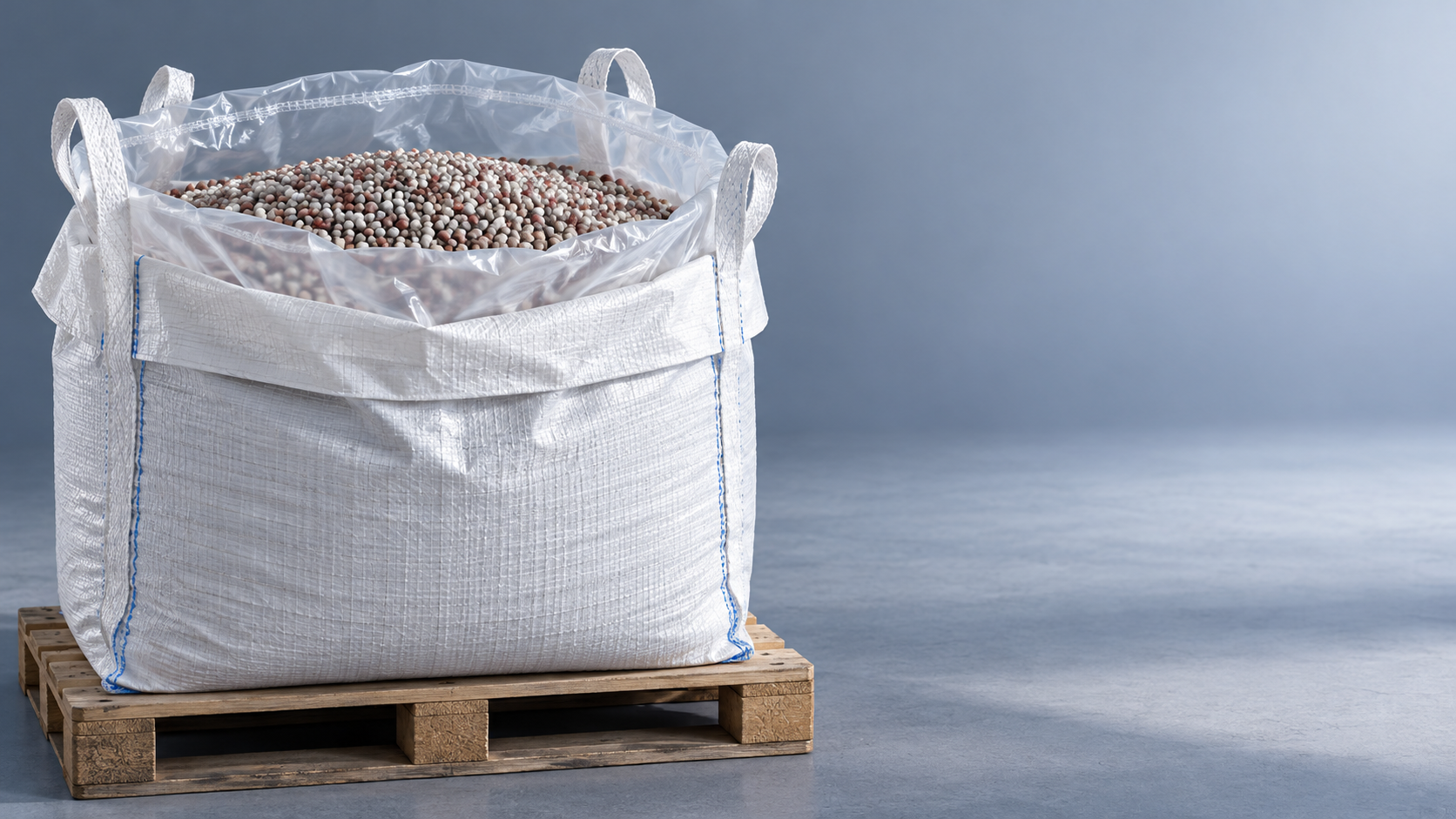
Which bulk bag liners help protect NPK fertilizer from moisture?
For NPK fertilizer in bulk bags, a properly fitted, heat-sealed polyethylene liner is often a practical starting point. For more moisture-sensitive formulations, extended storage, or demanding ocean routes, a verified high-moisture-barrier laminate may justify the additional cost. Neither option works reliably if its seals leak, its film is punctured, or the fertilizer enters the bag with excessive moisture.
That distinction matters when comparing quotations. “PE-lined jumbo bag” describes a packaging concept, not a measurable level of protection. Buyers need to establish how much moisture the complete package can admit, whether it survives handling, and how it will be closed on the actual filling line. Film thickness alone cannot answer those questions.
Start with the fertilizer and the route, not the liner catalogue
NPK is not one uniform material. Compound granules and physical blends can differ in moisture sensitivity, particle strength, surface treatment, and initial moisture content. The same nutrient ratio does not necessarily mean the same storage behaviour. Some salt combinations also have a lower critical relative humidity than their individual ingredients, so an assessment based on one raw material can be misleading.
Ask the fertilizer producer for its finished-product moisture specification, recommended storage conditions, and available hygroscopicity or caking information. If those data are unavailable, a packaging trial with the actual formulation is more useful than a generic assurance that a liner is “fertilizer grade.”
Then map the exposure. A short delivery into a dry warehouse is different from a sea shipment followed by weeks in a humid distribution centre. Include destination storage, not just sailing time. Also distinguish moisture absorption from other causes of caking: stacking pressure, fines, temperature cycling, and granule properties can contribute. A better moisture barrier will not correct every flow problem.
Which liner constructions are worth considering?
Heat-sealed polyethylene: a sensible baseline
LDPE and LLDPE-based liners are common candidates because they combine useful moisture resistance with flexibility and heat-sealability. Blends can balance processing, toughness, and handling requirements. For controlled storage and a manageable exposure period, a well-made PE liner may be sufficient without moving to a more expensive laminate.
The important qualification is “well-made.” Request nominal thickness, thickness tolerance, resin construction, and water vapour transmission data. Greater thickness generally reduces transmission through the same material under the same conditions, but it does not compensate for an open neck or a damaged seam. Nor does extra thickness automatically provide the best puncture resistance; film formulation and manufacturing quality matter.
Multilayer films: check what the extra layers actually do
A coextruded multilayer PE liner can distribute sealing and mechanical functions across different layers. That can be useful where granules stress the film during filling or transport. However, “multilayer” is not itself evidence of a superior moisture barrier. Ask for the finished construction’s measured performance rather than relying on the number of layers.
Be particularly careful with oxygen-barrier claims. EVOH is widely used for oxygen protection, but its presence does not by itself establish low water vapour transmission. A specification designed for an oxygen-sensitive product should not be carried across to NPK without checking the relevant moisture data.
Foil and metallized laminates: options for more demanding exposure
Aluminium-foil laminates can provide very low water vapour transmission when correctly manufactured and kept intact. They are worth evaluating where the formulation is particularly moisture-sensitive or the exposure period makes ordinary PE protection inadequate. Their trade-offs include higher cost, more demanding sealing requirements, and vulnerability to barrier damage from severe flexing or puncture.
Metallized films are another possibility, but they are not interchangeable with continuous aluminium foil. Performance depends on the metallized layer, supporting films, lamination quality, and handling damage. Compare test results for the proposed construction. A shiny appearance is not a performance specification.
Read barrier data carefully before paying for an upgrade
Water vapour transmission rate, or WVTR, is commonly expressed in grams per square metre per day. Lower values indicate less transmission under the stated test conditions. Those conditions are essential: results measured at different temperatures or humidity gradients are not directly comparable.
For each quotation, request the test method, temperature, relative humidity conditions, film thickness, and identity of the tested construction. ASTM F1249 and the ISO 15106 series are examples of methods used to assess water vapour transmission through plastic films, although the appropriate method depends on the material and measurement range.
There is no universal WVTR limit that makes every NPK shipment safe. The acceptable value depends on the product’s moisture tolerance, exposed liner area, exposure duration, and environment. Film data support comparison, but they do not describe leakage through closures or damage after filling. For a new route or formulation, evaluate the assembled package as well.
The closure can undo the value of the film
A tied liner neck is not equivalent to a continuous heat seal. Tying may be operationally convenient, but folds can leave moisture pathways. Where moisture exclusion is critical, specify how the filling neck will be sealed, how the discharge end is closed, and how closure quality will be checked.
Sealing also has to work outside the sample room. Fertilizer dust in the seal area, wrinkles, inconsistent dwell time, or unsuitable equipment can create weak channels. Ask the supplier to demonstrate sealing with the proposed liner and representative filling conditions. The most expensive barrier film is a poor purchase if the packing line cannot seal it consistently.
- Check that the liner dimensions suit the filled FIBC, including its corners and spouts, without excessive stretching or loose folds.
- Confirm that liner attachment points do not create unsealed penetrations through the barrier.
- Agree on seal inspection and leak-testing procedures suitable for the package; appearance alone is insufficient.
- Verify discharge behaviour so the liner does not pull into the outlet, obstruct flow, or require unsafe manual intervention.
A coated woven outer bag can reduce exposure to splashes and improve containment, but it should not automatically be treated as a water-vapour-tight enclosure. Likewise, a moisture liner does not replace the outer bag’s load-bearing function. Evaluate the FIBC and liner together.
Do not seal existing moisture into the shipment
A high-barrier liner restricts moisture movement in both directions. If fertilizer is packed too wet, or temperature differences cause moisture to redistribute internally, the liner cannot remove that water. Filling temperature, product moisture, and cooling conditions therefore belong in the packaging discussion.
Container condensation is a separate exposure pathway. A dry, sound container, appropriate stowage, and protection from wet floors or roof drips remain necessary. Container desiccants can help manage surrounding air when correctly selected and installed, but they do not extract moisture efficiently from inside a sealed liner. Desiccants placed inside the product enclosure require a separate compatibility, capacity, contamination, and recovery assessment.
Avoid casually specifying perforated liners to release air during filling. Perforations compromise the moisture barrier. Where air evacuation is necessary, discuss a filling and deaeration arrangement that preserves the agreed protection after final closure. Also check the formulation’s safety data sheet and applicable transport classification before finalising packaging requirements.
Turn the quotation into an acceptance specification
For buyers sourcing through Shandong Huafeng Chemical Co., Ltd., a chemical export service provider based in Shandong, the useful coordination task is to connect the fertilizer producer, bag converter, packing operation, and shipping plan. A broad product portfolio makes clear product-specific specifications more important, not less.
For example, an electronic ceramic material such as Barium titanate CAS#12047-27-7, used in multilayer ceramic capacitors, has a different packaging assessment from granular fertilizer. Specifications should remain tied to the correct product identity, current safety documentation, and handling conditions rather than being reused across a chemical catalogue.
For NPK fertilizer in bulk bags, put the following into the purchase specification: exact liner construction and dimensions; thickness tolerance; agreed WVTR test conditions; closure method; inspection requirements; and trial acceptance criteria. Require approval before changes to the resin, laminate, film gauge, or sealing arrangement. Otherwise, a successful sample may not represent later deliveries.
A meaningful trial uses the actual fertilizer, intended fill weight, normal filling equipment, and representative handling and storage. Compare moisture content and discharge behaviour before and after exposure using agreed sampling methods. Define unacceptable caking in operational terms: needing to break up lumps manually is different from a bag that will not discharge. Retain batch records and photographs to help separate product, packaging, and transit issues if a dispute arises.
Choose sealed PE when its measured performance and package trial support the route. Move to a verified higher-barrier laminate when the moisture budget or exposure demands it. If the supplier cannot explain the closure, test conditions, or construction being supplied, resolve those gaps before paying for thicker film. That is usually a better purchasing decision than buying the most elaborate liner on the quotation sheet.
Send Us Your Inquiry Today
