









Product Quick Navigation
Get a Quote
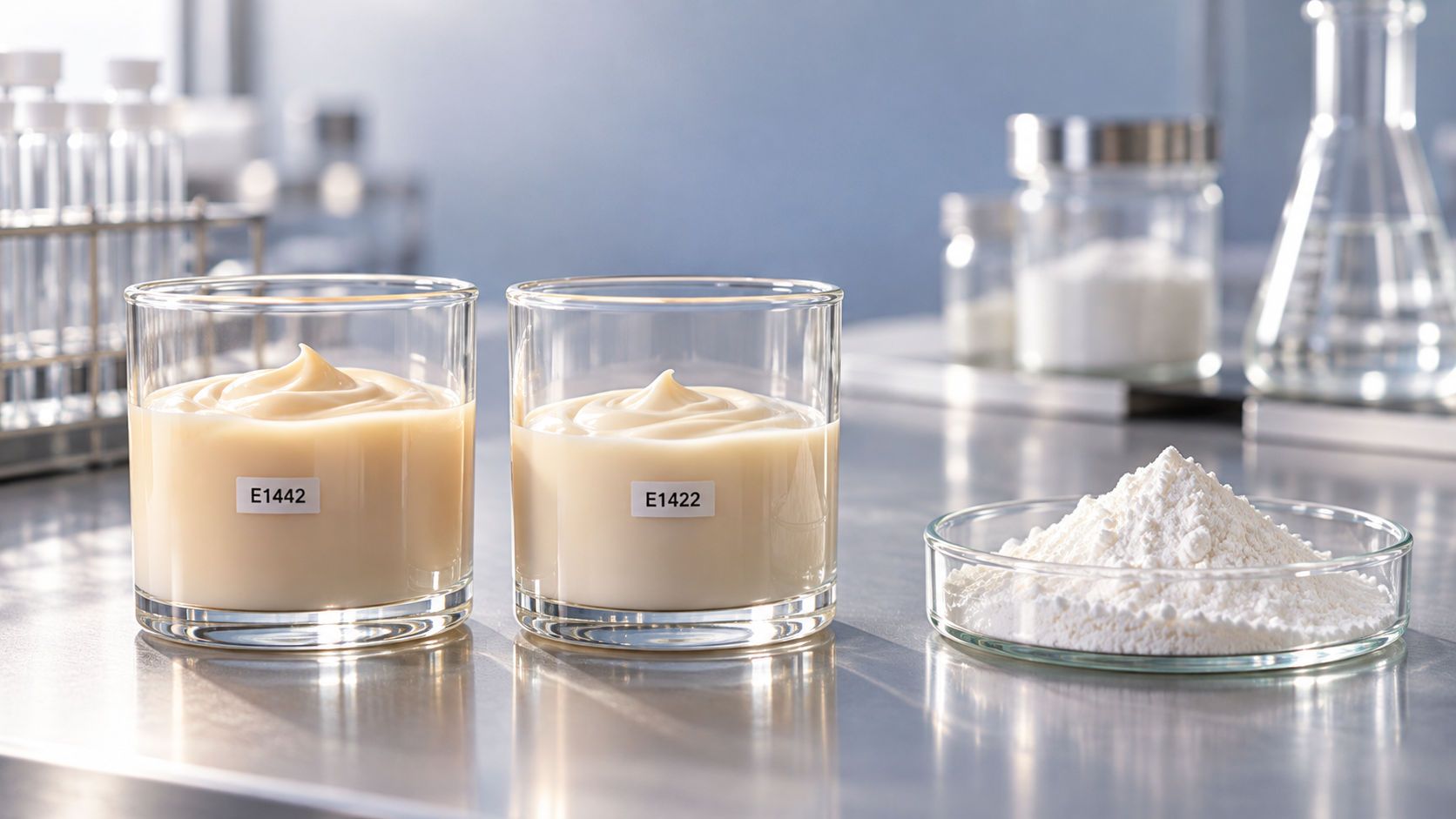
Hydroxypropyl distarch phosphate (E1442) and acetylated distarch adipate (E1422) are strong candidates for limiting syneresis in frozen sauces. For an initial screening program, a waxy maize or tapioca grade specifically designed for freeze–thaw stability is a sensible starting point. Neither additive number guarantees performance: the starch source, degree of modification, cooking conditions, and sauce composition all influence how much water separates after thawing.
For technical selection, give priority to a grade that retains a smooth texture and controls water release through the intended freezing, storage, thawing, and reheating sequence. A viscosity specification measured in a simple starch paste cannot establish that performance. The most useful comparison is between fully formulated sauces processed under representative conditions, with acceptance limits set before testing begins.
Why E1442 and E1422 belong on the shortlist
Syneresis occurs when a sauce structure loses its ability to retain water. During freezing, ice formation concentrates the remaining liquid phase and changes the environment around starch and other ingredients. During storage and thawing, starch chains can reassociate, and the thickened structure may contract or reorganize. The result can be visible liquid, a spongy gel, graininess, or a sauce that becomes thinner after stirring.
The two candidates address different parts of this problem through combined chemical modifications. In E1442, hydroxypropyl substitution interferes with starch-chain reassociation, while phosphate cross-linking helps the swollen granules withstand processing stress. In E1422, acetyl substitution also limits reassociation, while adipate cross-linking contributes resistance to granule breakdown during processing. Both modification systems can support frozen-sauce stability when the grade is matched to the application.
This distinction matters because resistance to cooking damage and resistance to freeze–thaw deterioration are separate performance requirements. A starch can survive a demanding cook yet still release water after freezing. Another may perform well in a gently prepared frozen sauce but lose viscosity under the heat, acidity, or shear used on a production line. A suitable modified starch must satisfy both requirements in the same formulation.
E1442 is a reasonable first candidate where repeated freeze–thaw exposure is an important concern. E1422 is also a credible option for frozen sauces that require processing tolerance and stable texture. There is no dependable universal ranking between them. A particular E1422 grade may outperform a particular E1442 grade because their botanical sources, substitution levels, cross-linking, and intended cooking profiles differ.
Other modified starches may be suitable, but a product described only as “cross-linked” or “heat stable” deserves closer examination. Those descriptions do not establish freeze–thaw performance. Ask for evidence relevant to frozen foods and determine whether the claimed stability applies to a simple paste, a model sauce, or a formulation sufficiently close to yours.
Choose the grade around the sauce and the process
Botanical source helps narrow the search. Waxy maize starch has a high amylopectin content, making it a useful starting material where reducing starch retrogradation is important. Tapioca-based grades can also be attractive where a smooth texture and relatively neutral flavor are priorities. These are screening considerations, not guarantees of a particular mouthfeel or storage result. Modification and processing can substantially change the behavior associated with the original starch.
A sauce’s target texture should guide this choice. A pourable gravy, a clingy glaze, and a thick filling can all pass a basic water-separation check while behaving very differently during serving. Record whether the desired sauce should flow readily, coat a surface, hold suspended particles, or recover body after stirring. Excessive elasticity or a pasty mouthfeel can disqualify a grade even when its syneresis result is good.
Acidity creates another selection boundary. In an acidic sauce, starch may be exposed to acid while hot, increasing the risk of viscosity loss. Record the finished pH, the point at which acid enters the batch, and the subsequent time at temperature. A candidate that works when acid is added near the end of cooking may fail when the same acid is present throughout a prolonged heat treatment.
Shear exposure also needs a realistic description. Mixing speed alone gives an incomplete picture: equipment geometry, processing time, pump type, and the state of starch hydration affect the stress experienced by swollen granules. Include homogenization or other intensive processing where relevant. Strong cross-linking can improve tolerance, but a grade that requires more cooking than the process supplies may remain underdeveloped and provide disappointing viscosity.
Check the relationship between starch hydration and ingredient addition. Sugar, salt, fat, and other solids can alter water availability and paste development. Two sauces with the same starch dosage and final viscosity may enter freezing with different structures because their cooking and addition sequences differ. Compare candidates using the actual recipe and sequence wherever practical.
The required preparation method also separates suitable grades from unsuitable ones. A conventional cook-up starch needs sufficient heat and water to develop its intended functionality. A cold-prepared sauce may require a pregelatinized or otherwise cold-swelling grade. E1442 or E1422 identification alone does not tell the evaluator whether the material can function in a cold process.
Make the freeze–thaw trial answer the commercial question
Begin by defining the exposure the finished product must tolerate. A sauce frozen once and reheated directly from frozen faces a different challenge from one thawed under refrigeration, portioned, and frozen again. Package size and freezing rate also matter because they influence ice formation and temperature gradients. Use the intended package geometry and a representative freezing method when moving beyond laboratory screening.
A practical evaluation can use the following sequence:
- Prepare each candidate in the complete sauce formulation, documenting ingredient order, cooking temperature, holding time, and mixing conditions.
- Measure the fresh sauce after a defined conditioning period, recording appearance, texture, viscosity, and any initial separation.
- Freeze samples under controlled conditions and store them for periods relevant to the intended product life.
- Thaw or reheat using the expected customer procedure, then assess water release and eating quality.
- Where repeated exposure is foreseeable, add defined freeze–thaw cycles and examine the change after each cycle.
Repeated cycles are useful for screening weaknesses, but they should not automatically be treated as equivalent to a stated number of months in frozen storage. Cycling and continuous storage create different stresses. A grade can withstand several short cycles yet develop an unacceptable texture during extended storage. Use accelerated screening to eliminate weak candidates, then verify the finalists under representative storage conditions.
Measure syneresis consistently. For example, collect separated liquid after a defined thawing and resting period and express its mass relative to the original sample mass. Specify container shape, sample size, temperature, holding time, and whether the sauce is stirred before measurement. Without these controls, differences in handling can obscure differences between starches.
Centrifugation can provide an additional comparative stress test, provided its conditions are fixed. Treat the result as a screening measurement rather than a direct prediction of visible separation in the package. A sauce that releases liquid under centrifugation may still meet its serving requirement, while a sample with little measurable separation may have an unacceptable gelled or grainy texture.
Assess viscosity at a controlled temperature and under defined measurement conditions. Sauces are often sensitive to shear, so a single viscosity reading can hide differences in pourability, cling, and recovery after mixing. Compare the fresh, thawed, and reheated samples at equivalent temperatures. Include sensory assessment for smoothness, pastiness, stringiness, flavor release, and the appearance of any oil or water layer.
Identify the separated phase before assigning the failure to starch. In an emulsified sauce, an oil layer can indicate emulsion instability rather than starch syneresis. Protein aggregation may also contribute to graininess and water release in dairy-containing systems. Increasing starch concentration may thicken the continuous phase without resolving the underlying failure.
Interpret results without letting viscosity dominate
For the first comparison, testing candidates at the same starch concentration helps reveal functional differences. A second comparison at a similar fresh-sauce consistency is often valuable because it shows how each grade performs at a usable dosage. These comparisons answer different questions. Equal concentration highlights relative thickening and stability; comparable starting texture helps determine the practical formulation required for each option.
A candidate should not be selected solely because it produces the least separated liquid. A very thick sauce may retain water but fail pouring, pumping, portioning, or sensory requirements. Set limits for both water release and texture. Include fresh-product requirements as well as post-thaw performance so that freeze–thaw protection does not come at the expense of the intended eating experience.
If all candidates fail, examine the failure pattern before increasing dosage. Low viscosity immediately after cooking suggests insufficient hydration, inadequate cooking, or processing breakdown. Acceptable fresh texture followed by progressive gel firming and water release points toward storage-related structural changes. Failure only after reheating suggests that the reheating step or its interaction with the formulation needs attention.
A blend with another starch or a hydrocolloid may help when a single grade cannot deliver the required balance, but it adds formulation variables. Establish how the shortlisted starch behaves first. Then evaluate any supporting ingredient against a specific deficiency, such as suspension or water retention, while checking its effects on mouthfeel and processability.
Before approving a grade, obtain its exact food-grade identity, botanical source, preparation requirements, specification, and relevant regulatory documentation. Confirm permitted use and labeling for the destination market and food category. An E-number does not by itself establish that every grade is suitable for every food application or that the same label declaration applies across markets.
The final specification should connect supply consistency to application performance. Routine viscosity and moisture limits can support quality control, but the qualification record should also preserve the recipe, process conditions, and freeze–thaw acceptance criteria used to approve the material. Changes in grade, source, or manufacturing characteristics may justify renewed application testing even when the additive designation remains unchanged.
For a frozen sauce, the defensible choice is therefore a specific E1442 or E1422 grade that passes the intended use cycle at an acceptable dosage and texture. Start with candidates designed for frozen applications, then let the finished sauce determine the selection. Approval should rest on what happens after storage, thawing, and reheating—the stages at which the customer will judge it.
Send Us Your Inquiry Today
