









Product Quick Navigation
Get a Quote
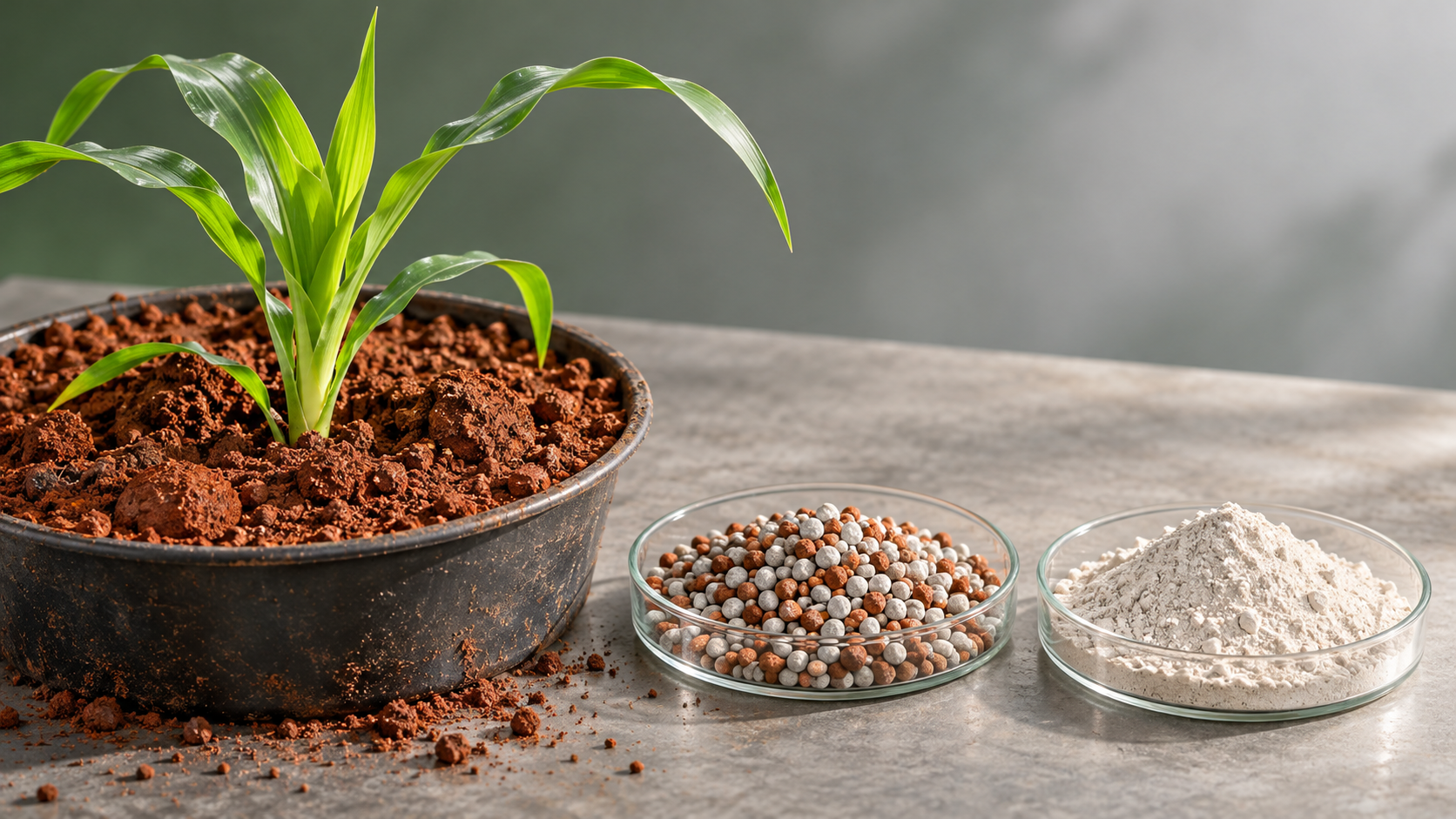
The most suitable fertilizers for acidic tropical soils in Southeast Asia are usually a soluble phosphorus source, potassium matched to crop sensitivity and soil reserves, and nitrogen applied in stages. Lime or dolomite belongs alongside this program wherever acidity restricts rooting. A concentrated NPK fertilizer alone will not correct aluminum toxicity, magnesium deficiency, or rapid nutrient losses under heavy rainfall.
Choosing between these materials starts with separating three problems: acidity that limits root growth, phosphorus retained by iron and aluminum compounds, and mobile nutrients lost below the active root zone. Upland maize, flooded rice, oil palm, and tropical fruit crops require different responses, even when their soil pH readings look similar.
Read acidity together with the root environment
Soil pH indicates acidity, but it does not establish the lime requirement. Two soils with the same pH can require very different amendment rates because their clay content, organic matter, and reserve acidity differ. Exchangeable aluminum, exchangeable calcium and magnesium, and a locally calibrated lime-requirement test provide a stronger basis for treatment. The laboratory method also matters: pH measured in water should not be compared directly with a result measured in a salt solution.
On strongly weathered upland soils, aluminum toxicity can shorten roots and restrict access to both nutrients and water. Applying more fertilizer to that shallow root system often produces disappointing results. Where subsoil acidity is suspected, separate surface and subsurface samples help distinguish a nutrient shortage from a rooting restriction that surface treatment will address only gradually.
Phosphorus results need similar care. Extractants recover different fractions of soil phosphorus, so an interpretation calibrated for one method cannot simply be transferred to another. Use a test and crop-response interpretation established for the local soil conditions. A low available-phosphorus result alongside substantial total phosphorus is consistent with strong retention; it does not automatically justify a large broadcast application.
Flooded rice requires a separate interpretation. Flooding changes soil chemistry and often raises the pH of acidic mineral soils, altering phosphorus availability and metal solubility. Acid sulfate soils present a different problem: drainage can oxidize sulfides and generate severe acidity. Their management requires water control as well as amendments, rather than a fertilizer substitution alone.
Correct acidity before judging fertilizer performance
Choose calcitic lime when acidity correction and calcium supply are needed; choose dolomite when magnesium is also deficient. Neither material should be selected solely because it produces an alkaline laboratory slurry. Agricultural performance depends on neutralizing value, fineness, application rate, and contact with moist soil.
Compare lime products using their effective neutralizing capacity under the applicable local method. A material with high chemical purity but coarse particles can react slowly during the crop establishment period. Incorporation into the intended rooting layer improves contact where tillage is suitable. In established plantations, surface application requires more time, and its effect at depth needs separate assessment.
The target pH should follow the crop and soil constraints. Raising every acidic tropical soil toward neutrality can create unnecessary expense and reduce the availability of some micronutrients. Keep concentrated urea or ammonium fertilizers out of direct contact with freshly applied lime because the locally elevated pH can increase ammonia losses. Application timing and placement should account for this interaction.
Phosphorus sources: availability matters more than the headline grade
For a crop needing an immediate phosphorus response, water-soluble sources such as monoammonium phosphate, diammonium phosphate, single superphosphate, or triple superphosphate offer a more predictable starting point than untreated phosphate rock. Once dissolved, their phosphorus still reacts with the soil. Source selection therefore needs to be paired with placement and correction of severe acidity.
Band placement can improve early phosphorus access by concentrating fertilizer within reach of young roots and reducing its contact with the whole soil volume. Keep the band safely separated from seed. Broadcast incorporation remains useful where the objective is to build phosphorus fertility across a cultivated rooting zone. These approaches serve different purposes; a starter band does not necessarily correct a depleted field.
Rock phosphate deserves particular scrutiny. Acid conditions favor dissolution, but a low soil pH alone does not establish agronomic effectiveness. Low-reactivity material can supply phosphorus too slowly for a short-season crop. Liming also changes its dissolution environment. A specification showing total phosphorus without reactivity or suitable solubility information provides too little evidence for substitution.
Choose potassium around crop response and soil retention
Potassium chloride, commonly called muriate of potash or MOP, is a practical source where chloride is acceptable. Potassium sulfate, or SOP, becomes more attractive for chloride-sensitive crops, certain quality objectives, or situations requiring sulfur. SOP does not automatically produce a better crop response when chloride is tolerated and sulfur is already adequate.
Account for chloride already supplied through irrigation water and other fertilizers. Where salinity is a concern, the total salt load and placement matter alongside the potassium source. Excessive fertilizer concentration near roots can damage establishment even in a region with high annual rainfall, particularly during a dry interval.
On sandy soils or soils with low cation-exchange capacity, splitting potassium applications reduces the amount exposed to leaching before crop uptake. Heavier soils can retain more potassium, although retention and release depend on mineralogy. Crop removal is equally important: harvesting fruit, bunches, or biomass exports potassium that must be reflected in the nutrient budget.
A potassium response can also be constrained by magnesium deficiency. Large potassium inputs can aggravate magnesium uptake problems where magnesium supply is marginal. Dolomite is useful when both acidity and magnesium need correction; magnesium sulfate offers a more soluble magnesium source when further liming is unnecessary.
Nitrogen choice follows water management
Urea is suitable for many regional systems when placement and timing limit losses. Surface-applied urea can lose nitrogen as ammonia, including on acidic soils, because its hydrolysis temporarily raises pH around each granule. Incorporation or sufficient rainfall to move dissolved urea into the soil reduces this exposure. An intense storm, however, can produce runoff or subsequent leaching rather than efficient incorporation.
Ammonium sulfate supplies both nitrogen and sulfur, making it useful where sulfur deficiency is established. Repeated use contributes substantial acidity as ammonium is nitrified. Its nutrient value should therefore be weighed against the soil's buffering capacity and the associated lime requirement. Choosing it simply because the soil is tropical overlooks this continuing acidification.
Nitrate-containing fertilizers provide readily available nitrogen for suitable upland crops, but nitrate is vulnerable to leaching during heavy rainfall. In continuously flooded rice soils, nitrate is vulnerable to denitrification. Urea and ammonium-based strategies, with placement and timing suited to the water regime, generally fit those conditions better.
Split nitrogen applications around establishment and periods of strong crop demand. The appropriate split follows rooting depth, crop duration, soil texture, and expected rainfall. Controlled-release products or inhibitors warrant consideration where a defined loss pathway or application constraint justifies them. Their performance needs evidence under local temperatures and moisture conditions; a longer release period is not automatically a better match for crop uptake.
Use compound NPK only when the ratio fits
A compound NPK fertilizer simplifies application, but a convenient ratio can still create nutrient imbalance. Repeatedly applying a phosphorus-rich grade to satisfy nitrogen demand can accumulate phosphorus while leaving potassium short. Conversely, a grade suitable for a fruiting phase may provide too little phosphorus for establishment on a depleted soil.
Compare nutrient quantities on the same reporting basis. Fertilizer labels commonly express nitrogen as N, phosphorus as P2O5, and potassium as K2O; laboratory reports may use elemental phosphorus and potassium. Mixing these conventions produces incorrect application calculations. Separate nutrient sources offer greater adjustment where soil reserves and crop removal do not match an available compound grade.
For physical blends, particle-size compatibility affects segregation during transport and spreading. A sample taken from one part of a segregated load may not represent the nutrient ratio reaching the field. Moisture, caking, granule strength, and spreading characteristics therefore affect application accuracy as well as handling convenience.
Specifications that change the selection
A useful fertilizer specification identifies the guaranteed nutrients, their chemical forms, and relevant availability measures. For phosphorus, distinguish total content from water-soluble or other declared soluble fractions. For potassium, identify whether chloride or sulfate is the principal accompanying anion. Sulfur and magnesium declarations should distinguish the forms supplied because release rates differ.
Industrial chemical purity does not establish agricultural suitability. For example, Lead monoxide CAS#1317-36-8 is an industrial lead compound and must not be used as a fertilizer or liming material. Its purity and slurry pH provide no basis for agricultural application; introducing lead would contaminate the soil. Product identity, intended agricultural use, and contaminant specifications must agree before nutrient value is assessed.
Phosphate fertilizers and mineral amendments also require contaminant assessment against the destination's applicable requirements. A nutrient analysis alone cannot establish compliance. Batch documentation should connect the delivered material with its declared composition, while packaging must protect moisture-sensitive products during humid storage and transport.
Where two fertilizer programs remain plausible, a local comparison should hold nutrient rates comparable and separate the effect of liming from the effect of fertilizer source. Record application placement, rainfall or irrigation, crop response, and harvested yield or quality. For perennial crops, tissue analysis complements soil testing, provided sampling follows the crop-specific leaf position and growth stage. These observations reveal whether the remaining constraint is nutrient supply, acidity, or restricted uptake.
Send Us Your Inquiry Today
