









Product Quick Navigation
Get a Quote
How modified starch affects open time in cement-based tile adhesives
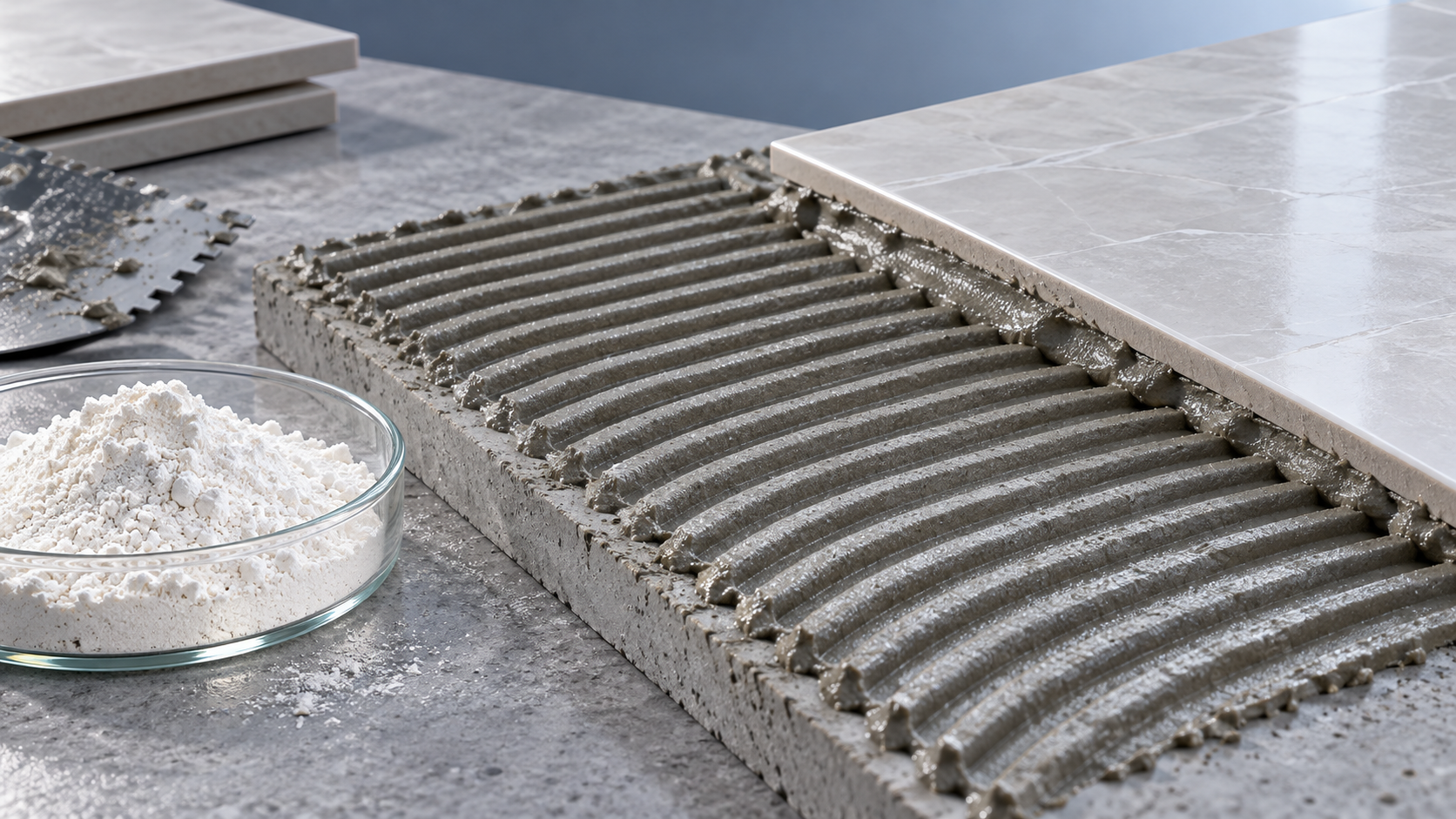
Open time determines how long a cement-based tile adhesive can remain exposed before tile placement compromises adhesion. Understanding how Building Material Modified Starch influences this window requires looking beyond workability to water retention, surface skin formation, and interactions with cellulose ethers. Its effect depends on starch chemistry, dosage, and the overall formulation—not every grade extends open time. The useful question is whether an additive preserves wetting and bond strength after a defined exposure period, rather than simply making fresh mortar feel better under the trowel.
That distinction matters on site. An adhesive can still look moist between its ridges while the exposed ridge surfaces have become difficult to wet. A tile placed at that point may sit securely without developing adequate contact. Improving anti-slip performance does not necessarily solve this problem; in some formulations, excessive structural build-up makes it worse.
Open time is an adhesion result, not a bucket-life observation
Three working periods are easily confused. Pot life describes usability after mixing. Open time concerns the interval between spreading the adhesive and placing the tile. Adjustment time concerns repositioning after placement. A modified starch can affect all three differently, so a longer workable period in the bucket does not establish longer open time on the substrate.
For cementitious adhesives evaluated under EN 12004-1, the ordinary open-time requirement is tensile adhesion strength of at least 0.5 N/mm² after not less than 20 minutes; the extended-open-time designation, E, requires that strength after not less than 30 minutes. Rapid-setting products have separate provisions. EN 12004-2 provides test methods, while ISO 13007-2 is another relevant reference. Always confirm the applicable edition, product classification, and market specification before setting acceptance criteria.
These are controlled test results, not guaranteed installation windows in every climate. Air movement, a warm substrate, low humidity, and substrate suction can shorten the usable interval. A laboratory claim should therefore remain separate from site guidance, especially when an adhesive is intended for exposed or hot-weather work.
What modified starch actually changes
“Modified starch” covers a broad family of materials. Construction-grade starch ethers are commonly used as low-dose rheology modifiers, but native starch, chemically modified starch, and blended commercial additives should not be treated as interchangeable. Modification chemistry, molecular characteristics, solubility, and any accompanying ingredients influence performance in alkaline cement pore solution.
Their most noticeable contribution is often greater cohesion and structural recovery after trowelling. Mortar may comb more cleanly, hold its ridges better, and resist tile slip. These changes can support installation, but the connection to open time is indirect: the mortar must retain enough mobile water and remain deformable enough to wet the tile when pressure is applied.
Water retention helps, but bulk moisture is not the whole story
Water leaves a spread adhesive through evaporation and absorption into the substrate. Hydration also progressively changes the paste. A suitable starch derivative may influence water distribution and retention, although its contribution must be measured alongside the cellulose ether already present. A water-retention result from a bulk mortar test does not, by itself, establish delayed surface skinning.
The exposed interface is the critical location. A thin surface layer can become resistant to wetting while the material underneath remains soft. A finger-touch check can flag this change during development, but it is only a screening observation. It cannot replace delayed-placement adhesion testing.
Too much structure can reduce tile contact
An adhesive needs enough structure to resist movement, yet its ridges must collapse under placement pressure. If starch addition raises yield stress excessively, the tile may bridge stiff ridges instead of bedding into them. Low-absorption porcelain makes this balance particularly important: reliable contact depends on wetting and deformation, not simply on the tile remaining in position.
This is why increasing dosage can improve a vertical slip result while reducing delayed-placement adhesion. The mortar feels firmer and appears more controlled, but the bond interface deteriorates. Treat this as a formulation trade-off, not an unexpected testing anomaly.
The cellulose ether interaction usually decides the outcome
Cellulose ethers such as HPMC and HEMC commonly provide much of the water retention and viscosity control in cement-based tile adhesives. Starch ethers often complement them by changing cohesion, yield behaviour, and trowelling response. They are not straightforward substitutes, even when two mixtures have similar apparent consistency.
A useful evaluation separates two questions: what happens when starch is added to an unchanged formulation, and what happens when the formulation is rebalanced around it? Cutting cellulose ether while introducing starch changes several variables at once. Any loss of open time could reflect reduced water retention, altered rheology, or both—not necessarily an unsuitable starch grade.
Water adjustment creates another comparison problem. At fixed water content, a higher-structure mortar may be harder to spread. At matched application consistency, it may require more water, which can affect porosity, shrinkage, and strength. Run both comparisons where practical, and label them clearly. Neither result should be presented as though only starch chemistry changed.
Cement source, sand grading, filler surface area, redispersible polymer powder, air content, and setting-control additives also influence the result. Certain starch chemistries may affect hydration, but longer setting time is not proof of longer open time: surface drying can still end the placement window well before the mortar sets.
Build the trial around delayed placement
Start with a stable reference adhesive and an additive-free control. Select candidate dosages from the supplier’s documented recommendation for the particular grade rather than borrowing a universal starch dosage. Record whether the addition is expressed against total dry mix, binder, or another basis; otherwise, apparently comparable trials may use quite different concentrations.
Keep raw-material lots, mixing sequence, maturation time, remixing, substrate preparation, and trowel geometry consistent. Low-dose additives require particular care in weighing and dry blending. Poor dispersion can create misleading differences between laboratory batches and can become a larger problem during production scale-up.
A practical evaluation should connect application observations with measured adhesion:
- Fresh mortar: record water demand, consistency, density or air content where relevant, trowel drag, ridge stability, and slip behaviour.
- Exposed mortar: place tiles at the specified delay intervals. Use separate specimens for exploratory transfer checks so the adhesion specimens remain undisturbed.
- Cured specimens: measure tensile adhesion under the applicable method and record failure modes, not only the average strength.
- Robustness: repeat promising formulations with additional batches, then examine realistic temperature, airflow, or substrate-suction challenges separately from compliance testing.
Choose delay intervals that reveal where performance starts to fall, rather than testing only one convenient passing point. Immediate-placement results are also useful: if they decline after starch addition, there may be a broader contact or strength problem rather than a specific loss of open time.
Read the failure pattern before changing the dosage
When initial adhesion remains acceptable but delayed-placement adhesion drops sharply, investigate surface drying, skin formation, and reduced wetting first. Transfer observations can help distinguish incomplete ridge collapse from an exposed surface that no longer bonds effectively. They are diagnostic evidence, not substitutes for the prescribed test.
If both immediate and delayed adhesion decline, check water demand, entrained air, dispersion, hydration effects, and overall polymer balance. Increasing a water-retention additive without identifying the cause may simply add viscosity to a mortar that already resists bedding.
Failure mode adds context. Separation at the tile–adhesive interface can support a contact-related explanation, whereas cohesive failure within the adhesive points toward a different limitation. Neither observation proves a single mechanism, and tile-back condition or substrate variability must also be considered.
Look for repeatable margin above the required threshold. A formulation that passes once but varies substantially across batches is a weaker development choice than one with slightly less attractive trowelling feel and more consistent delayed adhesion.
Grade identity and supply consistency belong in the technical review
Building Material Modified Starch is a purchasing category, not a complete technical specification. Request the grade identity, recommended application, moisture specification, relevant viscosity test conditions, storage guidance, and batch documentation. A viscosity number is difficult to interpret without its solution concentration, temperature, and measurement method. Ask whether the supplied product is a single derivative or a formulated blend.
For an export service provider such as Shandong Huafeng Chemical Co., Ltd., based in Shandong, China, these documentation and traceability questions connect technical qualification with supply stability. A broad chemical portfolio and responsive export coordination can support sourcing, but replacement grades still need formulation testing. Equivalent descriptions on commercial paperwork do not establish equivalent mortar performance.
Portfolio boundaries also matter. Beet Red CAS#7659-95-2 is a betanin-based colorant, not a construction starch ether. Even if a colorant preparation contains a dextrin carrier, that does not establish suitability for cementitious adhesive modification. Product identity and intended function should be checked before sample approval, rather than inferred from a shared reference to starch-derived ingredients.
Approve a modified starch when it delivers the required balance: manageable trowelling, adequate ridge collapse, acceptable slip, and repeatable adhesion after the specified placement delay. Keep the validated water range, cellulose ether grade, and mixing procedure attached to that approval. A grade change should trigger a focused comparison, not an assumption that the same dosage will preserve open time.
Send Us Your Inquiry Today
