









Product Quick Navigation
Get a Quote
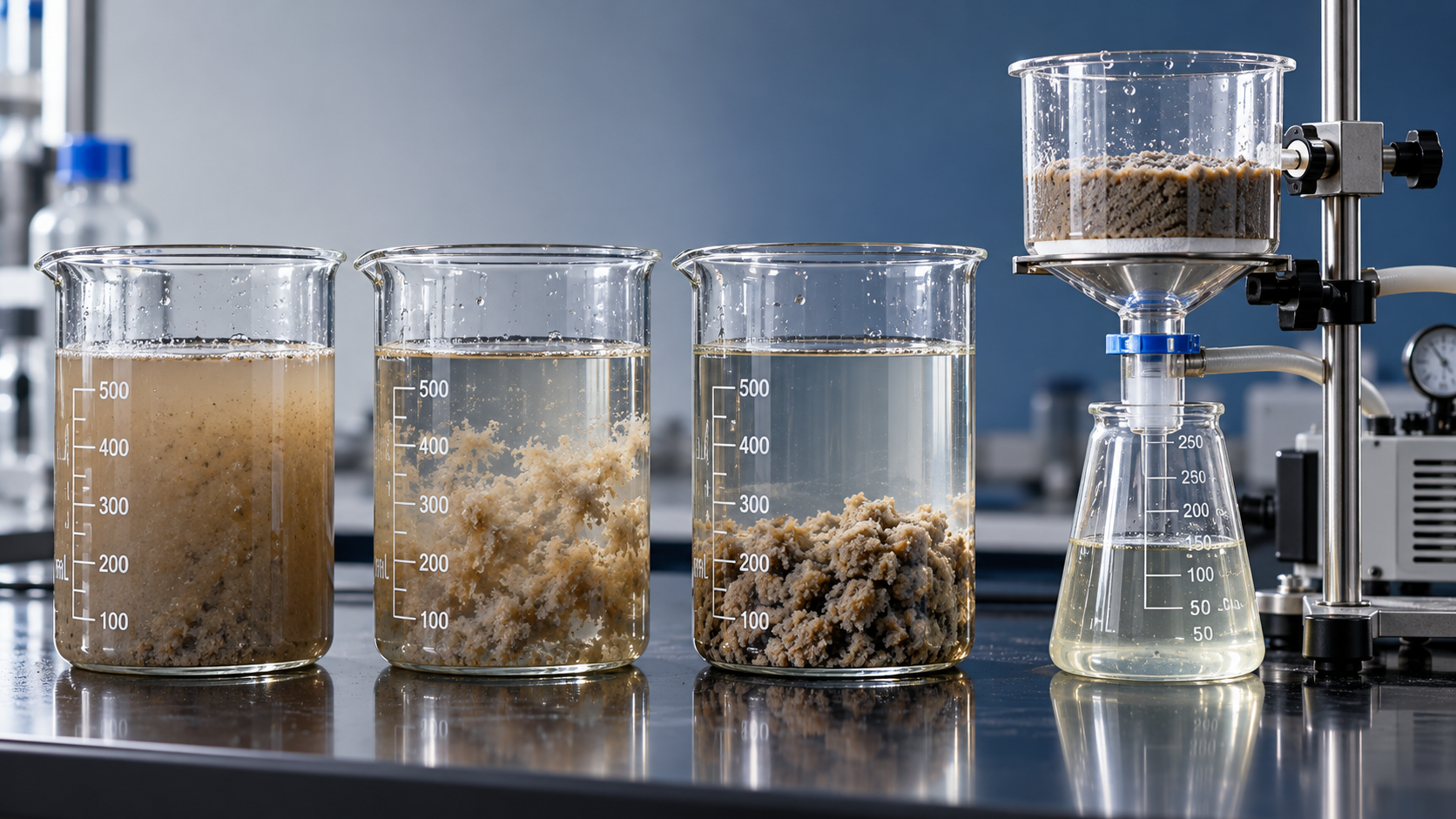
Select polyacrylamide flocculant charge by screening the charge type against the actual sludge, then comparing charge densities at several doses under conditions that resemble the dewatering process. Cationic polymers are a logical starting point for many biological sludges, but the highest cationic charge is not automatically the best choice. The useful operating window is where solids capture, water release, cake dryness, and floc survival remain acceptable without excessive polymer consumption.
Charge selection cannot be separated completely from molecular weight, polymer architecture, preparation quality, or mixing. A grade that produces large flocs in a beaker may still perform poorly in a centrifuge or form a compressible cake in a press. The decision therefore needs two stages: controlled bench screening to identify promising chemistry, followed by equipment trials to establish the operating dose and performance limits.
Distinguish charge type from charge density
Charge type describes whether the polymer carries positive, negative, or essentially no ionic charge. Charge density describes how much ionic functionality the polymer contains. These properties influence adsorption onto sludge particles and the balance between charge neutralization, localized charge interactions, and polymer bridging.
Supplier descriptions such as “low,” “medium,” and “high” charge are not universal specifications. A reported percentage may refer to ionic monomer content on a molar or mass basis. Charge expressed in milliequivalents per gram provides different information and still requires a defined basis and measurement method. Compare products only after confirming what each charge value means.
Molecular weight must also be distinguished from charge density. A high-molecular-weight polymer can bridge particles effectively, while its charge controls adsorption behavior. If candidate grades differ substantially in both properties, a performance difference cannot confidently be attributed to charge alone.
Use sludge characteristics to narrow the candidates—not to declare a winner
Record the sludge source, treatment history, feed solids concentration, volatile solids fraction, pH, conductivity, temperature, and upstream chemical additions. These variables provide a defensible starting point and help explain changes between sampling days.
Waste activated sludge contains microbial cells, fine particles, and extracellular polymeric substances that influence both charge demand and water retention. Increasing polymer charge can improve aggregation without releasing water held within the biological matrix. Where clear filtrate coincides with persistently wet cake, insufficient charge neutralization may not be the limiting problem.
Primary sludge contains a different balance of settleable solids, fibers, fats, and organic matter. Blending primary and biological sludge can therefore shift the preferred polymer grade even when the measured feed solids concentration stays unchanged. Digestion also changes particle structure and soluble components; an undigested-sludge result should not be treated as a specification for digested sludge.
For industrial sludge, identify the solids before choosing a charge family. Metal hydroxides, mineral fines, oils, fibers, and precipitated organic material create different adsorption conditions. Ferric or aluminum coagulants used upstream can change the available binding sites and polymer demand. Their presence does not automatically make an anionic polymer preferable, but it justifies testing beyond a default cationic selection.
Interpret pH and conductivity together
pH affects the ionization of sludge surfaces and some polymer functional groups. Quaternary ammonium groups retain their positive charge across a broad practical pH range, whereas amine-containing functionality can be pH-dependent. Anionic carboxyl groups also respond to pH. Ask suppliers about the actual ionic chemistry rather than assuming all grades within a charge family behave identically.
Conductivity helps identify changes in dissolved-ion conditions. Electrolytes can alter electrostatic interactions and polymer-chain extension, while multivalent ions may influence adsorption and bridging. A grade selected in dilute laboratory water may consequently behave differently when prepared with plant water or applied to a saline industrial sludge.
Adjust pH during screening only if pH adjustment is a realistic operating option. Otherwise, testing at an artificial pH can identify an attractive result that the plant cannot reproduce.
Treat charge measurements as diagnostic evidence
Zeta potential and charge-demand measurements can help distinguish sludge batches and explain polymer response. They do not directly identify the best dewatering grade.
Zeta potential characterizes electrokinetic behavior at the particle slipping plane. A charge-demand titration measures response to a particular titrant under specified conditions. Neither measurement fully describes a heterogeneous sludge containing fibers, biological flocs, dissolved organics, and fine colloids.
Use consistent sampling, dilution, pH, and measurement procedures when comparing results. Dilution can change ionic strength and adsorption equilibria, making measurements less representative of the feed. Measurements on separated liquor describe that fraction, not necessarily the whole sludge.
Do not make zero zeta potential the automatic endpoint. Bridging and localized charge interactions can produce useful flocculation before complete neutralization. The practical endpoint is effective separation under the relevant mechanical conditions, not a particular electrical reading.
Build a screening matrix that separates charge effects from preparation errors
Begin with fresh, representative sludge and minimize storage-related changes. Keep the sample mixed sufficiently to prevent segregation without unnecessarily breaking its structure. Record sample age and temperature, particularly when testing biological sludge.
A manageable initial comparison might include low-, medium-, and high-charge cationic grades with broadly comparable molecular weight and architecture. Add anionic or nonionic candidates when sludge composition or upstream conditioning provides a technical reason. Such categories are screening labels, not prescribed charge-percentage ranges.
Prepare every polymer according to its formulation requirements. Powder products need adequate wetting and dissolution; emulsions require correct inversion and dilution. Confirm that stock solutions contain no visible undissolved particles or gel agglomerates. Keep preparation water, solution age, and storage conditions consistent, while allowing each formulation its necessary maturation time.
Normalize all doses to active polymer per unit of sludge dry solids:
Polymer dose, kg active/t dry solids = active polymer mass added, kg ÷ sludge dry solids mass treated, t.
For example, 1 litre of sludge containing 20 g/L dry solids holds 0.020 kg of dry solids. Adding 0.10 g of active polymer corresponds to 5 kg active polymer per tonne of dry solids. This is a calculation example, not a recommended operating dose.
Comparisons based only on litres of commercial product can be misleading because active content differs. Also control the water introduced with diluted polymer: unequal dilution can change apparent drainage performance.
Test a dose series for each candidate, extending from visibly insufficient conditioning through the useful region and into the point where additional polymer stops helping or causes deterioration. Use consistent addition order, mixing intensity, contact time, and separation time. Repeat promising combinations and include a reference grade in subsequent test batches.
Measure water release and solids capture—not just floc size
Large flocs are easy to observe but are not a sufficient selection criterion. They may contain trapped water, compress under pressure, or fragment during transfer. Evaluate several linked outcomes:
- Drainage rate: how quickly free water separates under a defined test procedure.
- Filtrate or centrate quality: turbidity or suspended solids, using consistent methods.
- Cake solids: measured after a defined dewatering cycle.
- Solids capture: calculated from suitable feed and outlet measurements.
- Shear tolerance: performance after a controlled mixing or transfer challenge.
- Dose sensitivity: whether acceptable performance persists across a useful operating range.
Capillary suction time and specific resistance to filtration can support screening, but their results depend on sample properties and test conditions. A lower capillary suction time does not by itself establish the driest full-scale cake. Use these measurements to rank candidates alongside capture and cake results, rather than replacing them.
Compare each grade near its own useful dose range. Testing all products at one identical dose may reject a suitable grade simply because it requires a different addition rate.
Match the winning charge range to the dewatering equipment
Centrifuges expose conditioned solids to substantial mechanical stress. A polymer that gives excellent gravity drainage can fail if its flocs break during feed acceleration or separation. Bench tests should include a reproducible shear challenge, while plant trials should track centrate solids, cake solids, throughput, torque, and relevant machine settings.
Belt filter presses require effective initial drainage followed by consolidation through pressure zones. Poor early drainage can allow sludge migration or loss from the belt. A candidate should form a permeable structure that remains manageable under compression; maximum visible floc size is not the objective.
Screw presses require conditioning compatible with the machine’s thickening and compression behavior. Assess solids leakage, drainage stability, cake discharge, and screen fouling rather than relying only on beaker clarity.
Chamber or membrane filter presses depend strongly on cake permeability and compressibility. Evaluate filtrate volume against time and final cake solids at a defined pressure cycle. Where lime or metal salts are part of conditioning, reproduce that chemistry and addition sequence during polymer screening.
Recognize when changing charge is the wrong correction
These symptoms are not unique diagnoses. Their value is to prevent a charge change from masking a preparation, hydraulic, or mechanical problem.
Specify an operating window rather than a single charge number
Validate shortlisted grades over representative sludge conditions, including meaningful changes in blend composition and solids loading. Maintain comparable machine settings initially, then optimize each candidate within the equipment’s operating limits. Allow sufficient stabilization and collect paired feed, cake, and liquid samples.
The preferred grade should meet cake-solids and capture requirements at a sustainable throughput, with an acceptable active-polymer dose and tolerance to normal feed variation. A slightly higher polymer cost may be justified by lower wet-cake disposal costs or reduced solids recycle; a lower dose is not a saving if capture deteriorates.
Record the selected product’s charge basis, molecular-weight description or agreed viscosity method, active content, preparation requirements, dose range, and validated feed conditions. Charge percentage alone is not an adequate substitution specification. When a replacement grade is proposed, confirm equivalence through performance testing: nominally similar charge does not guarantee the same adsorption, floc strength, or dewatering response.
Send Us Your Inquiry Today
