









Product Quick Navigation
Get a Quote
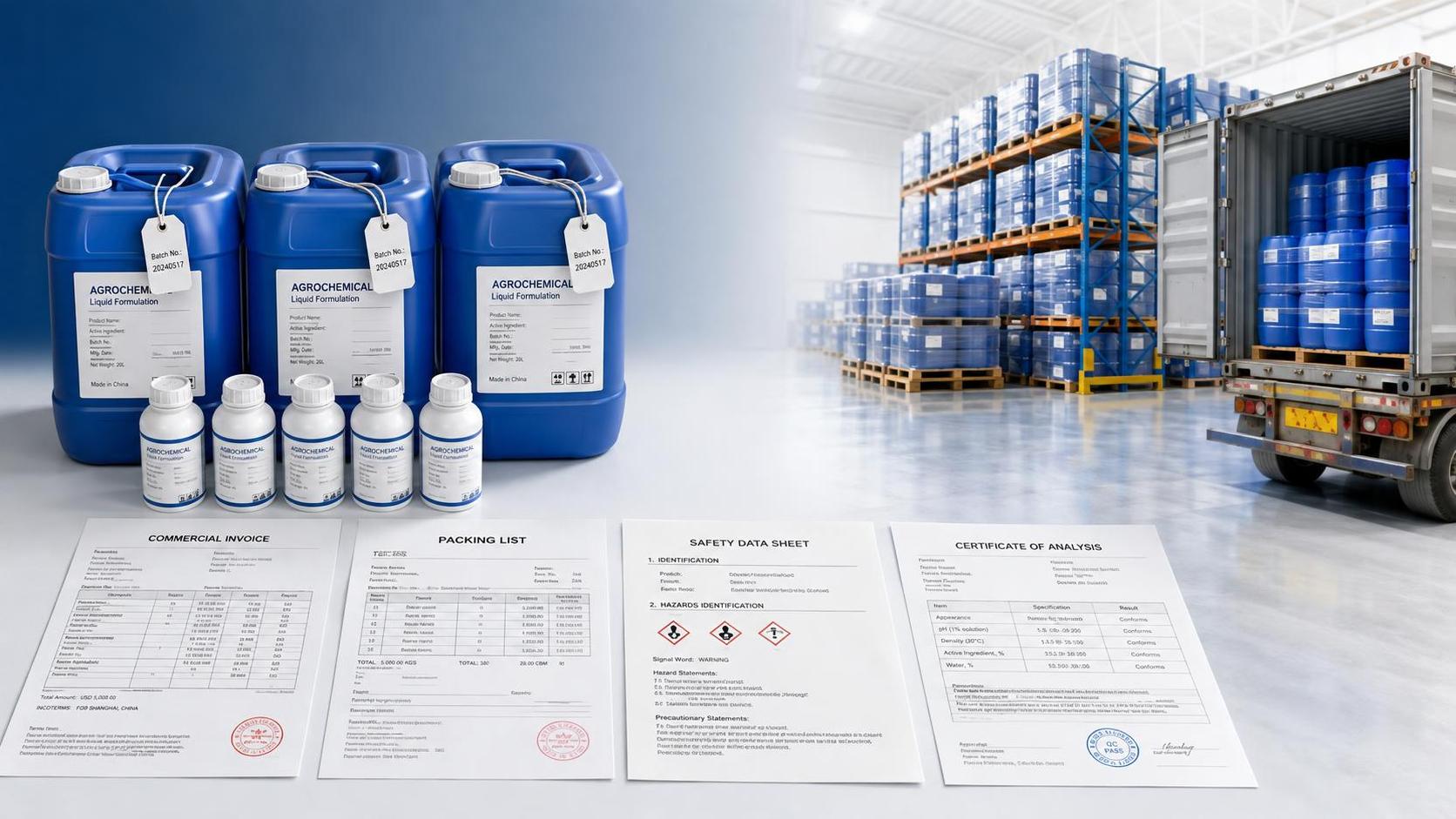
Agrochemical exports to Russia require a document set that proves three things at the same time: the product is legally permitted for the intended use, its composition and hazards are accurately declared, and the shipment matches the approved product information. Missing documents can delay customs release, block distribution, or create a mismatch between the registered product and the goods arriving at the border.
The exact file package changes with the product category, active ingredient, formulation, intended use, packaging format, and whether the product is already registered in Russia. A herbicide, insecticide, fungicide, seed treatment product, plant growth regulator, adjuvant, and fertilizer should not be treated as interchangeable categories merely because all are used in agriculture. Registration status and labeling rules are often the first points to confirm before production, packing, or shipment booking.
Start with Russian Product Registration Status
For crop protection products, registration is usually the controlling document. A pesticide or agrochemical intended for circulation in Russia generally needs to correspond to an approved registration entry before it can be imported and marketed. The registration record links the commercial product to details such as the active substance, formulation type, concentration, approved uses, application rates, hazard classification, packaging information, and label content.
A registration certificate, extract, or equivalent official confirmation should be reviewed against the actual shipment specification. The product name alone is not enough. A small difference in active ingredient concentration, formulation code, impurity profile, co-formulant, or intended crop use can mean that the imported product does not align with the registered item.
Pay close attention to formulation descriptions. For example, an emulsifiable concentrate and a suspension concentrate may contain the same active ingredient but are distinct formulations with different physical properties, solvents, surfactants, storage behavior, and label precautions. A registration for one should not be assumed to cover the other. The same issue arises when a product is supplied in a different pack size or when a private-label name is used instead of the name appearing in registration materials.
Where the shipment concerns fertilizers rather than regulated plant protection products, the documentation route may differ. Nutrient composition, contaminant limits, product classification, and conformity requirements can become more relevant than pesticide registration. Mixed products require extra care: a fertilizer containing pesticidal claims, biological components, micronutrients, or growth-regulating substances may be assessed differently from a conventional mineral fertilizer.
Core Commercial and Customs Documents
Customs documents establish the transaction, identify the cargo, and support classification and valuation. They should describe the goods consistently across every document. Discrepancies in product name, quantity, net weight, gross weight, unit of measure, package count, or country of origin create avoidable questions during clearance.
- Commercial invoice: States the seller and consignee, product description, quantity, price, currency, delivery terms, and payment terms. The description should identify the formulation and active ingredient where appropriate, rather than using a broad term such as “agricultural chemicals.”
- Packing list: Shows how the consignment is packed, including drum, bottle, bag, carton, intermediate bulk container, or pallet details. It should reconcile with transport documents and the physical cargo.
- Sales contract or purchase agreement: Supports the commercial basis of the shipment. Product specifications, Incoterms, quality provisions, and documentary responsibilities should not conflict with the invoice.
- Transport document: This may be a bill of lading, air waybill, rail consignment note, or road transport document. The named goods, shipper, consignee, weights, and number of packages must match the shipment records.
- Customs declaration data: Accurate product classification is essential because duties, controls, and documentary requirements may follow the customs code. Classification should be based on composition and function, not only on the trade name.
Many clearance problems originate before goods leave the factory. A formula expressed as “500 g/L” on the label, “50%” on the invoice, and “500 g/kg” in the safety data sheet can be technically different, even if those values appear similar at first glance. Liquid formulations commonly use mass-per-volume units, while solids are often stated by mass percentage. The declared basis must be consistent with the approved technical data.
Safety Data Sheet and Hazard Transport Records
A current safety data sheet is expected for chemical products and should be prepared in a form suitable for the Russian market, commonly in Russian or accompanied by an accurate Russian translation. It needs to reflect the actual commercial formulation, not merely the active ingredient or a generic product family.
The safety data sheet should identify the product and supplier, hazardous components, physical and chemical properties, toxicological information, environmental hazards, first-aid measures, fire response, accidental-release procedures, storage conditions, disposal considerations, and transport information. For agrochemicals, the most useful review points are often the composition range, flash point, pH, density, solubility, viscosity, environmental toxicity statements, and recommended personal protective equipment.
Transport classification must be checked separately from product registration. A registered agrochemical can still be dangerous goods for carriage because of flammability, corrosivity, acute toxicity, environmental hazard, or another transport classification. Where dangerous-goods rules apply, the shipment may require a dangerous goods declaration, correctly marked packages, approved packaging, emergency information, and carrier-specific documentation.
Do not assume that a non-flammable product is outside dangerous-goods controls. Certain water-based or low-odour formulations may still be regulated because of aquatic toxicity or acute health hazards. Conversely, a product’s agricultural hazard statements do not by themselves determine its transport class. The transport determination should be supported by formulation-specific test data and the applicable mode of transport.
Certificate of Analysis and Product Specification
A certificate of analysis, often called a COA, links the delivered batch to the agreed quality requirements. It should include the product name, batch or lot number, manufacturing date where applicable, test date, relevant specification limits, actual results, and an authorized release statement. The batch number must match the number printed on the package and shown in batch records.
For a pesticide formulation, the COA commonly addresses active ingredient content, appearance, pH, density, particle size or suspensibility where relevant, emulsion stability, wet sieve residue, moisture, and other formulation-specific parameters. A technical material COA may focus more heavily on active ingredient assay, related impurities, water content, acidity or alkalinity, melting range, and physical form.
The COA should not be copied from an unrelated lot. Customs authorities, registration holders, distributors, and downstream laboratories may compare the document against retained samples or test results. A batch certificate that contains vague wording such as “conforms to standard” without identifying the tested properties offers weak support when a question arises about quality or composition.
A separate technical specification is useful when it clearly defines the supplied product. It should state the formulation type, active ingredient and concentration, permitted tolerances, appearance, storage temperature, shelf life, packaging material, and handling limitations. This specification must remain aligned with the registered product dossier, safety data sheet, and label.
Labeling Must Match the Approved Product
Russian-language labeling is a practical and regulatory requirement for imported agrochemicals. The package label should be treated as a controlled document, not as a late-stage translation exercise. It needs to correspond to the product registration and safety information, while also identifying the imported lot correctly.
Typical label content includes the product name, formulation, active ingredient information, purpose and approved uses, hazard pictograms and warning statements where applicable, precautionary measures, storage conditions, first-aid instructions, disposal directions, net content, batch number, manufacturing or expiry information where required, country-of-origin details, and responsible party information. The exact content and format depend on product classification and applicable Russian requirements.
Several label errors recur in agrochemical shipments. One is translating the trade name accurately while translating the application instructions from a different formulation. Another is using a hazard classification taken from the technical active ingredient rather than the diluted commercial product. A third is leaving the lot number off the Russian over-label even though the underlying container carries it in another language. These errors can make it difficult to establish a reliable connection between registration, label, COA, and physical goods.
Over-labeling should be evaluated before shipment. Applying Russian labels after arrival may be restricted by the product category, customs procedure, warehouse controls, or the requirement that safety information be available at the point of import. Labels should also remain legible throughout normal storage and transport. Adhesives that fail on high-density polyethylene drums, low-temperature containers, dusty bags, or solvent-exposed surfaces create compliance issues even when the wording was initially correct.
Origin, Conformity, and Supporting Certificates
A certificate of origin may be needed to support tariff treatment, trade documentation, customer requirements, or customs verification. The country of origin should be supported by production records and should be consistent across the invoice, packing list, label, and certificate. The country where cargo is loaded is not necessarily the country of origin.
Additional conformity documents may be required depending on the product classification and the rules applied to that class of goods. These can include declarations, certificates, test reports, or other evidence of conformity. The relevant route should be confirmed for the finished commercial product, not inferred from a similar chemical. A technical-grade active ingredient, a formulated pesticide, and a foliar fertilizer may be subject to different requirements even when supplied under related product names.
Analytical reports can be particularly important when a product contains controlled substances, has a restricted impurity profile, or requires confirmation of a declared nutrient or active ingredient level. Reports should identify the laboratory, sample, method where provided, date, and product batch. A test report without a clear sample-to-batch connection has limited value in a document review.
Build the Shipment File Around One Product Identity
The most reliable approach is to establish a master product identity before finalizing export paperwork. This identity should include the exact commercial name, technical name where relevant, formulation type, active ingredient concentration and unit, customs classification, package size, batch number format, hazard status, registration reference, and label version. Each document can then be checked against the same reference.
- Confirm whether the item is a registered plant protection product, a fertilizer, a technical material, or a mixed-use product with a separate compliance route.
- Compare the approved registration details with the production formula, specification, COA template, and Russian label artwork before the batch is packed.
- Determine transport classification from the finished formulation and chosen mode of transport. Prepare dangerous-goods records when applicable.
- Issue the invoice, packing list, transport document, origin evidence, and batch documents using the same product description and units of measure.
- Retain controlled copies of the registration evidence, label, safety data sheet, COA, and shipping records so that questions after arrival can be answered against the shipped batch.
Document dates also deserve attention. A safety data sheet revision date, registration validity period, certificate issuance date, manufacturing date, and product shelf life should not contradict one another. A valid registration does not correct an expired product, and a current safety data sheet does not prove that a particular batch meets specification.
Points That Commonly Cause Rework
Trade names are often treated as the primary identifier, yet agrochemical compliance depends more heavily on the full product identity. Two products with nearly identical names may differ in formulation, concentration, or use pattern. The same name may also appear on a technical material and a finished formulation, which should be documented separately.
Pack size changes deserve a document review as well. Changing from a 1-litre bottle to a 5-litre container can affect label layout, transport packaging, pallet configuration, net-weight calculations, and sometimes the packaging information tied to the registered product. It should not be handled merely as a logistics adjustment.
Finally, ensure that translated documents preserve technical meaning. Terms for concentration, dilution, application rate, storage temperature, protective equipment, and disposal must be translated with chemical accuracy. A wording change that appears minor can alter a safety instruction or create a conflict with the registered use directions. The export file should read as one consistent account of the exact product being shipped.
Send Us Your Inquiry Today
