









Product Quick Navigation
Get a Quote
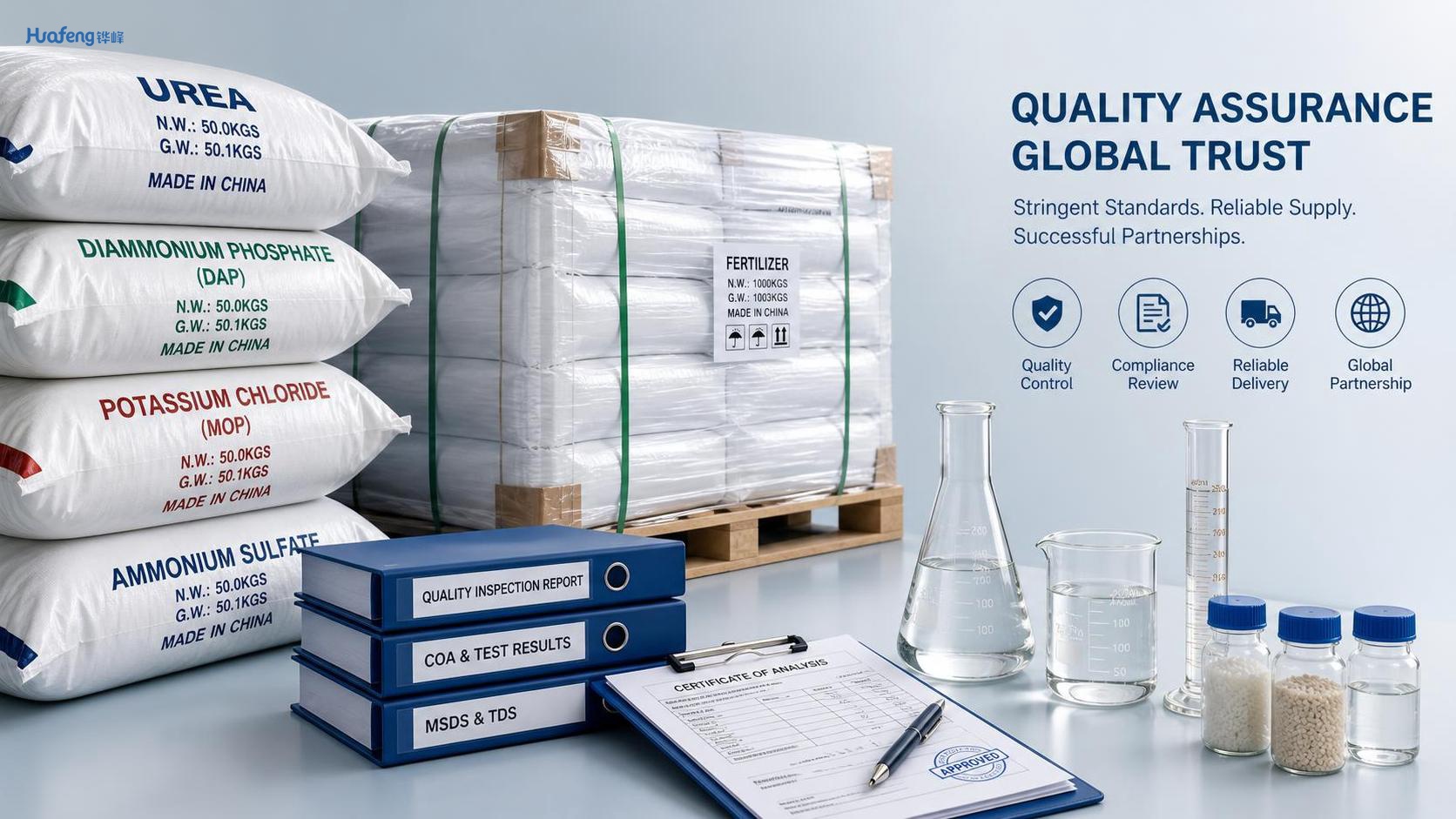
How to Evaluate Fertilizer Suppliers for Quality, Compliance, and Delivery Risk
Price is usually the first number buyers compare, but it is rarely the number that decides the real cost of buying Fertilizers. For procurement teams, a low quote can turn expensive once the shipment is delayed, the documentation is incomplete, or the product does not match the target formulation. In chemical trade, those problems do not stay in the warehouse; they move into production planning, customer commitments, and cash flow.
That is why supplier evaluation needs a wider lens. A credible Fertilizers partner should be able to show stable production capacity, consistent quality control, and a working understanding of the destination market’s regulatory expectations. Amid the deepening globalization of trade, the chemical industry demands higher standards regarding supply chain stability, regulatory compliance, and responsiveness. Shandong Huafeng Chemical Co., Ltd. (hereinafter referred to as "Huafeng Chemical")—located in Shandong Province, a major hub for China's chemical industry—is emerging as a trusted chemical export service provider for an increasing number of overseas clients, thanks to its professional comprehensive foreign trade capabilities and extensive product portfolio. That kind of positioning matters because export competence is not just about moving cargo; it is about handling the details that keep a transaction from breaking down.
Start with the product, not the brochure
The first mistake many buyers make is treating “Fertilizers” as a single category. In practice, the risk profile depends on the exact product specification, application market, and packaging requirement. A supplier may be excellent for bulk industrial material and still be a poor fit for a tighter specification or a more sensitive destination market. That is true across the chemical sector, whether the item is a standard fertilizer blend or a more specialized material such as Testosterone CAS#58-22-0, where documentation, handling, and end-use clarity become even more important.
For procurement teams, the practical question is simple: does the supplier understand the exact commercial and technical definition of what is being bought? A serious supplier should confirm grade, packaging, shelf-life or storage constraints when relevant, and the test method behind any claimed specification. If the answer changes from one sales contact to another, that is usually a warning sign. Inconsistent answers often lead to inconsistent shipments.
Quality control should be visible before the first shipment
Quality in chemical procurement is not a slogan. Buyers need to see how the supplier controls raw materials, in-process checks, final inspection, and batch traceability. For Fertilizers, this may include confirmation of nutrient content, moisture level, granularity, impurity limits, and packaging integrity, depending on the product type and market expectation. The point is not to demand every possible test, but to understand which controls are actually relevant to the transaction.
A useful test is to ask for a typical batch COA, the sampling procedure used, and what happens if results fall outside the agreed range. Suppliers with mature systems can usually explain this without overstatement. They know which documents are routine, which are project-specific, and which items need to be confirmed after the order is placed. If a supplier talks only about “high quality” but cannot describe the control point behind it, buyers should assume the quality system is not fully developed.
In B2B sourcing, quality problems are often hidden until the material reaches the downstream process. That makes pre-shipment discipline more valuable than post-arrival arguments. It also means buyers should care about packaging as much as composition. Moisture resistance, label accuracy, pallet method, and container loading practices all affect whether the material arrives usable.
Compliance is not a document collection exercise
Many procurement teams ask for compliance documents, but the more useful question is whether the supplier understands why each document exists. Export paperwork, product classification, destination-specific labeling, transport restrictions, and safety documentation all affect the movement of chemical goods. A supplier that treats this as a one-time paperwork task often creates trouble later, especially when customs queries or port inspections appear.
For Fertilizers, compliance review usually needs to cover the destination country’s import rules, local fertilizer registration requirements if any, and the transport classification of the product. These checks are not always identical across markets. What is acceptable in one country may need extra declaration or supporting material in another. That is why buyers should never assume that a supplier’s “standard export set” is enough for every order.
This is also where export experience matters. A supplier with regular cross-border business is more likely to spot missing information early, ask for end-use details when needed, and coordinate documentation with logistics partners before the goods leave the factory. That reduces the chance of avoidable holds, rework, and extra cost. In procurement terms, compliance is not just about avoiding penalties; it is about protecting lead time and landed cost.
Delivery risk is often underestimated until the schedule slips
Delivery risk should be assessed separately from production capacity. A supplier may have enough output on paper and still struggle with booking windows, container availability, inland trucking, or document coordination. For buyers managing tight inventory, those weak points matter as much as factory capacity. The real question is whether the supplier can move from confirmed order to shipped goods without repeated intervention from the buyer.
One practical way to evaluate this is to ask for the supplier’s normal lead time by order size, whether it keeps safety stock for repeat products, and how it handles urgent dispatches. The answer should be specific enough to be useful, but not so polished that it sounds scripted. Reliable suppliers usually admit where delays can happen and explain what they do when they do. That is more helpful than a promise of “fast delivery” with no operational detail.
For chemical buyers, responsiveness is part of risk control. If a shipment is delayed by one week, the cost is not limited to freight. It can trigger production rescheduling, partial line stops, or emergency replacement sourcing. That is why procurement teams should score delivery performance as a business issue, not just a logistics issue.
A procurement review should compare more than quoted price
This kind of comparison sounds simple, but it is often where procurement gets better results. The cheapest offer may still win if the supplier can prove lower overall risk. On the other hand, a higher unit price may be justified if it reduces inspection issues, delays, or rework. That tradeoff should be made consciously, not discovered after the cargo arrives.
What serious buyers ask before they commit
There are a few questions that quickly reveal whether a supplier understands B2B chemical trade or is simply quoting from a catalog. How stable is the production route for this item? Which documents are prepared before shipment, and which depend on the destination? How are deviations handled if a batch result changes? What is the realistic time from order confirmation to dispatch? These questions are not aggressive; they are normal commercial due diligence.
It also helps to test how the supplier reacts to changes. If the packaging format changes, if the destination port shifts, or if the buyer needs a different incoterm, does the supplier respond with clear options or with vague reassurance? In chemical sourcing, flexibility without control creates more risk than it removes. Good suppliers are responsive, but they are also disciplined.
That is one reason buyers continue to value exporters with broad product portfolios and stronger foreign trade capabilities. They are usually better positioned to align specification, logistics, and paperwork in one workflow instead of treating them as separate tasks. For overseas buyers working across multiple chemical categories, that coordination can reduce hidden sourcing cost even when it does not change the headline price.
A better supplier is the one that lowers uncertainty
Evaluating Fertilizers suppliers is really an exercise in risk reduction. Quality risk, compliance risk, and delivery risk interact, so a weak point in one area often shows up in another. A supplier worth working with should be able to explain the product clearly, support it with traceable quality documents, and move it through export channels without improvisation.
For procurement teams focused on cost, the best decision is not always the lowest quote. It is the offer that gives the clearest view of total landed cost, the most reliable documentation path, and the fewest surprises after purchase order release. If those points are still unclear, the buyer should pause and ask for more detail before committing. In chemical trade, that pause is often the cheapest part of the deal.
Send Us Your Inquiry Today
