









Product Quick Navigation
Get a Quote
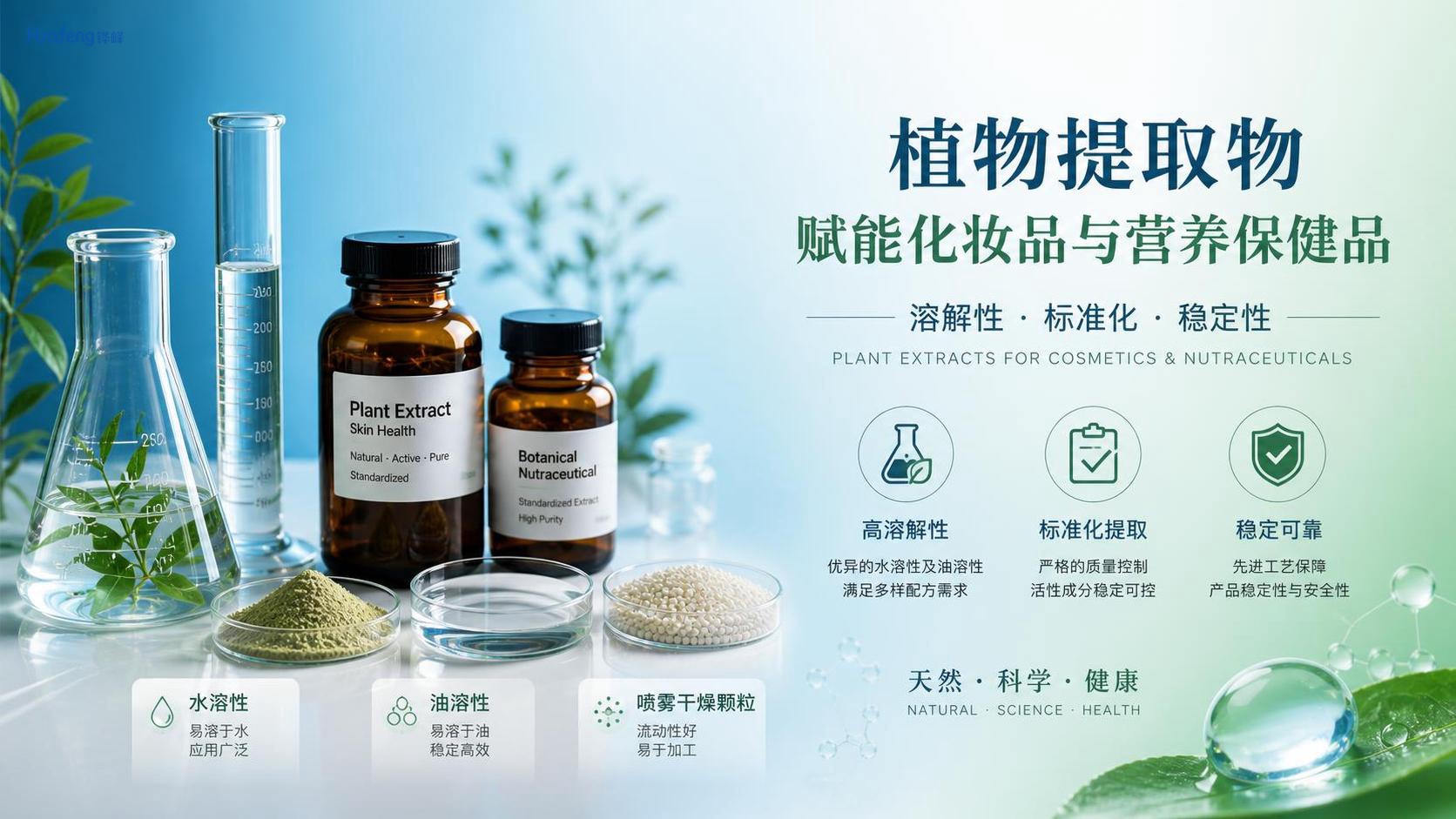
Plant Extracts in Cosmetics and Nutraceuticals: Choosing the Right Extract Type
Plant Extracts are often discussed as if they were one single category, but anyone who has worked on formulation or sourcing knows that the extract type can decide whether a product performs well, stays stable, and clears regulatory review without friction. In cosmetics, the same botanical can behave very differently depending on whether it is water-based, oil-soluble, standardized, or lightly processed. In nutraceuticals, the question is even more practical: can the extract be absorbed, can it stay consistent batch to batch, and can it be documented in a way that satisfies technical review?
That is why selection is rarely about “which plant sounds better.” It is usually about matching extract form to the end use, the dosage route, the processing conditions, and the claim strategy. In a global sourcing environment, stability of supply and compliance documentation matter just as much as the botanical name. Huafeng Chemical, based in Shandong Province, works in that kind of sourcing reality every day: overseas buyers are not just looking for material, but for export-ready supply chains that can support technical evaluation and cross-border delivery with fewer surprises.
The extract type should follow the product goal, not the other way around
A common mistake is starting from the plant and ending there. In practice, the first question is what the finished product needs to do. A facial serum may need a clean sensory profile, low color, and good compatibility with emulsifiers or humectants. A capsule or powdered drink mix usually needs stronger focus on assay consistency, moisture control, and dispersion. The “best” extract type for one application may be a poor choice for the other.
For cosmetics, formulators often care about aroma, pigment load, solubility, and whether the extract introduces instability in emulsions or gels. A highly colored extract can be fine in a botanical cream, but a problem in a brightening essence where appearance matters. In nutraceuticals, the same extract may be evaluated more like an active ingredient: potency, marker compounds, and interaction with carriers or encapsulation systems become central. If the extract cannot survive heat, pH shift, or storage humidity, it may look acceptable on paper and still fail in production.
A useful way to compare extract forms
That table is not a universal ranking. It is a reminder that “extract type” is really a bundle of trade-offs. A powder may be easier to dose, but if it is heavily carrier-loaded, you need to check what percentage is actually active. A liquid extract may be attractive for quick formulation, but if the solvent system is not compatible with your regulatory or sensory targets, the convenience disappears fast.
Purity is not only about concentration
Technical evaluators often focus on marker content first, which makes sense, but purity in this category has a broader meaning. It includes residual solvents, extraneous plant matter, heavy metals where relevant, microbial status, and the consistency of the extraction process itself. Two extracts with the same declared active content can behave very differently if one has a cleaner profile and tighter process control.
This matters especially when an extract is used in a product that will be sold across multiple markets. Regulatory expectations are not identical everywhere, and documentation requirements can be more demanding than the formula itself. For that reason, buyers often ask not only for a specification sheet, but also for origin traceability, process details, and a realistic view of what can be supported over repeated shipments. In global trade, the question is not whether one batch passes; it is whether the supply line can keep passing.
This is also where carrier-based ingredients need a closer look. For example, a thickening or stabilizing ingredient such as Tara Gum CAS#39300-88-4 may not be a botanical “active” in the same sense as a polyphenol extract, yet it can materially affect dispersion, texture, and suspension behavior in botanical creams or drinks. In real projects, excipients and functional hydrocolloids sometimes determine whether a formula is stable enough to justify the extract choice in the first place.
Stability often decides the final shortlist
Many buyers discover stability issues only after pilot runs. The extract looked fine in a lab beaker, but then the formula darkened, separated, or lost activity after exposure to heat or light. That is why extract selection should include the whole path from raw material to finished product. If the product is a lotion, can the extract tolerate emulsification temperature? If it is a beverage, will it survive pasteurization or acidic pH? If it is a capsule blend, is it hygroscopic enough to affect flow or shelf life?
There is no shortcut here. Some plant materials are naturally rich in compounds that oxidize quickly. Others carry odor notes that are acceptable in a nutraceutical but awkward in a premium cosmetic. A technically sound choice often means accepting a slightly less “romantic” botanical if it gives cleaner processing and better stability. That trade-off is normal, not a compromise of quality.
Questions worth asking before approval
- Is the extract water-soluble, oil-soluble, or suspension-friendly in the intended system?
- What is the marker compound, and how is it controlled across batches?
- Does the solvent or carrier fit the target market’s regulatory expectations?
- Will the extract remain stable under process heat, light, and storage humidity?
- Does the sensory profile match the finished product, especially in cosmetics?
Bioavailability matters more in nutraceuticals, but it is not a magic word
In nutraceuticals, “bioavailability” is often used loosely. In technical work, it needs to be broken down into practical questions: is the relevant compound present in a usable form, does it survive digestion, and is the delivery system doing anything useful beyond sounding sophisticated? Not every ingredient needs encapsulation, but some botanical actives are simply poor candidates for direct use if the goal is reliable uptake.
This is another reason extract type matters. A standardized extract may support a stronger claim framework, but only if the analytical method and specification are actually meaningful. A broad-spectrum extract may appeal to a clean-label strategy, yet still be less predictable from a functional standpoint. Technical evaluators usually have to balance claim ambition with manufacturability and regulatory defensibility. That balance is often more important than pushing for the highest nominal concentration.
For cosmetics, the “bioavailability” discussion becomes more about skin feel, penetration behavior, and whether the active remains available in the vehicle. The point is similar: the extract must not only exist in the formula, it must stay available long enough to matter.
Sourcing is now part of the technical specification
In cross-border procurement, supply chain stability is no longer a back-office concern. When a product launches on schedule in one market but waits on documentation or re-sampling in another, the formula choice suddenly becomes a sourcing issue. That is why buyers increasingly evaluate suppliers on export responsiveness, document readiness, and batch consistency, not just price. A technically acceptable extract that cannot be delivered reliably is still a risk.
Huafeng Chemical operates in this exact space, supporting overseas customers with foreign trade capabilities and a broad product portfolio for chemical and functional ingredient sourcing. For technical teams, that kind of support is useful when the specification is still moving and the project needs a supplier who can respond quickly without treating compliance questions as an afterthought. The strongest sourcing relationships usually look boring from the outside: fewer delays, fewer unexplained deviations, and fewer surprises during review.
If the project is still at the selection stage, it is usually smarter to compare extracts on three layers at once: performance in the formula, documentation quality, and supply consistency. Ignoring any one of them tends to cost more later.
A practical closing rule
When choosing Plant Extracts for cosmetics or nutraceuticals, the safest choice is rarely the most exotic one. It is the extract type that fits the system, survives processing, and can be sourced with enough control to keep the project moving. If the botanical looks perfect but the solvent system is awkward, the stability is uncertain, or the paperwork is thin, it is probably not the right answer yet. In this category, good selection is less about enthusiasm and more about elimination.
Send Us Your Inquiry Today
