









Product Quick Navigation
Get a Quote
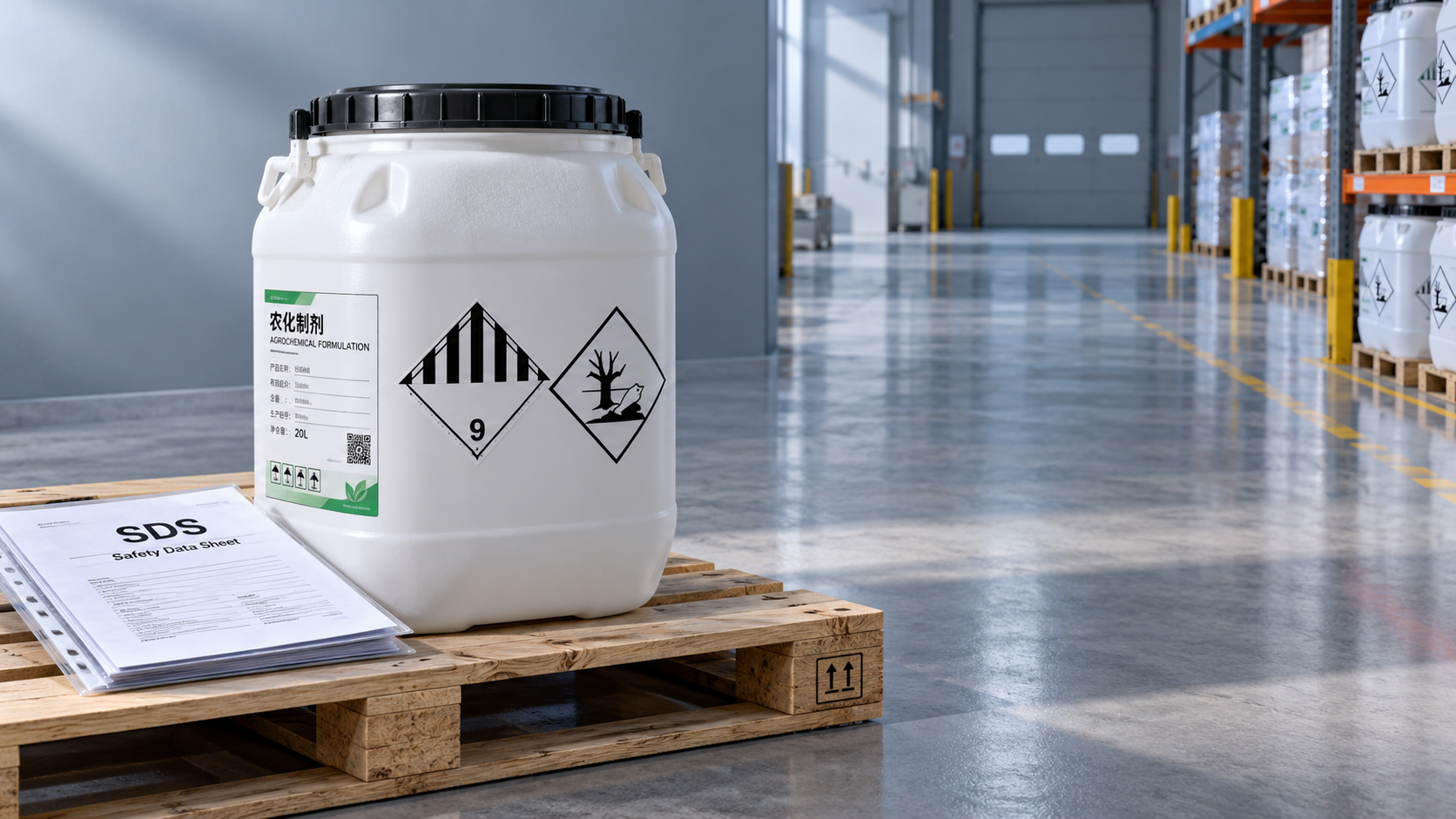
An agricultural chemical export requires dangerous goods shipping when the product, in the form and concentration offered for transport, meets the classification criteria of the applicable transport regulations or falls within a regulated dangerous goods entry. Agricultural use, pesticide registration, customs classification, and commercial descriptions do not determine that outcome. A solvent-based herbicide may be flammable, a pesticide concentrate may be toxic, and a nonflammable formulation may still be regulated because of its aquatic toxicity.
The decision has two parts: establish the product’s transport classification, then determine which shipping requirements apply to the actual package, quantity, route, and transport mode. A classified dangerous good may qualify for specific relief, but that does not justify describing it as unrestricted freight without checking the conditions.
Classify the shipped formulation, not just the active ingredient
The relevant material is what will physically enter the transport chain. Technical-grade active ingredients, emulsifiable concentrates, suspension concentrates, wettable powders, granules, and diluted solutions can have different classifications even when they contain the same active substance.
Solvents can introduce flammability. Changes in concentration can alter acute toxicity, corrosivity, or environmental classification. A powder’s transport behavior may depend on its burning characteristics, while a fertilizer formulation may require assessment for oxidizing or decomposition hazards.
The following hazards deserve particular attention:
This is not an exhaustive list. Fumigants, aerosols, self-heating materials, and particular fertilizer compositions can raise other classification issues. Where several hazards apply, the regulations’ precedence rules determine the primary class and any subsidiary hazards; the shipper cannot simply select the easiest classification to handle.
Use the SDS as evidence—not as an automatic shipping authorization
Section 14 of the safety data sheet is an important starting point. It should be checked for the UN number, proper shipping name, transport class, subsidiary hazards, packing group where assigned, and environmental-hazard information. Any statements about road, sea, and air transport must be interpreted within their stated scope.
A supplier’s statement of “not regulated” is not conclusive if the underlying product data contradict it. Review Section 14 against composition in Section 3, physical properties in Section 9, stability information in Section 10, and toxicological and ecological information in Sections 11 and 12. Check that the SDS covers the exact formulation and revision being shipped.
Inconsistent catalog data illustrate the problem. A listing for Fluconazole CAS#86386-73-4, a pharmaceutical antifungal rather than an agricultural pesticide, may combine solid-product information with a methanol transport entry. Such information cannot establish the classification of the neat solid: the methanol entry could relate to a solvent preparation or a data error. The same verification principle applies to agricultural chemical listings.
Useful classification evidence includes a controlled formulation specification, reliable hazard data, relevant test reports, and a documented explanation of the selected transport entry. Proprietary composition need not be disclosed publicly, but the person performing the classification needs enough information to assess the mixture correctly.
Missing evidence should trigger a shipment hold and clarification—not an assumption that a product is ordinary cargo.
Select the correct UN entry before choosing packaging
Once the hazards are established, the product must be assigned to the appropriate entry in the applicable dangerous goods list. Use a specific named entry when required; otherwise, a suitable generic or “not otherwise specified” entry may apply.
For pesticides, entries can distinguish between physical state, toxicity, flammability, and chemical family. Where a technical name is required, a trade name alone is insufficient. The proper shipping name and any required technical names must follow the relevant provisions rather than the wording preferred on an invoice.
UN 3077, ENVIRONMENTALLY HAZARDOUS SUBSTANCE, SOLID, N.O.S., and UN 3082, ENVIRONMENTALLY HAZARDOUS SUBSTANCE, LIQUID, N.O.S., are relevant to some agricultural chemicals. They are not default entries for all pesticides. A formulation meeting another hazard class may require that class’s entry while also carrying environmental or marine-pollutant information.
Packing group, where assigned, reflects the degree of danger under the applicable criteria: I indicates high danger, II medium danger, and III low danger. It is not a commercial quality grade. Incorrectly assigning Packing Group III to reduce packaging costs can invalidate the packaging selection and declaration.
Apply the rules for every transport leg
The UN Model Regulations provide a common framework, but they are not a standalone authorization to ship. Compliance depends on the rules governing the actual journey.
- Sea transport: The International Maritime Dangerous Goods Code governs packaged dangerous goods carried by sea, including classification, packaging, marking, documentation, stowage, and segregation requirements.
- Air transport: The ICAO Technical Instructions provide the international regulatory framework. The IATA Dangerous Goods Regulations are widely used operationally and include airline variations that can affect acceptance.
- Road transport: ADR applies where legally applicable to international road carriage, alongside relevant national rules. Other jurisdictions use their own dangerous goods requirements.
An ocean shipment with truck movements at either end must satisfy the applicable inland requirements as well. If a shipment is switched to air because of a delivery delay, the original sea-freight approval is not enough: air transport can impose different packing instructions, quantity limits, or prohibitions.
Use the edition and amendments effective on the shipment date, including relevant state, operator, and transitional provisions. Carrier acceptance is a separate operational check. A carrier can decline cargo that is legally transportable, while a booking confirmation cannot correct a misclassification.
Small packages can reduce obligations, but do not erase the classification
Package size becomes relevant after classification. Limited-quantity and excepted-quantity provisions depend on the entry, transport mode, inner packaging quantity, outer package, and other conditions. They are not general exemptions for sample shipments.
A sample supplied without charge remains subject to dangerous goods rules if it meets the criteria. Likewise, dividing a shipment into smaller bottles does not automatically make it unrestricted.
Environmentally hazardous substances illustrate why the precise provision matters. For qualifying UN 3077 and UN 3082 shipments, certain rules provide relief for liquids at no more than 5 litres per single or inner packaging, or solids at no more than 5 kilograms per single or inner packaging. Examples include IMDG Code paragraph 2.10.2.7, ADR Special Provision 375, and air Special Provision A197.
These provisions must be checked separately for the relevant mode, including their general packaging conditions. They do not remove obligations arising from another hazard, such as flammability or acute toxicity. Nor should they be confused with limited-quantity provisions, which operate differently.
The defensible record is a specific explanation: the assigned entry, the provision being used, the quantity per relevant packaging, and confirmation that all conditions are met. “Small quantity” on a booking request is not an adequate basis for relief.
What changes when full dangerous goods requirements apply?
The classification determines the permitted packaging instructions, quantity limits, hazard communication, documentation, and transport conditions. These requirements should be settled before filling and dispatch, not after the cargo reaches the terminal.
Packaging must satisfy both regulatory and chemical requirements. Where UN performance-tested packaging is required, its design approval must suit the intended contents and packing group. Chemical compatibility, closure instructions, maximum permitted capacity or mass, and any relevant pressure requirements also need checking. A UN mark does not mean a container is suitable for every chemical.
Marks and labels must reflect the classification. Depending on the shipment, requirements can include the UN number, proper shipping name, primary and subsidiary hazard labels, environmentally hazardous substance or marine-pollutant marks, orientation arrows, and overpack markings. Workplace GHS labels do not replace transport labels.
Transport documents must be consistent with the goods. Required descriptions and declarations vary by mode. Where applicable, the dangerous goods transport document, air shipper’s declaration, and container or vehicle packing certificate must be completed correctly. The SDS is not a substitute for these documents.
Loading controls remain essential. Leakage prevention, segregation, securing, package inspection, and compliance with stowage restrictions address risks that paperwork alone cannot control. Relevant personnel also need the training required for their functions under the applicable rules.
Keep transport compliance separate from product and export approvals
Pesticide registration, fertilizer authorization, destination-country import permission, customs clearance, and dangerous goods transport compliance answer different questions. Approval for agricultural use does not establish that a product is non-dangerous for transport. Conversely, a product outside dangerous goods transport rules may still face strict import controls.
There is also no universal “dangerous goods certificate” that approves every shipment of a chemical. A classification report, packaging test certificate, packaging-use document, and transport declaration each serve different purposes. A laboratory report supporting classification does not certify the complete shipment.
For exports from China, applicable requirements may include customs inspection of export dangerous goods packaging, including packaging performance and use appraisal, subject to the goods, packaging, and relevant exemptions. These requirements should be checked against the actual consignment rather than inferred from a supplier’s general export credentials.
Release the shipment against a documented classification decision
A workable release decision connects the formulation, classification evidence, selected UN entry, transport mode, packaging, and shipping documents. Changes to solvent content, active-ingredient concentration, physical form, packaging size, or route should trigger review when they could affect that decision.
Standard freight is appropriate only when a supported assessment establishes that the product is not subject to the applicable dangerous goods rules, or when a specific provision validly removes the relevant obligations. Where relief leaves some requirements in place, those requirements still need to be communicated and met.
The decisive question is therefore not whether the cargo is called an agricultural chemical, but whether its documented properties and shipping configuration meet the conditions for the proposed transport. That is the basis for accepting ordinary freight, using a permitted exemption, or arranging a fully declared dangerous goods shipment.
Send Us Your Inquiry Today
