









Product Quick Navigation
Get a Quote
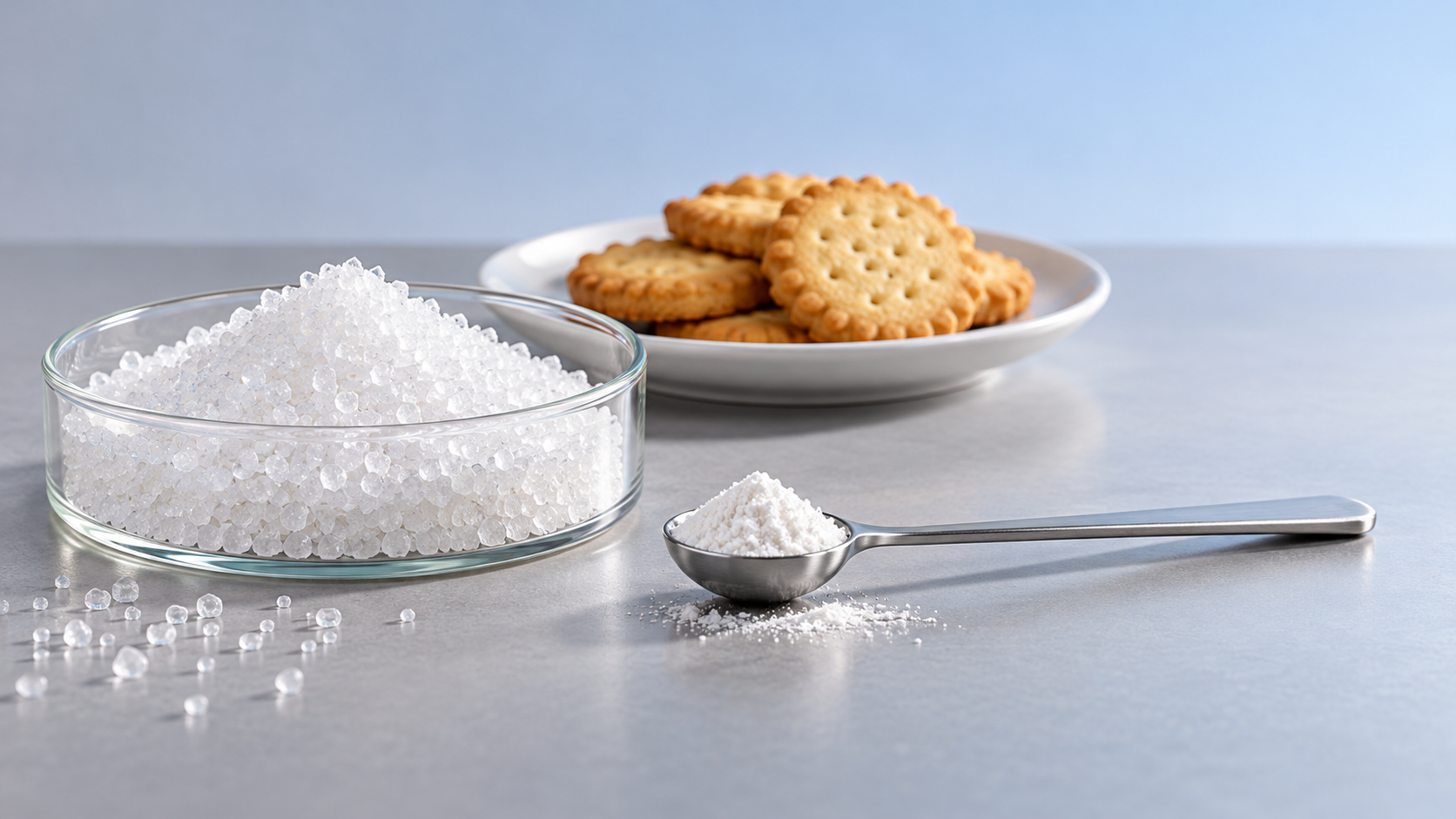
Bulk sweeteners supply sweetness along with substantial ingredient mass; high-intensity sweeteners provide strong sweetness at much lower use levels. That difference becomes important when replacing sugar in a recipe. A beverage may need relatively little structural adjustment, while a biscuit or frozen dessert can lose texture, volume, or processing performance even when its sweetness seems correct.
Food sweeteners therefore cannot be compared on sweetness alone. Bulk ingredients can influence moisture retention, crystallization, freezing behavior, and mouthfeel. High-intensity options mainly address sweetness and usually cannot reproduce those functions by themselves. The practical question is not simply which ingredient tastes sweeter, but which jobs sugar performs in the particular food.
The two categories describe function, not just calorie content
In broad formulation terms, bulk sweeteners are ingredients used in appreciable quantities that contribute both sweetness and solids. Sugars such as sucrose, glucose, and fructose perform this role. In sugar-reduction discussions, however, “bulk sweetener” often refers more specifically to sugar alcohols, also called polyols, such as sorbitol, maltitol, xylitol, and erythritol.
Those meanings should be distinguished when reading specifications or comparing ingredients. A supplier discussing bulk sweeteners may mean polyols rather than every carbohydrate that adds sweetness and mass. The category does not automatically mean sugar-free, calorie-free, or suitable for every reduced-sugar claim.
High-intensity sweeteners include ingredients such as sucralose, acesulfame potassium, aspartame, saccharin, steviol glycosides, and monk fruit extracts standardized for sweetening components. Their sweetness is much greater than sucrose on a weight basis, although relative intensity varies with concentration, food composition, and sensory conditions.
“High-intensity” is not a synonym for “artificial.” It describes sweetening strength rather than origin. Likewise, a plant-derived ingredient is not automatically a bulk sweetener or a direct replacement for sugar.
What disappears when sugar is removed?
Consider a biscuit formula in which sucrose is replaced only with enough high-intensity sweetener to match the original sweetness. The formula now contains much less material. Keeping the remaining ingredients unchanged does not preserve the original proportions, dough behavior, or baked structure.
Sugar affects how water is distributed, how dough spreads, and how the product develops color and texture. Some sugars also participate in browning reactions; sucrose behaves differently from reducing sugars. A polyol may restore solids without reproducing the same browning behavior. Matching ingredient weight is therefore only a starting point.
In frozen desserts, dissolved sweeteners influence freezing-point depression and the amount of unfrozen water. Replacing sugar with a tiny amount of an intense sweetener can produce a harder product unless the rest of the formulation is adjusted. Different bulk sweeteners also affect freezing differently, so equal weights need not give equal scoopability.
Preservation requires separate attention. Sugar can lower water activity when present at sufficient concentration. Removing it from a jam, filling, or syrup may change microbial stability. Restoring viscosity with a gum does not necessarily restore water activity or shelf life; those properties need appropriate measurement and validation.
Equal sweetness does not mean equal taste
Sucrose is a useful sensory reference because sweetness develops and fades in a familiar way. Other sweeteners may have a slower onset, a longer finish, or accompanying bitter, metallic, licorice-like, or cooling sensations. These effects depend on the specific ingredient and its concentration, not simply its category.
Some polyols create a noticeable cooling sensation as they dissolve. That can suit a mint confection but feel out of place in a creamy filling. High-intensity sweeteners may leave lingering sweetness that changes how fruit acids, cocoa, coffee, or flavorings are perceived.
Blending can help separate these problems. One ingredient may supply bulk, another may raise sweetness, and a combination of intense sweeteners may produce a more acceptable sensory profile than either alone. Such blends still need testing: sweetness contributions are not always simply additive.
Evaluate candidates in the finished product at its intended serving temperature. A sweetener screened only in water may behave differently in an acidic drink, a protein-rich dessert, or a fat-containing filling. Include aftertaste and mouthfeel in the assessment rather than judging only the first impression of sweetness.
Calories, digestion, and label claims need separate checks
Ordinary sugars provide energy. Many polyols provide less energy than sugars, but their energy values differ, and local labeling rules may assign different factors. Erythritol should not be assumed to behave nutritionally like maltitol or sorbitol merely because all three belong to the polyol group.
High-intensity sweeteners generally contribute little energy at normal use levels because the required quantity is small. A retail packet or spoonable blend, however, can contain carriers or bulking ingredients. The nutrition of the complete mixture cannot be inferred from the intense sweetener alone.
Digestive tolerance is another distinction. Certain polyols may cause gastrointestinal discomfort or laxative effects, particularly at higher intakes. Evaluate the amount per serving and plausible total consumption, not only the percentage in the formulation. Applicable warning-label requirements also need checking in the destination market.
“Reduced sugar,” “sugar-free,” and “low calorie” are different claims. Replacing sugar with another ingredient does not automatically qualify a product for all of them. Nor does a sweetener’s calorie content alone establish the finished food’s blood-glucose effect or suitability for an individual dietary need.
Choosing a system for the actual application
Beverages: start with sweetness and stability
In a clear flavored drink, sugar’s structural role may be relatively limited compared with its role in confectionery. High-intensity sweeteners can therefore be practical when the goal is sweetness with little added energy. Nevertheless, removing dissolved sugar may reduce body and alter the balance between sweetness and acidity.
Selection should reflect beverage pH, processing temperature, storage conditions, and expected shelf life. Aspartame, for example, has heat and storage limitations that must be evaluated for the intended process. No assumption that all intense sweeteners are equally stable under heat or acidic conditions is reliable.
Baked goods and confectionery: solve the solids problem first
A biscuit, chewy candy, or hard confection needs more than a sweetness target. Start by identifying whether the original sugar supplies crystalline structure, a glassy phase, moisture control, browning, or dough-processing properties. Candidate bulk sweeteners should be screened against those functions before fine-tuning sweetness with an intense sweetener.
Watch for changes after production as well as during mixing. An acceptable freshly made sample may become sticky, grainy, soft, or dry during storage. Water absorption and crystallization behavior often explain these failures better than sweetness intensity does.
Dairy and fruit desserts: keep ingredient roles separate
Yogurt-style products and fruit desserts may require a combined adjustment to sweetness, solids, acidity, and appearance. Fibers, proteins, or other permitted bulking ingredients can help replace selected physical functions, but they are not interchangeable and may introduce their own texture or labeling constraints.
Color is a separate function. If a red or purplish-red shade is required, Beet Red CAS#7659-95-2 is a betanin-based colorant option, not a sweetener. Its suitability should be assessed against the product’s processing and storage conditions. Where a commercial color preparation includes dextrin, that carrier also belongs in the ingredient review; it does not make the pigment a bulk-sweetening replacement.
A workable evaluation sequence
Testing becomes more informative when sweetness, physical performance, and compliance are treated as related but distinct questions. Otherwise, a formulation may be rejected for the wrong reason—for example, blaming an intense sweetener for thin mouthfeel caused by missing sugar solids.
- Describe the original sugar’s functions. Record its contribution to sweetness, solids, texture, water activity, freezing, fermentation, or browning. Not every application involves every function.
- Set measurable product targets. Define the required sweetness profile, texture, serving size, energy or sugar objective, and storage conditions. Use the original product as a reference where appropriate.
- Select the bulk system. Where substantial sugar mass is removed, decide which ingredients will replace the necessary solids and physical properties. Do not assume a one-for-one substitution will work.
- Adjust sweetness separately. Use sensory screening to establish the intense sweetener level or blend. Supplier sweetness estimates provide a starting point, not a guaranteed finished-product conversion.
- Test after processing and storage. Check relevant physical and sensory attributes, including sweetness retention, crystallization, separation, firmness, and any change in aftertaste.
Low-dose ingredients also require suitable weighing and mixing controls. A premix may improve distribution, but its carrier changes the composition of the system. Confirm the active sweetener concentration before calculating additions; a diluted preparation is not equivalent to the same mass of a concentrated ingredient.
Read the specification before comparing supply options
An ingredient name alone is insufficient for sourcing. Ask whether the material is a single substance or a blend, what its assay or active content is, and whether it is supplied as a powder, granule, or liquid. Moisture, particle size, solubility, and carrier composition can affect dosing and processing even when two materials share the same sweetener name.
Compare cost at the finished-formulation level rather than only by price per kilogram. An intense sweetener may require little material, but a sugar-replacement system may also need bulking ingredients and process adjustments. Bulk sweeteners, conversely, are used in larger quantities and can impose different storage and handling requirements.
Before commercial use, confirm that each ingredient is permitted for the intended food category and destination market, including applicable use limits, purity criteria, labeling, and warnings. Aspartame-containing foods, for instance, require attention to phenylalanine labeling requirements. A specification or safety data sheet alone does not establish authorization for every food application.
The decisive distinction is whether the product needs sweetness alone or sweetness plus sugar’s physical contribution. That determines whether a high-intensity sweetener can carry most of the task, whether a bulk replacement is necessary, or whether the formulation needs both.
Send Us Your Inquiry Today
