









Product Quick Navigation
Get a Quote
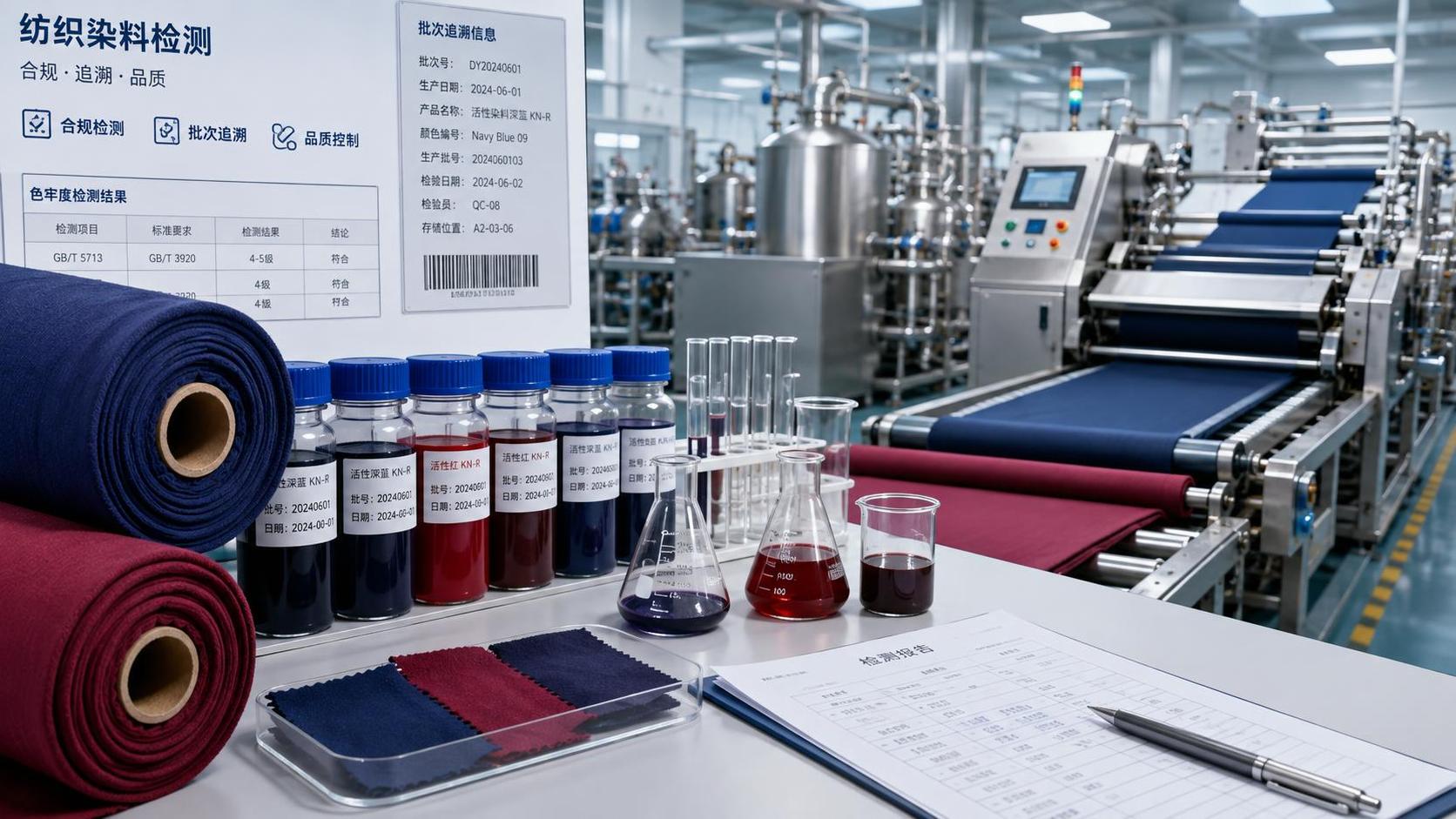
A fabric sample can look commercially acceptable in a buying office and still become a sourcing failure once it reaches a destination market. The problem often appears after color approval: a laboratory report is incomplete, a dyestuff contains a restricted impurity, a finishing process changes the chemical profile, or the shipment documents do not match the actual material. For export fabric sourcing, textile dye compliance affects far more than shade selection. It determines whether a fabric can be placed on the market, whether a supplier can be retained, and how much unplanned risk sits in the supply chain.
The practical answer is that buyers should assess dye compliance before approving bulk production, not after fabric testing is finished. A qualified sourcing decision requires linking the target market’s chemical requirements to the fiber type, dye class, dyeing process, auxiliary chemicals, finishing treatment, and documentary evidence. Textile Dyes are only one part of the chemical system, but they are often the starting point for identifying whether a supplier has meaningful process control or is only reacting to test failures.
Why dye compliance changes the sourcing decision
Export fabric is evaluated through several connected layers. The visible result is color, but compliance evaluation reaches behind the appearance of the material. Depending on the destination, end use, and customer specification, a fabric may be screened for restricted substances, substances that can be released under certain conditions, heavy-metal residues, formaldehyde, aromatic amines associated with certain azo colorants, chlorinated carriers, allergenic dispersive colorants, or other chemical concerns. The exact limits and restricted substance lists vary by market and customer program, so a generic statement that a dye is “eco-friendly” is not enough for a purchasing decision.
A supplier may produce deep black polyester, bright red cotton, or a complex blended-fiber fabric with stable color performance while still having difficulty meeting the buyer’s chemical requirements. This is because compliance risk is affected by the entire route used to create the shade. The dye itself matters, but so do salt, alkali, dispersing agents, reducing agents, carriers, wash-off chemicals, softeners, coatings, printing binders, and post-dyeing finishes. A fabric that passes one test scope may fail another if the buyer later changes the intended application from outerwear to children’s products, from upholstery to skin-contact garments, or from domestic sale to export.
For business evaluation, the key question is not simply whether a factory can provide a test report. It is whether the factory can show that the tested fabric represents a controlled and repeatable production system.
The risk often begins with an unclear product brief
Compliance problems frequently start before a supplier is contacted. A purchase inquiry may identify the fabric composition, weight, color, and quantity but omit the final market, end use, consumer group, printing or finishing requirements, and customer-specific restricted substance expectations. That leaves the mill to select dyes based mainly on cost, shade strength, availability, and production habits. The resulting fabric may be technically suitable for one market but unsuitable for another.
Before comparing quotations, the sourcing team should establish a chemical compliance brief that answers several operational questions:
- Which country or regional market will receive the finished goods?
- Will the fabric have direct, prolonged, or limited skin contact?
- Is the fabric intended for adult apparel, children’s articles, home textiles, industrial use, or another application?
- Are there brand, retailer, converter, or garment-maker requirements that are stricter than the applicable legal baseline?
- Will the fabric receive additional printing, coating, washing, water repellency, antimicrobial treatment, lamination, or other processing after dyeing?
- Which test standard, test method, sample preparation approach, and reporting format does the buyer need?
This brief should accompany color and quality specifications from the beginning. Without it, a supplier may quote a lower-cost route that later requires reformulation, repeat lab work, or re-dyeing. Re-dyeing is not merely a scheduling issue. It can alter hand feel, tensile properties, color fastness, shrinkage behavior, and chemical residues, creating a second round of quality uncertainty.
Dye class must match both fiber chemistry and compliance expectations
Different fibers need different dye systems. Reactive dyes are widely used for cellulosic fibers because they can form a bond with the fiber under appropriate processing conditions. Disperse dyes are commonly used for polyester and other hydrophobic synthetic fibers. Acid dyes may be selected for wool, silk, nylon, or polyamide applications, while vat, sulfur, pigment, direct, cationic, and other systems have their own use boundaries.
From a compliance perspective, the dye class is not a shortcut to approval or rejection. It is a signal for where to investigate. A buyer evaluating polyester fabric dyed with disperse colorants should ask about the supplier’s controls for the relevant dye components, migration behavior, and wash-off process. For cotton dyed with reactive dyes, questions may focus on dye selection, fixation efficiency, hydrolysis management, washing sequence, salt and alkali use, and whether residual unfixed colorant is adequately removed. For blends, the assessment becomes more complex because different fiber components may require separate dye systems, and uneven treatment can affect both shade consistency and chemical test results.
Deep shades deserve additional attention. Black, navy, dark brown, burgundy, and heavily saturated colors may require more intensive dyeing or a more complicated dye combination than pale shades. This does not make dark colors non-compliant by definition. It means the buyer should avoid assuming that a passing light-color lab dip proves the supplier can deliver compliant bulk fabric in every shade. The approved colorway, construction, finish, and production route should be represented in the validation process.
Color matching is not the same as chemical approval
A lab dip normally confirms whether a shade can be matched under controlled conditions. It may also give an early indication of color fastness and reproducibility. However, a lab dip alone does not demonstrate that full-scale production will meet a restricted substance requirement. Bulk production may involve different machines, water conditions, batch sizes, auxiliaries, drying conditions, and finishing steps. When evaluating a fabric source, keep color approval and compliance approval as related but separate gates.
This distinction is particularly important when the commercial team asks for a quick color revision. Substituting one yellow, red, blue, or black component to meet a revised shade target can change the chemical profile of the formula. The supplier should have a controlled process for reviewing substitutions rather than treating every color correction as a purely visual adjustment.
Documents reveal whether the supplier controls the process
Documentation is sometimes treated as an administrative requirement that can be collected shortly before shipment. In reality, it is part of supplier qualification. A reliable document package should allow the buyer to connect the purchase order, fabric specification, colorway, production batch, chemical inputs, test sample, and final shipment. If those links cannot be established, a favorable report has limited value because it may not represent the fabric being exported.
A report should be read rather than simply filed. Check the material description, test date, sample receipt date, tested parameters, units, stated limits, and conclusion. Confirm whether the report covers the buyer’s actual concern. A report for a greige fabric does not validate a finished dyed fabric. A report for one composition may not apply to a blend. Likewise, a report on fabric before printing, coating, or softening cannot automatically support the compliance status of the final treated article.
How to evaluate a supplier before bulk commitment
Early supplier screening should be proportional to the commercial and regulatory risk. A repeat supplier with a stable, documented chemical management system may need routine verification. A new supplier, a new dyehouse, a new color range, a new finish, or a market with strict customer requirements calls for deeper review. The objective is not to demand every possible document from every mill; it is to verify the controls that matter for the order.
- Define the target compliance scope. Provide the destination market, product use, applicable customer standard, and any prohibited chemical list before color development starts.
- Review the proposed dyeing route. Ask which dye class will be used for each fiber component, whether the shade involves special technical risks, and what finishing steps follow dyeing.
- Request evidence of chemical input control. The supplier should be able to identify the dyes and auxiliaries used, maintain relevant supplier information, and manage substitutions through an approval process.
- Approve representative development samples. The sample should reflect the intended composition, shade depth, processing route, and finish as closely as possible.
- Set testing at the right stage. Test the finished fabric or a production-representative sample, not only a preliminary swatch. For high-risk articles, buyers may require defined lot-based verification.
- Link release to records. Before shipment, confirm that the tested sample, bulk lot, and shipping fabric can be traced through clear lot identification.
This sequence reduces the tendency to solve compliance failures through last-minute paperwork. When a nonconformance occurs after the fabric is already packed, options become expensive: reprocessing may be impossible, replacement material may miss a garment production window, and the buyer may have to separate or hold stock while the issue is investigated.
Failures that appear after testing are usually traceability failures
A fabric can pass pre-production testing and still create an export problem later. One reason is uncontrolled change. A dye supplier may be replaced because of availability, a dyeing formula may be adjusted to correct a shade, a softener may change to improve hand feel, or a finishing line may use a different treatment. Each change can be commercially reasonable, but it needs to be evaluated against the original compliance scope.
Another source of failure is contamination. Shared equipment, storage areas, transfer containers, or finishing lines can introduce residues that were not part of the approved formula. Good sourcing evaluation therefore includes practical questions about segregation, cleaning procedures, labeling of chemicals, and handling of returned or partially used materials. These process details are especially relevant where the same facility handles multiple customer specifications or a wide variety of dyeing recipes.
Color fastness should also be reviewed alongside chemical compliance, even though the two are not identical. Poor wash, rubbing, perspiration, or light fastness can lead to color transfer, complaints, or rework. A fabric with acceptable restricted-substance results but unstable color performance is still a weak sourcing choice. The best evaluation combines chemical conformance with performance requirements rather than allowing one to substitute for the other.
When a test result does not meet the requirement
The first response should not be to request a new report immediately. Start by identifying what was tested, what failed, and whether the sample accurately represented the shipment lot. A meaningful investigation usually follows this order:
- Confirm the test scope, method, limit, and sample identity.
- Review the dye recipe, auxiliary chemical records, finishing recipe, and any changes made after approval.
- Determine whether the issue is linked to one color component, a finishing chemical, contamination, incomplete washing, or a mismatch between the requested and actual specification.
- Assess whether corrective processing is technically suitable without damaging performance or creating another compliance concern.
- Retest only after the corrective action has been documented and the new sample represents the intended bulk material.
Replacing the dye may be necessary, but it is not always the only corrective action. In some cases, washing, soaping, reduction clearing, curing conditions, or finishing chemicals are the relevant variables. In other cases, the selected route cannot reasonably meet the requirement at the required shade depth, and a reformulation or alternative fabric choice is needed. Buyers should ask for a clear explanation of the root cause and the controlled change, rather than accepting a simple assurance that the next batch will be better.
Building compliance into supplier comparisons
Price comparisons can become misleading when suppliers are not quoting the same compliance basis. One mill may include approved chemical inputs, traceability records, representative testing, and controlled finishing in its offer, while another may price only to a color and quality sample. The lower quotation may later require additional testing, reformulation, or shipment delays that were not visible at the sourcing stage.
During evaluation, compare suppliers on the evidence behind their claim of compliance: their ability to interpret the product brief, identify the dye route, document chemical use, manage formula changes, and connect reports to bulk lots. This approach does not require a buyer to become a dye chemist. It requires the buyer to recognize where a broad assurance is insufficient and where specific records are needed.
For export fabric sourcing, dye compliance is best treated as a release condition built into development, production, and shipment control. When the market requirement, textile construction, color recipe, finishing route, and test evidence are aligned before bulk production, compliance becomes a managed sourcing variable rather than a late-stage obstacle.
Send Us Your Inquiry Today
