









Product Quick Navigation
Get a Quote
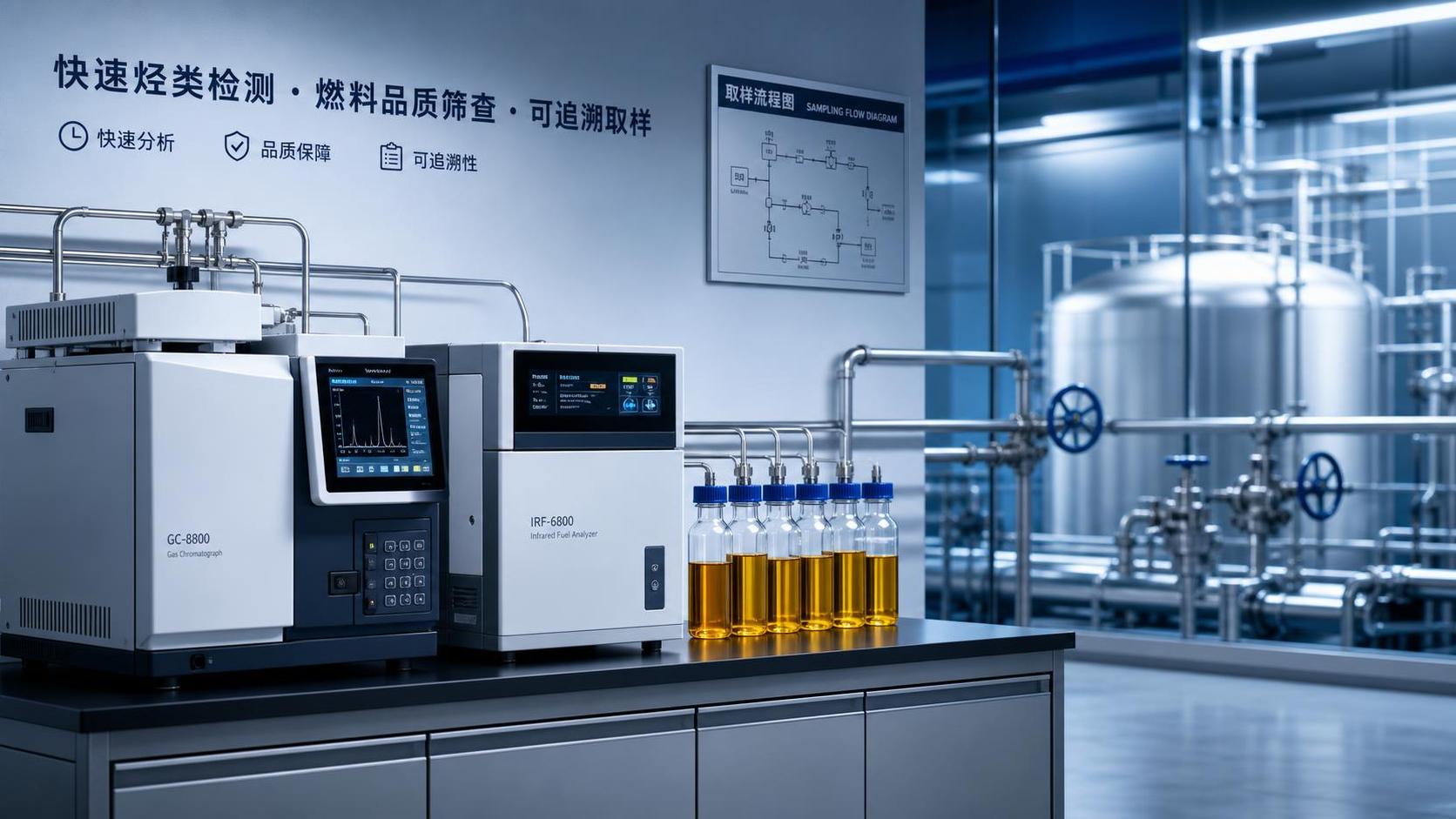
Speed hydrocarbon testing is a rapid screening approach used to assess whether a fuel or hydrocarbon stream is consistent with its expected composition and handling properties. The result is not a substitute for every reference test required by a contract, product specification, or governing standard. Its value lies in shortening the time between sampling and a defensible operational decision: hold, segregate, release for controlled use, or send for confirmatory analysis.
For fuels entering tanks, blending systems, loading racks, or process units, a delay can allow an off-specification material to mix with compliant inventory. Fast analysis can reveal shifts in volatility, hydrocarbon distribution, water presence, or unexpected chemical markers before that happens. It also creates a traceable record around receipt, transfer, and release events, which is especially useful when cargoes pass through multiple transport and storage interfaces.
What “speed hydrocarbon” analysis measures
The term speed hydrocarbon commonly describes a fast analytical workflow rather than one fixed instrument method. Depending on the fuel type and the purpose of the test, the workflow may use portable or benchtop gas chromatography, infrared spectroscopy, density measurement, flash point screening, distillation-related indicators, water testing, or a combination of these techniques. The method selected must match the decision being made.
Gas chromatography can separate components according to their retention behavior and produce a compositional fingerprint. In gasoline-range materials, this may indicate the relative presence of light paraffins, olefins, aromatics, oxygenates, and heavier fractions. In diesel, kerosene, solvent, or marine fuel streams, the same principle may expose an abnormal boiling-range pattern, a change in aromatic content, or contamination by another petroleum product.
Infrared methods do not identify every individual compound, but they can rapidly compare the spectral response of a sample with a verified reference material. Strong deviations can indicate oxygenated compounds, aromatic changes, residual solvents, oxidation products, or mixing with an incompatible stream. Density, refractive index, conductivity, and color are also useful supporting indicators, although none should be treated as proof of composition by itself.
Fast methods work best when they are tied to a defined material family and a documented acceptance range. A result described only as “normal” or “abnormal” is difficult to defend. The analytical record should show the sample identification, collection point, test method, reference or control used, instrument status, result, units, and disposition decision.
Fuel consistency is revealed through patterns, not a single number
A fuel may meet one measured property while still being unsuitable for its intended use. Density can remain close to target after blending with certain components. A visually clear sample can still contain compounds that alter combustion behavior, emissions-related properties, elastomer compatibility, or downstream separation performance. For this reason, rapid fuel assessment should interpret several related observations together.
In a gasoline-range sample, a faster-than-expected front end of the chromatogram may indicate excess light ends or cross-contamination from a more volatile product. This can affect vapor pressure behavior and handling losses. A heavier tail may suggest diesel, kerosene, lubricating oil, or degraded residue entering the stream. A shift in aromatic or oxygenate signals can matter where product specifications impose compositional limits or where blending components must be declared.
For middle distillates, the concern may be less about a single peak and more about the overall carbon-number envelope. A sample with a broader or displaced hydrocarbon distribution may have been mixed with a lighter cutter stock, a heavier fuel fraction, or another material from a shared line. Density and flash point can support that interpretation, but confirmatory testing remains appropriate when the initial result could affect shipment release or product segregation.
Residual and heavy fuel products require additional caution. Their complex composition can make rapid spectral comparison useful for flagging deviations, yet viscosity, sediment tendency, stability, water, and compatibility may require separate methods. A fast compositional screen cannot establish storage stability merely because the measured fingerprint resembles a previous lot.
Contamination signals that warrant attention
Contamination does not always originate from a clearly visible event. Product can be affected by line displacement, incomplete draining, tank-bottom disturbance, incorrect valve alignment, hose residue, rainwater ingress, condensation, unsuitable cleaning chemicals, or unrecognized material left in a transport compartment. A rapid screen provides an early signal, but the subsequent investigation must consider the physical route taken by the material.
- Water-related change: Free water may be detected by visual examination or a field water test, while dissolved water may require a more sensitive method. Water can promote corrosion, interfere with combustion, reduce lubricity in some applications, and contribute to phase separation where oxygenated components are present.
- Unexpected oxygenates or solvents: Infrared bands or chromatographic peaks outside the approved pattern may point to alcohols, ketones, ethers, or cleaning residues. The effect depends on concentration and fuel type, so a screening signal should lead to targeted confirmation rather than an immediate assumption about the contaminant.
- Cross-product mixing: A shift toward lighter or heavier hydrocarbons can occur after transfer through a common pipeline, manifold, or loading arm. The approximate volume of interface material, prior line contents, and actual valve sequence are relevant to determining whether segregation is required.
- Oxidation or degradation: Extended warm storage, air exposure, reactive contaminants, or unstable blend components can alter odor, color, acidity-related indicators, gum-forming tendency, and spectral response. These changes may develop after receipt, so retained samples are useful when comparing a later result with the original condition.
A rapid result should never be interpreted in isolation from the sample condition. Haze, suspended particles, strong odor, phase separation, pressure release during sampling, or unusual container temperature can all affect both the measurement and the underlying risk assessment. Those observations belong in the test record.
Sampling controls the usefulness of the result
Even a well-maintained instrument cannot correct a nonrepresentative sample. The sample point must reflect the material being evaluated. A tank-top grab sample may miss settled water or sediment. A sample collected immediately after a pump starts may reflect line heel rather than bulk inventory. A flowing sample from a properly flushed point often gives a better indication of transfer material, while tank assessment may require samples from more than one level when stratification is plausible.
Sampling containers must be clean, compatible with the fuel, correctly sealed, and labeled at the time of collection. Hydrocarbon samples can lose volatile components through poor closure or excessive headspace. Samples intended for oxygenate, water, or trace-contamination review need especially careful protection from external contamination. Where static accumulation is possible, bonding, grounding, vapor control, ignition-source exclusion, and the relevant site procedure remain necessary during collection and handling.
Temperature should be recorded because density, viscosity, vapor behavior, and some instrument responses are temperature-sensitive. If a sample is warmed or cooled before testing, that history should be documented. A result generated from a sample that has stood unsealed in direct sunlight may describe the altered sample rather than the original fuel.
Building a rapid test sequence around release decisions
Speed hydrocarbon testing is most effective when the test sequence follows the movement of material. At receipt, a baseline screen can be compared with shipping documentation, prior approved material, or a retained pre-transfer sample. Before unloading, an abnormal screen may justify a hold while a second sample is collected. During transfer, a quick review of interface material can support segregation decisions. After tank filling, a final sample can establish the condition of the receiving inventory.
The release criteria should distinguish between a screening limit and a contractual product limit. A screening limit is an internal trigger for investigation, retesting, or segregation. It should not be presented as a formal specification unless the analytical method, calibration, precision, and approval basis support that use. This distinction prevents a common mistake: treating a fast instrument reading as interchangeable with a reference laboratory result.
When a result is outside the expected range, the immediate response should preserve evidence. Retain the original sample, collect a duplicate where conditions allow, prevent further commingling, identify the affected tank, line, or compartment, and record the transfer status. A follow-up analytical plan can then target the suspected issue: water determination, detailed chromatography, distillation characteristics, flash point, sulfur-related analysis, acidity-related testing, particulate examination, or another method suited to the observed deviation.
Method verification and instrument discipline
Rapid methods need routine control materials, clean sample paths, and an auditable calibration approach. A chromatograph can show false shifts when its inlet liner, column, carrier gas, detector, or integration settings are unstable. Spectral instruments can produce misleading comparisons when the cell is contaminated, the background is poor, or the library reference does not represent the current product grade. Portable devices also require attention to battery condition, warm-up time, environmental temperature, and vibration.
Verification should include repeat analysis of an appropriate control sample and review of the expected measurement repeatability. If duplicate results disagree beyond the method’s normal behavior, the source may be sampling heterogeneity, instrument drift, sample preparation, or data processing. Repeating the same questionable calculation without examining those variables can create false confidence.
Reference materials should be selected carefully. A legitimate product can vary between batches because of feedstock, blending recipe, refinery configuration, seasonal requirements, or transport history. Comparing every lot with one historic sample may create unnecessary alarms. A controlled library of approved profiles, supported by the relevant specification and test conditions, is more useful than a single “golden sample.”
Interpreting results alongside safety and compatibility
Fast fuel analysis can identify issues that carry operational safety implications. An unexpectedly light component can increase vapor generation and alter the controls needed during venting, loading, and storage. A heavier contamination can raise flash point or viscosity while degrading atomization or filtration. Water and solids can cause corrosion, microbial activity in certain systems, separator malfunction, or unstable tank-bottom conditions.
Compatibility also extends beyond the fuel itself. Hoses, gaskets, coatings, meters, filters, and storage seals may respond differently to aromatic-rich, oxygenated, or solvent-contaminated streams. When a screening result suggests an unusual blend, material compatibility should be reviewed before the fuel is routed through equipment not intended for that composition.
Similar control logic applies where fuel-fired utilities support textile processing. A change in burner fuel quality can affect heat delivery to starch preparation, drying, or finishing operations. The material characteristics of process additives must remain separate from fuel-quality testing, yet stable utility conditions support consistent preparation of products such as Modified Starch for Textile Sizing, which may require complete dissolution above its specified preparation temperature before use.
Documentation that supports technical review
A useful speed hydrocarbon record connects the analytical result to the movement of material. It identifies the product grade, batch or tank reference, sampling time, sampling point, container condition, temperature, instrument method, calibration status, raw output, interpretation, and any hold or release instruction. Records should also distinguish observed facts from assumptions. “Broad late-eluting distribution observed” is a fact; “diesel contamination confirmed” is not justified until the appropriate confirmation is complete.
For cross-border movements, consistent terminology matters. Product names, units, sampling points, and method references should be clear enough that a receiving laboratory can compare them with its own results. Ambiguous labels such as “mixed fuel,” “normal sample,” or “passed by quick test” create avoidable disputes because they do not state what was measured or against which acceptance basis.
Rapid hydrocarbon analysis is most reliable when it is treated as a controlled decision tool: representative sample, fit-for-purpose method, verified instrument, defined trigger limits, preserved evidence, and confirmatory testing where the consequence warrants it. That discipline turns a fast result into useful operational information without assigning it a level of certainty the method cannot support.
Send Us Your Inquiry Today
