









Product Quick Navigation
Get a Quote
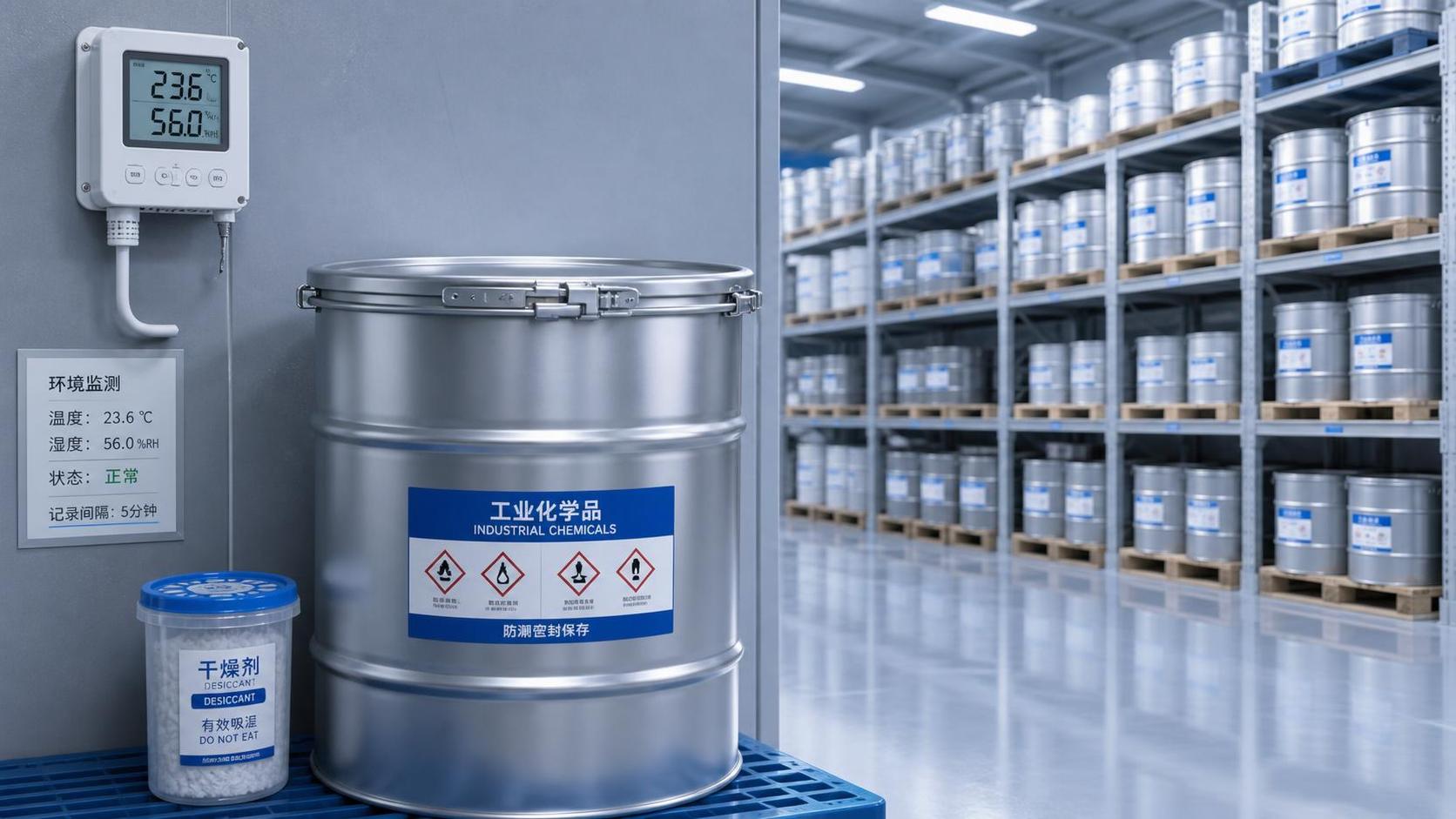
For quality control and safety teams, deciding whether moisture-sensitive chemical materials can be kept at room temperature requires more than reading “store at RT” on a supplier label. That instruction may be appropriate for a sealed container under defined warehouse conditions, yet inadequate for an opened drum in a humid production area, a partly used laboratory bottle, or a shipment that crosses several climate zones.
The practical question is not whether room temperature is inherently safe. It is whether the material, packaging, handling pattern, and environmental controls together can keep moisture uptake within the limits that protect product quality, process performance, and worker safety.
This distinction matters because moisture exposure is not always visible. A powder may retain a normal appearance while its assay, flowability, particle behavior, or reactivity has changed. A liquid may remain clear while water content rises enough to affect a moisture-sensitive formulation or downstream synthesis. For companies managing international chemical supply chains, the decision must also account for freight duration, customs delays, warehouse transfers, and the documentation expected by customers and regulators.
“Room Temperature” Is a Condition Range, Not a Storage Strategy
In chemical documentation, room temperature usually refers to an ordinary controlled indoor temperature rather than a single universal value. In practice, many facilities interpret it as roughly 15-30°C, but the acceptable range should come from the supplier’s technical documentation, stability data, safety data sheet, and internal quality requirements. It should never be inferred only from common practice.
Temperature alone does not determine whether storage is acceptable. Relative humidity, temperature cycling, air exchange, sunlight, packaging closure, container headspace, and opening frequency can all be more consequential for hygroscopic materials. A warehouse maintained at 22°C but operating at 75% relative humidity may present greater product risk than a warmer but dry controlled area. Conversely, refrigeration can create condensation risks if cold containers are opened before they equilibrate in a dry environment.
For this reason, “room temperature storage” should be treated as a qualified statement: storage at a documented temperature range, within a defined humidity environment, using validated packaging and controlled handling practices. It is not a substitute for a material-specific storage assessment.
Start With the Material’s Moisture Failure Mode
Moisture-sensitive materials do not all fail in the same way. Quality and safety teams should identify the mechanism of concern before specifying environmental controls. The level of control suitable for a mildly hygroscopic liquid may be wholly unsuitable for an anhydrous reagent, a hydrolysis-prone intermediate, or a material capable of hazardous reaction with water.
The most common failure modes include:
- Moisture absorption: Hygroscopic solids and liquids can take up atmospheric water, changing assay, concentration, density, viscosity, or pH.
- Hydrolysis: Water may chemically degrade esters, acid chlorides, anhydrides, organometallic compounds, silanes, and other reactive substances. In these cases, moisture is not merely a quality issue.
- Physical change: Powders may cake, agglomerate, lose flowability, or develop electrostatic and dust-handling problems. Some products may liquefy or form hydrates.
- Packaging degradation: Moisture can compromise labels, corrugated outer packaging, desiccants, closure liners, or corrosion protection for metallic components.
- Process variability: Extra water can alter reaction stoichiometry, solvent balance, drying load, crystallization behavior, and analytical results.
- Safety escalation: Certain materials may release heat, corrosive vapors, flammable gases, or pressure when exposed to water. Such materials should not be managed as ordinary hygroscopic products.
A useful internal classification separates materials into three groups. The first includes substances for which moisture mainly affects commercial quality or ease of use. The second includes materials where absorbed water can cause specification failure or process deviation. The third includes water-reactive substances where atmospheric exposure can introduce an immediate safety concern. Only the first group will commonly be suitable for standard indoor storage, and even then only with compatible packaging.
Use Data to Define the Storage Decision
Supplier descriptions such as “hygroscopic,” “air sensitive,” or “keep tightly closed” are important warning signals, but they do not by themselves define a complete warehouse requirement. The storage decision should be built from data that relate to the intended use and the maximum expected storage period.
For quality assessment, the most useful inputs typically include water-content specification, assay limit, impurity profile, stability study results, container-closure information, recommended shelf life, and results from retained-sample testing. Karl Fischer moisture testing is often appropriate where water content is a critical quality attribute, although the method and acceptance criteria must match the material and the relevant product specification.
Safety teams should review the safety data sheet, particularly the stability and reactivity information, incompatible materials, hazardous decomposition potential, and recommended protective measures. The SDS should be current and jurisdictionally appropriate; its content supports hazard communication but does not replace a site-specific risk assessment.
Where a material is purchased for regulated pharmaceutical, food, electronics, or analytical use, the receiving specification may be stricter than the general industrial product specification. A material that is acceptable for bulk neutralization may be unacceptable as an API-related raw material, HPLC solvent, GC reference material, or reagent used in moisture-controlled synthesis. The storage standard should therefore follow the most demanding justified use case, not the least demanding use case in the portfolio.
Packaging Often Determines Whether Ambient Storage Works
Many disputes over storage conditions are actually packaging-control failures. A product may be stable in an unopened, nitrogen-purged, properly sealed drum with a compatible liner, while becoming unsuitable after repeated opening and resealing. The label may not communicate that difference clearly enough for routine operations.
Quality teams should confirm the primary container material, closure type, liner compatibility, tamper-evident system, fill level, and any inert-gas blanket. For solids, moisture-barrier bags, heat seals, and desiccant systems deserve particular attention. For liquids, cap integrity, gasket compatibility, and vapor-space exposure are central. Outer cartons and pallets protect logistics handling but should not be mistaken for moisture barriers.
A practical receiving inspection should verify that closures are intact, containers show no leakage, labels remain legible, and any required moisture-control components are present. If the shipment experienced unusual delay, flooding, container damage, or extended exposure to high humidity, quarantine and targeted testing may be more appropriate than routine release.
Once the container is opened, the control strategy changes. Facilities should establish a defined maximum open time, resealing method, withdrawal procedure, and retest trigger. For high-value or highly sensitive materials, decanting into smaller validated containers may reduce repeated exposure. A broad instruction such as “close promptly after use” is not sufficient where water content or hydrolysis products can affect release decisions.
Humidity Control Must Match Real Operating Conditions
Ambient storage can be suitable only when the actual storage environment is understood. This requires more than a single thermometer on the warehouse wall. Temperature and humidity mapping should reflect seasonal variation, door openings, loading bays, upper-rack locations, exterior walls, and areas near HVAC discharge. The objective is to identify the conditions the product actually experiences, including temporary excursions.
For many moisture-sensitive materials, a controlled dry room is not automatically necessary. A well-maintained indoor warehouse with documented humidity monitoring, limited exposure during handling, and appropriate sealed packaging may be adequate. But where product quality depends on very low water content, the decision should be justified through stability evidence, packaging performance, and warehouse data rather than cost preference.
Environmental alarms should be meaningful. An alarm limit that is set above the level likely to affect the material adds little value. Equally, an alarm system without a documented response process does not create control. Teams should define who investigates excursions, how affected stock is identified, what evidence is reviewed, and when testing or disposition by quality assurance is required.
A Useful Example: Hygroscopic Does Not Always Mean Refrigerated
Triethanolamine illustrates why the label must be read in context. It is generally supplied as a clear, colorless to slightly yellow oily liquid and is often described as suitable for storage at room temperature. At the same time, it is hygroscopic and air sensitive. Those characteristics mean that the room-temperature instruction should not be interpreted as permission to leave an opened container exposed in a humid work area.
For users handling Triethanolamine CAS#102-71-6 as a chemical intermediate, neutralizing agent, formulation component, or laboratory reagent, the relevant question is whether moisture uptake will affect the intended process or specification. Its complete miscibility with water can make absorbed moisture less obvious than it would be in a powdered material. Where concentration, alkalinity, analytical performance, or formulation consistency matters, controlled closure practices and water-content verification may be more important than lowering the storage temperature.
This is also a reminder that low-temperature storage may introduce a separate operational issue. Triethanolamine has a melting range near ordinary cool-room temperatures, so cold conditions can lead to crystallization or partial solidification depending on grade and environment. A storage policy should address both moisture control and the practicality of dispensing, sampling, and restoring a homogeneous product. The correct answer is not simply “ambient” or “refrigerated”; it is a documented control range aligned with product behavior and use.
Compliance Means Demonstrating Control, Not Collecting Certificates
For chemical businesses operating across borders, storage control is part of a broader compliance system. Customers may ask for certificates of analysis, safety data sheets, batch traceability, transport records, packaging information, and evidence that product quality was protected through warehousing and shipment. The exact documentation requirements depend on the material, market, application, and contractual commitments.
Quality management systems such as ISO 9001 can provide a useful framework for documented procedures, nonconformance handling, calibration, supplier control, and corrective action. However, certification alone does not demonstrate that a specific moisture-sensitive material has been stored appropriately. The evidence must connect the stated requirement to actual controls: monitored conditions, calibrated instruments, defined acceptance criteria, trained personnel, and retained records.
For materials entering pharmaceutical or food-related supply chains, additional requirements may apply under the customer’s quality agreement or applicable regulations. These should be reviewed case by case. It is risky to assume that a general-purpose industrial storage procedure will meet the expectations of a regulated end use.
Transport classification should likewise be kept separate from storage suitability. A material may not require special temperature-controlled transport under dangerous-goods rules while still needing protection from moisture to preserve commercial quality. Conversely, a product with significant chemical hazards needs controls based on its hazard profile even if moisture has little effect on purity.
Common Assumptions That Create Avoidable Risk
One frequent assumption is that a material described as stable at room temperature can tolerate all warehouse conditions. Stability statements normally depend on the original unopened package and recommended conditions. They do not validate storage beside open loading doors, in uncontrolled tropical humidity, or through repeated partial withdrawals.
Another is that visible appearance is an adequate release test. Discoloration, clumping, phase separation, and container corrosion are useful warning signs, but their absence does not prove compliance with water-content, assay, or impurity limits. Testing should be risk-based and linked to the failure mode that matters.
Teams also sometimes overcorrect by moving every moisture-sensitive material into refrigerated storage. This can increase cost, complicate logistics, and generate condensation when containers are opened or returned to ambient conditions. Refrigeration is appropriate only when supported by stability requirements and managed with a procedure that prevents condensation and temperature-related physical change.
Finally, supplier qualification should not end with a product specification. For export supply, buyers should understand the supplier’s packaging options, batch traceability, storage conditions before dispatch, shipment protection practices, and ability to provide timely technical and compliance documentation. These details often determine whether a product arrives within specification after a long transit rather than merely whether it met specification at the factory gate.
Turning the Assessment Into an Operating Rule
A defensible storage decision can be summarized in a short material-specific instruction: acceptable temperature and humidity range; required packaging state; whether an inert atmosphere or desiccant is needed; maximum time after opening; inspection and retest conditions; incompatibility controls; and escalation requirements after environmental excursions. This instruction should be available where receiving, warehousing, sampling, and production teams actually use it.
For products managed through global distribution, the same assessment should extend beyond the facility. Review the expected route, seasonal weather, freight mode, destination climate, likely dwell time, and handoff points. A robust room-temperature program is one that recognizes ambient conditions are variable, especially once a product leaves a controlled warehouse.
The decision is therefore less about choosing a temperature label and more about proving that moisture exposure remains controlled throughout the product’s real lifecycle. When that proof is supported by material data, packaging qualification, environmental records, and clear response procedures, room-temperature storage can be both practical and reliable. When those controls are absent, “room temperature” is only an assumption waiting to be tested.
Send Us Your Inquiry Today
