









Product Quick Navigation
Get a Quote
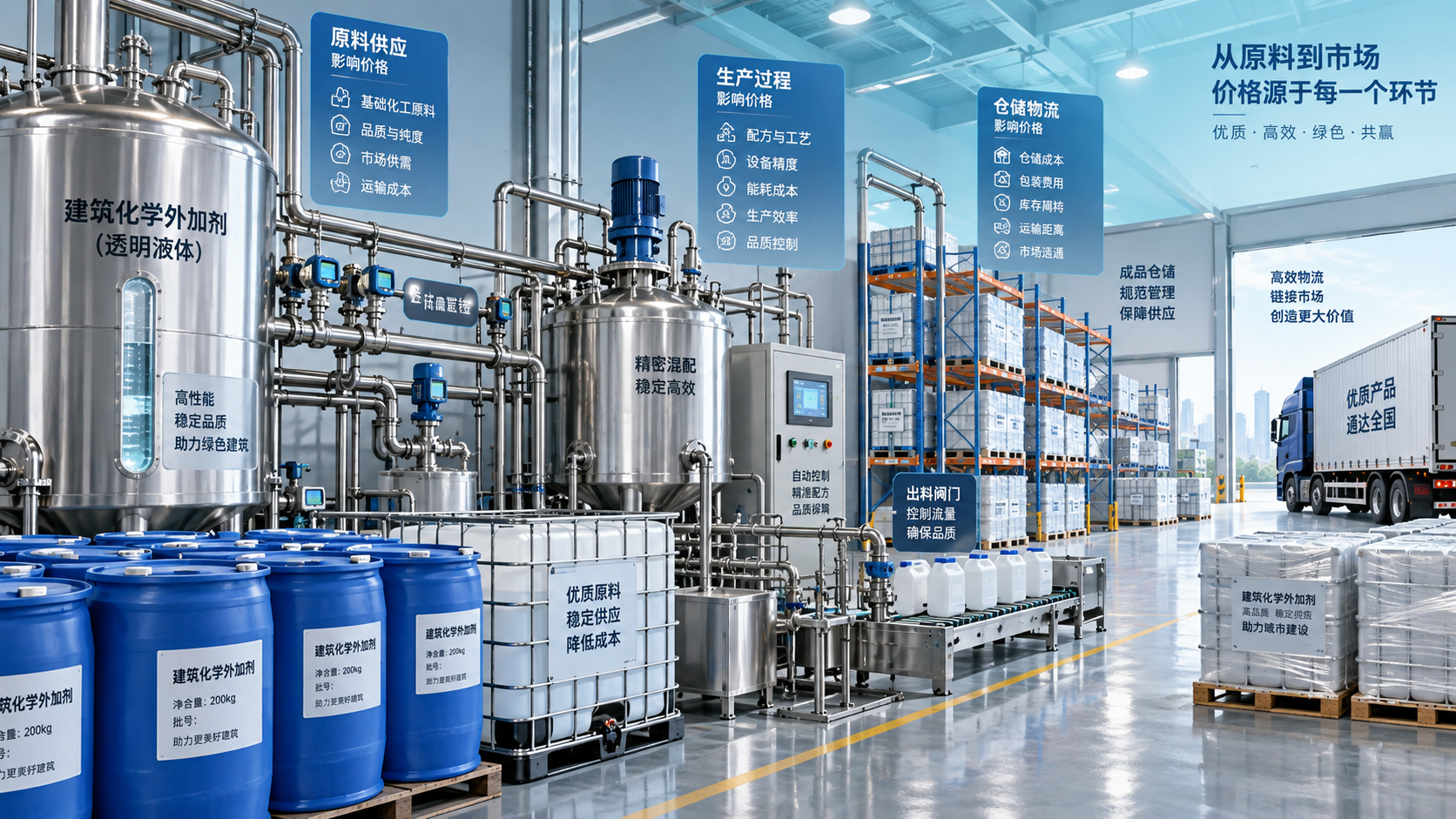
Price changes in construction chemical admixtures rarely come from a single event. A quotation for a polycarboxylate ether superplasticizer, accelerator, retarder, waterproofing additive, air-entraining agent, or viscosity modifier can move because of feedstock costs, formulation changes, production constraints, freight availability, or project-specific requirements. For procurement teams, the practical question is not simply whether prices will rise or fall. It is which cost driver is moving, how long that movement may last, and whether the quoted product remains technically comparable to the material previously approved.
The most significant price changes usually begin upstream. However, raw material movements do not pass through to admixture prices in a uniform way. A buyer who understands the structure of the formulation can distinguish a short-term market adjustment from a change that may affect the purchasing budget for several months.
Raw material exposure determines how sensitive a product is to price swings
Many Construction Chemical Admixtures are formulated from petrochemical, mineral, polymer, salt, and specialty chemical inputs. Their exposure to raw material volatility differs substantially. Water-reducing admixtures based on polycarboxylate ether chemistry, for example, can be sensitive to the cost and availability of monomers, initiators, solvents, and processing inputs. Set accelerators and retarders may depend more heavily on inorganic salts, acids, alkalis, or organic acids. Waterproofing and rheology-control systems can have meaningful exposure to polymers, surfactants, waxes, fillers, and dispersing agents.
This is why a broad statement such as “oil prices are up, so admixtures will be more expensive” is often incomplete. Petroleum-linked costs may influence polymeric admixtures, packaging, utilities, and road freight at the same time, but their effect on the final quotation depends on the product’s formulation and dosage rate. A low-dosage, high-performance additive may have a much higher value concentration than a bulk mineral-based additive. Its delivered cost can therefore respond differently to the same upstream market movement.
Procurement teams should ask suppliers which input category is driving a proposed adjustment: organic monomers, inorganic raw materials, energy, packaging, transport, or a specific imported intermediate. Suppliers may not disclose a complete formulation, nor should buyers expect proprietary details. They should still be able to explain the commercial basis of a price change in terms that permit a sourcing decision.
A useful distinction is between commodity exposure and specialty exposure. Commodity-linked inputs may experience visible market movements but are often available from several sources. Specialty intermediates may have less transparent pricing and fewer qualified producers. If one technical component is difficult to replace, its supply disruption can have a larger impact than a general increase in common feedstocks.
Energy and operating costs can matter even when the formula has not changed
Admixture pricing is not determined only by the cost of ingredients. Manufacturing may involve heating, cooling, blending, reaction control, drying, filtration, storage, and quality testing. Electricity, fuel, steam, water treatment, and waste handling can all affect the producer’s conversion cost. These cost elements become more visible when margins are already narrow or when plants are operating below efficient capacity.
For liquid admixtures, packaging and logistics can be especially important. Intermediate bulk containers, drums, flexitanks, pallets, and labels all carry cost. A product with a relatively stable ex-works chemical price can still show a meaningful delivered-price change if container availability tightens, packaging costs increase, or shipping conditions change.
Buyers should avoid comparing only price per kilogram or price per litre when evaluating substitutions. The relevant commercial measure is often the cost per cubic metre of compliant concrete, per tonne of cementitious material, or per square metre of treated construction area. A lower-priced admixture may require a higher dosage, additional adjustment at the batching plant, or different curing controls. The apparent saving can disappear once the full application cost is considered.
Supply availability often changes price before it changes market statistics
A published market indicator may show little movement while buyers encounter longer lead times, reduced shipment flexibility, or limited allocations. Construction admixtures are frequently produced to order or held in limited inventory because liquid products can require specific storage conditions and because formulation grades vary by application. A producer with full order coverage may raise prices selectively, reduce discounts, or prioritize contracted customers before a broad market price shift becomes obvious.
Plant maintenance, equipment downtime, feedstock shortages, and port disruption can all reduce supply. The impact is amplified where buyers require a particular grade that has already passed concrete trials or has been specified for a major infrastructure project. Switching to an alternative product is possible in many cases, but it requires technical review. Compatibility with cement type, supplementary cementitious materials, aggregate quality, water chemistry, and other admixtures must be checked before changing an approved source.
This technical qualification requirement is a reason procurement should not rely entirely on spot buying. A spot quotation can appear attractive while the lead time, batch consistency, or documentation package does not meet project needs. The cost of re-testing and the risk of disrupted concrete production can exceed the price difference between two otherwise similar offers.
Regional supply also matters. A supplier may have sufficient production capacity but be unable to deliver economically to a specific destination because of transport distance, hazardous-goods restrictions, container imbalance, road limitations, or destination handling requirements. For imported materials, the delivered price should be reviewed as a chain of costs rather than as a single supplier number: product, packaging, inland transport, export handling, ocean or air freight where applicable, insurance, duties, clearance, local delivery, and storage.
Regulatory and documentation requirements add cost unevenly
Compliance does not affect every admixture in the same way, yet it can change both the price and the availability of a product. Registration obligations, chemical inventory status, safety data sheet requirements, transport classification, labelling, restricted-substance controls, and customer-specific declarations all require administrative and technical resources. Where a product is sold across borders, these requirements may also vary by destination.
For buyers, the concern is not only whether a supplier can provide documents at the time of shipment. The more important question is whether the supplier’s product identity, composition range, and quality-control process align with the documents used for project approval and local compliance. A low quotation that omits required technical declarations, certificate support, or correctly prepared shipping paperwork can cause delays that are much more expensive than a modest price premium.
Some construction applications also impose additional restrictions through building codes, owner specifications, or indoor-environment requirements. These can affect the selection of preservatives, solvents, formaldehyde-related components, flame-retardant fillers, and other formulation ingredients. A supplier’s offer should therefore be evaluated against the actual specification, not just the generic product category.
For example, materials such as Aluminum hydroxide CAS#21645-51-2 may appear in wider construction-related supply chains as fillers or flame-retardant components rather than as standard concrete admixtures. Its price and suitability are influenced by particle properties, purity, handling requirements, and compatibility with the finished formulation. Treating every white mineral powder as interchangeable would overlook the performance and compliance implications that matter to compounders.
Grade changes can look like price changes
One of the most common procurement errors is assuming that two products with similar names are commercially equivalent. Construction chemical products are often sold under broad labels, while their performance depends on active content, solids level, pH, density, chloride level, molecular structure, setting behavior, water-reduction efficiency, air control, and interaction with the local concrete mix.
A lower offer may be based on a lower active-content liquid, a different concentration, a different packaging size, or a grade intended for another cement system. It may also exclude technical support, stability testing, or batch documentation that is included in the incumbent supplier’s price. These differences are not automatically unacceptable; they simply require the buyer to compare like with like.
- Confirm the applicable product specification and test method before requesting quotations.
- Compare active content, density, recommended dosage, and delivered packaging basis.
- Ask whether the quoted grade has changed from the previously approved material.
- Check compatibility with the cement, supplementary materials, and other admixtures used in the project.
- Review shelf life, storage limits, minimum order quantity, and shipment lead time alongside unit price.
- Separate ex-works price changes from freight, packaging, duty, and local delivery changes.
For concrete producers, dosage economics deserve particular attention. If one water reducer costs more per kilogram but achieves the required slump retention at a lower dosage or permits a reduction in water demand, it may improve the overall mix economics. Conversely, a cheaper product that causes inconsistent slump, delayed strength development, or excessive air content may raise operational costs. Procurement should use lab and plant data supplied through the technical approval process, rather than making the decision solely from the invoice line.
Contract structure determines how much volatility reaches the buyer
Two buyers can purchase the same admixture and experience very different price stability because their contracts are structured differently. A short validity period transfers more market movement to the buyer. A fixed-price agreement provides budget certainty but may require a volume commitment, a defined delivery schedule, or a price premium. Formula-based mechanisms can be useful where a major raw material is transparent and material to the final cost, although they work poorly if the selected index does not reflect the actual formulation.
For recurring demand, a practical arrangement may combine a committed base volume with a controlled flexibility band. This allows the supplier to plan production while giving the buyer some room for changing project schedules. Clear provisions should cover lead time, acceptable delivery windows, pricing basis, packaging, quality claims, and the process for approving equivalent grades during a supply disruption.
Where demand is project-based and irregular, buyers may gain more from prequalification and visibility than from locking in a long fixed price. Maintaining an approved list of technically suitable alternatives can reduce the time needed to respond when an incumbent supplier changes price or delivery terms. The objective is not to create unnecessary supplier complexity; it is to avoid being forced into an untested substitute under schedule pressure.
What to watch before the next buying cycle
Price movements become easier to manage when procurement tracks a small number of relevant signals rather than every chemical market headline. Monitor the inputs that actually matter to the products being purchased, the supplier’s available capacity, expected shipping conditions, and the timing of major project demand. Pair that information with an internal view of inventory coverage and the time required to qualify an alternative material.
When a supplier announces an increase, the best response is usually a structured comparison: identify the stated cost driver, confirm whether it affects the required grade, test whether the change applies to the chemical price or the delivered price, and assess the availability of approved alternatives. This turns a difficult price discussion into a procurement decision supported by technical and supply-chain facts.
Construction chemical admixture prices will continue to move because the products sit between chemical feedstock markets and project delivery schedules. Buyers are in a stronger position when they treat the quotation as more than a number: it is a combination of formulation, performance, compliance, packaging, transport, and reliable availability at the point when concrete or construction work must proceed.
Send Us Your Inquiry Today
