









Product Quick Navigation
Get a Quote
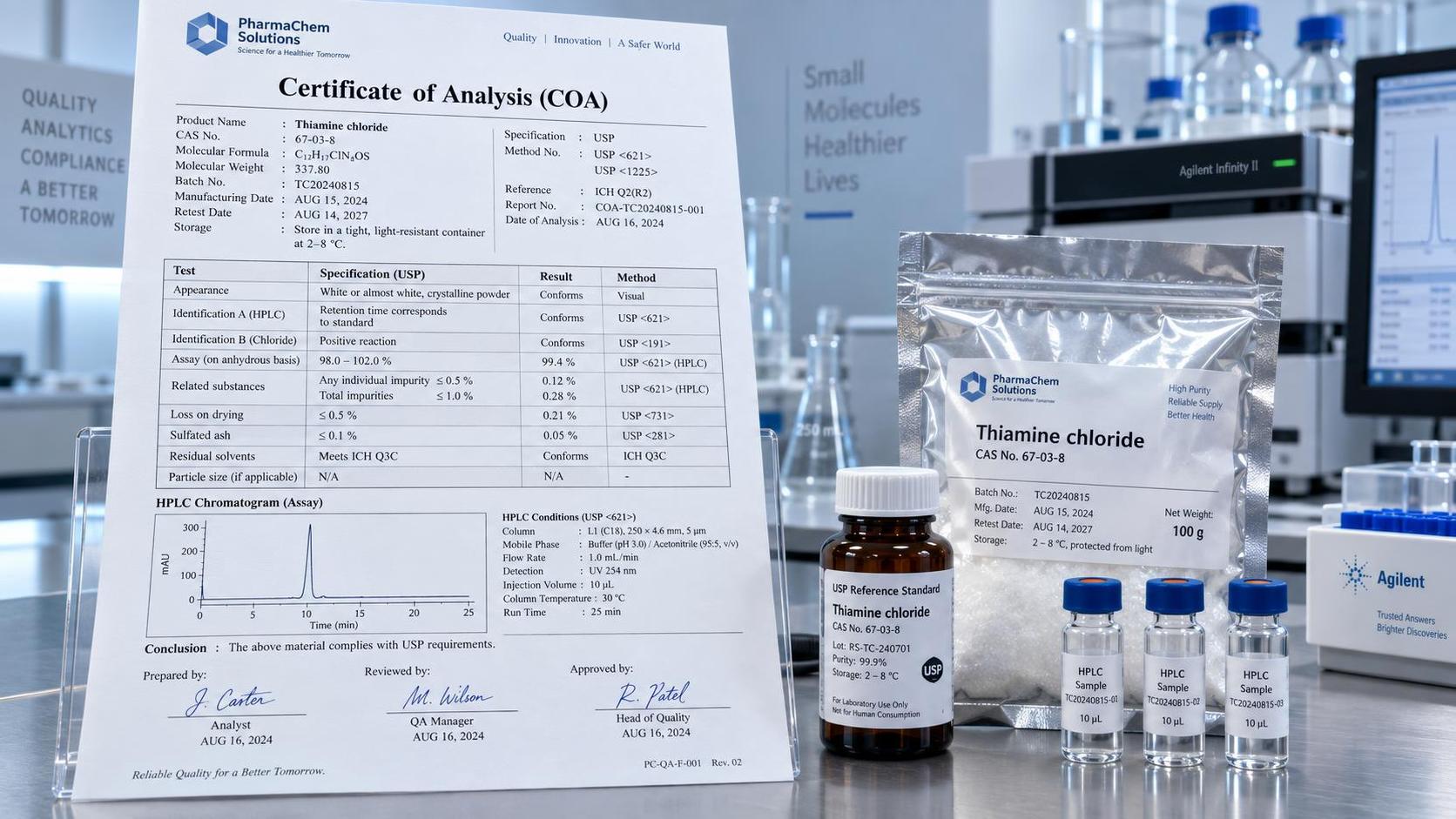
Why a Certificate of Analysis Is Non-Negotiable for Pharmaceutical Intermediates
For quality control (QC) and environmental, health & safety (EHS) professionals sourcing chemical raw materials, the Certificate of Analysis (COA) is not just paperwork—it’s your first line of defense. When procuring substances like Thiamine chloride CAS#59-43-8 for pharmaceutical intermediates, a validated COA directly impacts batch release decisions, regulatory audits, and patient safety. Without it, you’re operating on assumption—not data.
What QC Professionals Actually Need from a COA—Not Just What It Says
A compliant COA must go beyond generic declarations. It must be batch-specific, signed by an authorized quality representative, and include method references aligned with ICH Q2(R2), USP <71>, or EP 2.2.48. Crucially, it should report actual test results—not “meets specification” placeholders—for identity, assay, residual solvents, heavy metals, microbial limits, and related substances.
For example, thiamine chloride used in parenteral formulations demands strict control of chloride ion content and oxidation by-products. A robust COA will list measured values for impurities such as thiamine disulfide or sulfoxide—compounds that degrade stability and increase immunogenic risk. Generic certificates lacking chromatograms or raw instrument data offer zero traceability.
How Missing or Inadequate COAs Create Real Operational Risk
When a COA is missing, delayed, or inconsistent with shipping documents, QC labs face immediate bottlenecks: quarantine hold times extend, stability studies stall, and GMP audit findings mount. FDA Warning Letters consistently cite COA gaps as root causes for data integrity violations—especially when suppliers issue “duplicate” COAs post-shipment or omit testing dates.
Worse, inconsistent COAs erode confidence in supplier qualification. If one batch shows 99.2% assay and another—same lot number, different document—shows 98.7%, it signals analytical variability or documentation nonconformance. For intermediates destined for APIs, that variance may cascade into out-of-spec final dosage forms.
Three Must-Verify Elements Every COA Should Contain
1. Batch Traceability: Full batch/lot number matching the label, container, and shipping manifest—not a generic “product code.” This enables rapid recall if deviations emerge during downstream processing.
2. Testing Method Transparency: Explicit reference to pharmacopoeial methods (e.g., “USP-NF Monograph for Thiamine Chloride”) or fully validated in-house procedures—including equipment models, column specifications, and acceptance criteria. Vague phrases like “standard method” are red flags.
3. Stability-Relevant Parameters: For hygroscopic or light-sensitive materials like thiamine chloride—stored under inert atmosphere and protected from light—a compliant COA must report water content (Karl Fischer), residual solvents (GC), and appearance (white to off-white solid), all verified under controlled conditions.
Why Sourcing from China Adds Complexity—and Why COA Rigor Matters More
Global supply chains increasingly rely on Chinese manufacturers for cost-effective, high-purity intermediates. Yet regional differences in lab accreditation, regulatory enforcement, and documentation culture mean COA reliability varies widely. Unlike EU or U.S.-based suppliers subject to routine MHRA or FDA inspections, many Chinese exporters lack ISO/IEC 17025-accredited testing labs—or fail to maintain audit-ready records.
This is where due diligence shifts from “Is there a COA?” to “Can this COA withstand scrutiny?” At Shandong Huafeng Chemical Co., Ltd., every export shipment of chemical raw materials with COA undergoes dual verification: in-house QC testing per ICH guidelines, followed by third-party lab validation for critical parameters. Our COAs include full chromatograms, raw data summaries, and expiry/retest dates—all traceable to certified reference standards.
Practical Steps to Evaluate COA Credibility Before Purchase
Before approving a new supplier, QC teams should perform a three-tier review: First, cross-check the COA against the product specification—do limits align with your internal quality agreement? Second, verify signature authority: Is the signatory named, titled, and authorized per the supplier’s quality manual? Third, request method validation reports for at least one key test (e.g., HPLC assay for Thiamine chloride CAS#59-43-8). Reputable partners provide these without delay.
Also, insist on electronic COAs with digital signatures and time-stamped metadata. PDFs with editable fields or scanned signatures raise authenticity concerns—and complicate 21 CFR Part 11 compliance for U.S.-bound shipments.
How Huafeng Chemical Delivers COA Integrity You Can Rely On
As a Shandong-based exporter serving pharmaceutical clients across Europe, North America, and Southeast Asia, Huafeng Chemical embeds COA rigor into its operational DNA. Our facility maintains ISO 9001-certified quality management systems, with QC labs equipped for HPLC, GC-MS, ICP-MS, and KF titration. Every COA includes batch-specific test results, method citations, and storage condition notes—critical for compounds like thiamine chloride, which degrades above 248 °C (decomp) and requires dark, inert-atmosphere handling.
We don’t issue blanket certificates. Each COA reflects actual testing performed on the exact material shipped—not pooled data or historical averages. That consistency supports your GMP documentation, reduces CAPA burden, and strengthens your regulatory submissions. When your auditor asks, “How do you verify incoming raw material quality?”, your answer starts with a verifiable, transparent COA—not a promise.
Conclusion: Treat the COA as Your First Release Test
A Certificate of Analysis is far more than a compliance checkbox. For QC and EHS professionals, it’s the foundational evidence that chemical raw materials meet identity, purity, and safety requirements before they ever enter your facility. In pharmaceutical intermediate sourcing, where minor impurities can derail clinical trials or trigger recalls, skipping COA due diligence isn’t efficient—it’s expensive and dangerous.
Choose suppliers who treat COA generation as science—not administration. Demand specificity, traceability, and transparency. And remember: the strongest COA isn’t the longest one—it’s the one you can trust, replicate, and defend in front of regulators. With Huafeng Chemical, you get chemical raw materials with COA built on verified data, global standards, and real-world accountability.
Send Us Your Inquiry Today
