









Product Quick Navigation
Get a Quote
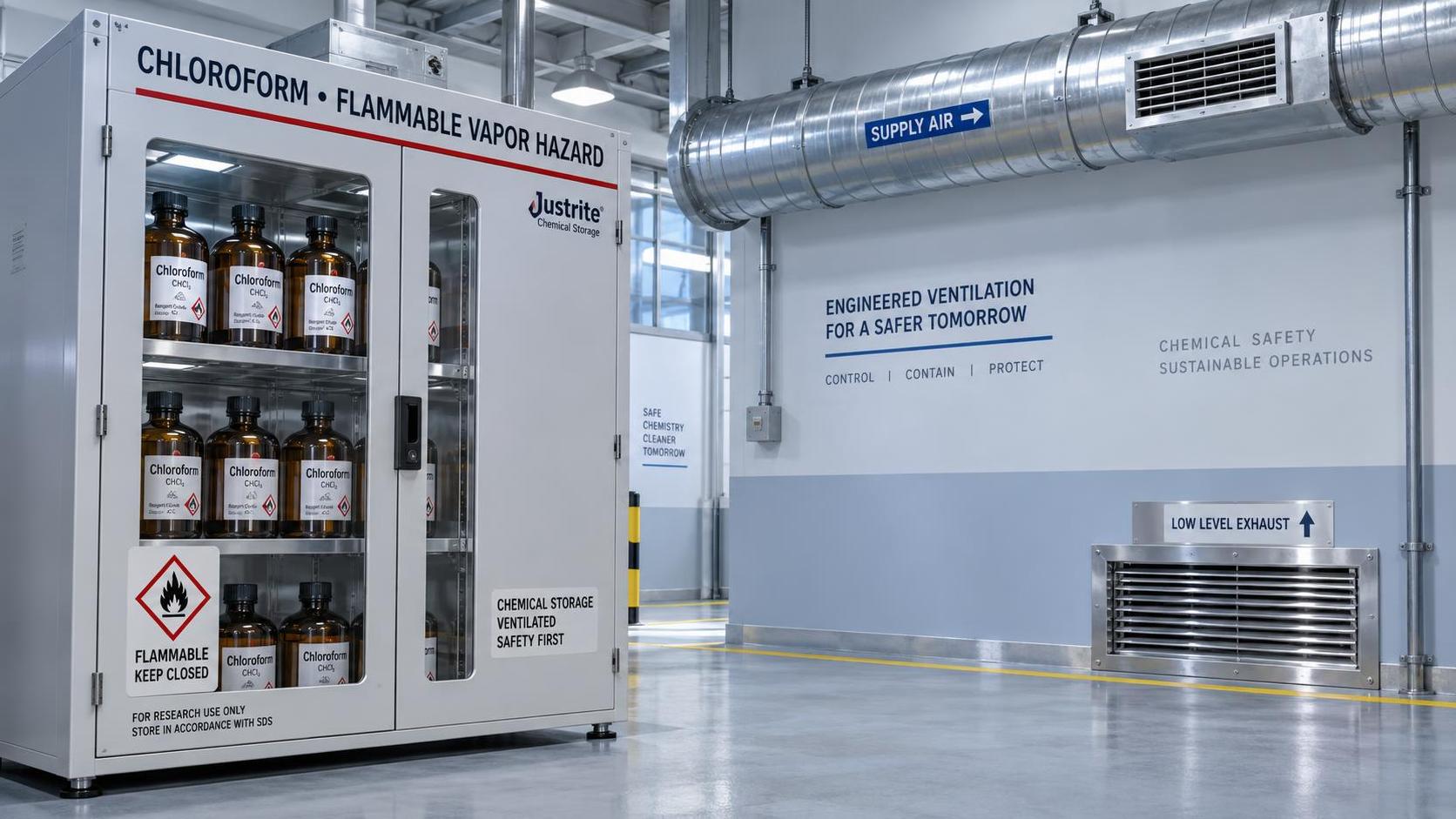
Why chloroform isn’t just “flammable”—it’s a vapor hazard that demands engineered containment
Chloroform doesn’t catch fire easily—but that’s exactly why misclassifying its storage is so dangerous. Its flash point is 62°C (144°F), well above room temperature, so it won’t ignite from a spark under normal conditions. But its real threat lies elsewhere: high vapor pressure (159 mmHg at 20°C), low autoignition temperature (460°C), and ability to form explosive mixtures with air across a wide range (12–18% v/v). That combination means chloroform vapors accumulate silently—especially in poorly ventilated spaces—and can travel meters before finding an ignition source. Storing it outside a designated flammables area isn’t merely noncompliant—it’s functionally inviting latent risk.
Flammables area: Not a label. It’s an engineering control.
“Flammables area” isn’t shorthand for “where we keep the flammable stuff.” It’s a defined physical zone built to three interlocking criteria: structural separation (fire-rated walls/doors), electrical classification (Class I, Division 2 or Zone 2), and—critically—mechanical ventilation designed to prevent vapor accumulation. In practice, this means chloroform must be stored in cabinets or rooms where airflow is not incidental but intentional: continuous, directed, and verified. We’ve seen clients assume a well-ventilated warehouse corner qualifies—only to find vapor concentrations exceeding 25% of the LEL during routine monitoring. That’s not theoretical. It’s what triggers OSHA citations and stops shipments at EU ports.
Ventilation specs: Why “10 air changes/hour” is necessary—but rarely sufficient
The 10 ACH (air changes per hour) minimum comes from NFPA 30 and ISO 8573-1 Annex B, but it’s a baseline—not a guarantee. Real-world performance depends on three things no spec sheet captures: duct placement, exhaust velocity, and vapor density. Chloroform vapor is 2.9 times heavier than air. If your exhaust grilles are mounted near the ceiling (standard for heat removal), you’re exhausting clean air while letting chloroform pool at floor level—right where drums sit and operators walk. The fix? Low-level exhaust, ideally within 30 cm of the floor, paired with supply air introduced high. And “explosion-proof” isn’t optional: standard motors can spark inside enclosures during maintenance or voltage fluctuation. One client in Jiangsu replaced non-certified fans after a near-miss incident—vapor had migrated into an adjacent utility corridor where a contractor was welding.
Monitoring isn’t optional—and it’s not just about alarms
Continuous vapor monitoring serves two distinct purposes: worker protection (TLV-TWA = 10 ppm) and fire prevention (LEL monitoring down to 5%). But here’s what’s often missed: calibration drift. Electrochemical sensors for chloroform lose sensitivity after 3–4 months in humid coastal environments—a reality for many Shandong-based facilities exporting to Southeast Asia or Latin America. We recommend cross-verifying with portable photoionization detectors (PID) during quarterly audits. Also, don’t rely solely on room-level monitors. Install point-of-release sensors near drum valves and transfer points. That’s where concentration spikes happen—not in the center of the room.
Storage isn’t isolated from other operations
Chloroform’s reactivity profile matters beyond fire risk. It degrades in light and reacts with oxygen over time to form phosgene—a highly toxic gas. That’s why amber-coated containers and nitrogen purging matter. But more subtly, storage location affects compatibility with nearby materials. For example, Stearic acid CAS#57-11-4 is routinely stored in adjacent zones for rubber compounding lines. While stearic acid itself poses minimal vapor risk (vapor pressure <0.1 mmHg at 25°C), its powder form can generate dust clouds—and chloroform vapors lower the ignition energy required for organic dust explosions. Separation distance isn’t just about fire rating; it’s about preventing unintended reaction pathways.
What Huafeng Chemical sees on the ground
Working with labs and manufacturers across 18 countries, we’ve noticed consistent gaps—not in knowledge, but in implementation. Clients understand the rules. Where they stumble is in translating them to local infrastructure: retrofitting old warehouses with low-level exhaust, sourcing certified fans in regions with limited industrial suppliers, or calibrating monitors against regional humidity. One European client passed audit on paper but failed operational verification because their “10 ACH” calculation assumed ideal mixing—while actual airflow maps showed dead zones behind pallet racking. That’s why our technical support includes ventilation schematics tailored to existing layouts—not just compliance checklists.
The quiet cost of cutting corners
Noncompliance rarely shows up as fire or explosion first. It appears as rejected batches (vapor-contaminated solvents affecting downstream reactions), delayed customs clearance (EU REACH documentation requiring verified storage logs), or elevated worker health claims (chronic exposure symptoms mistaken for fatigue). A recent review of 12 incident reports involving chloroform handling found 70% originated from ventilation failures—not ignition events. That’s the nuance: the hazard isn’t dramatic ignition. It’s slow erosion of control—until one variable shifts.
One practical step forward
Before upgrading hardware, map your current airflow with smoke tubes during active handling. Watch where vapors go—not where you hope they’ll go. Then validate with a calibrated monitor at three heights: 15 cm, 120 cm, and 200 cm above floor level. If readings differ by more than 3× between lowest and highest point, your ventilation design needs rethinking—not just recalibration. That test takes 90 minutes. It’s cheaper than a citation, safer than a near-miss, and more reliable than any spec sheet.
Send Us Your Inquiry Today
