









Product Quick Navigation
Get a Quote
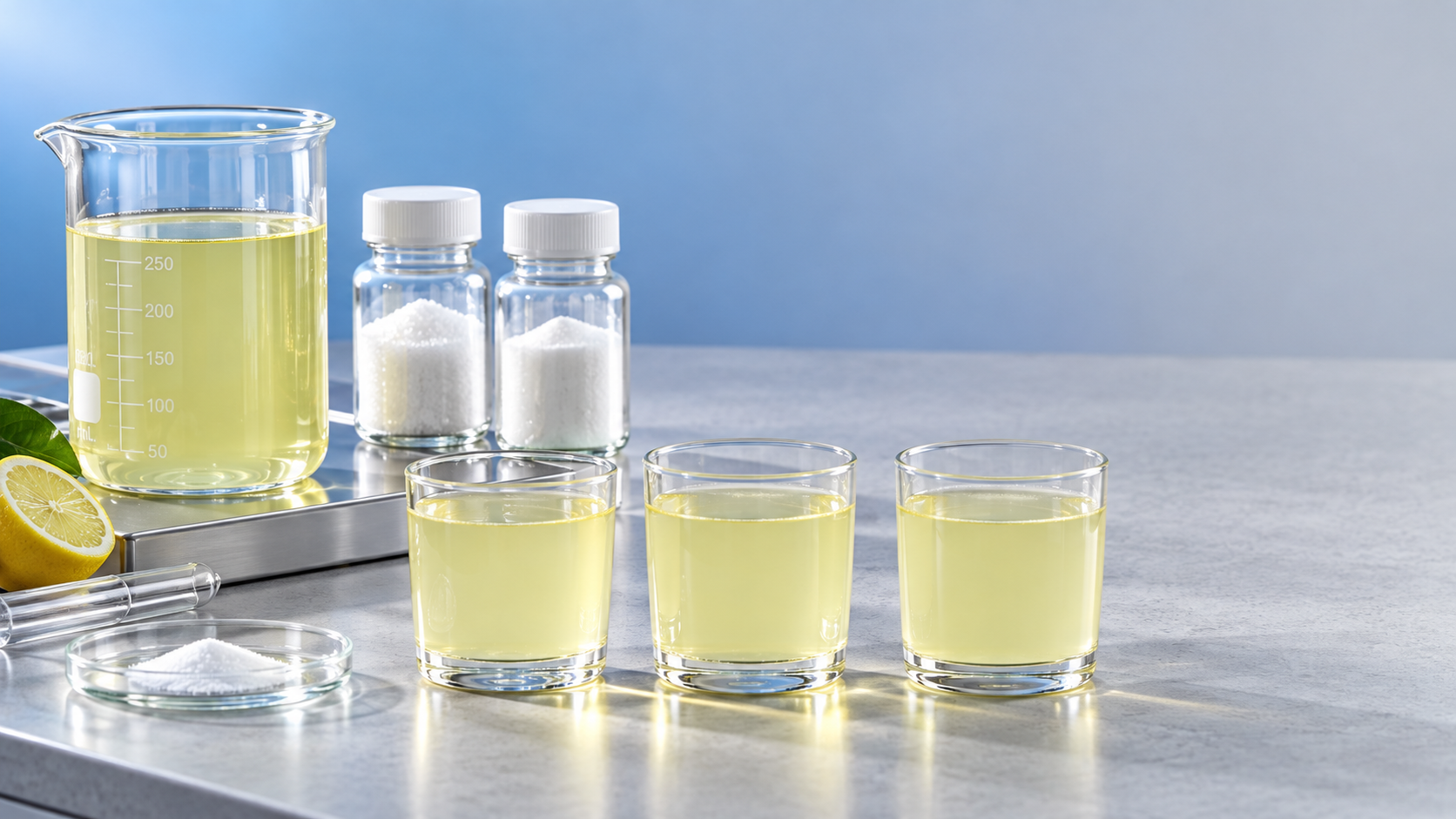
A sugar-free drink can match sucrose in peak sweetness and still finish bitter. The difference often lies in the timing: sweetness builds, peaks, and fades differently for each sweetener, while bitter or licorice-like notes may remain after the main sweetness has declined. A useful blend therefore does more than replace sugar intensity. It distributes sweetness across time while keeping each component below concentrations that produce unacceptable off-notes.
Blending food sweeteners can reduce perceived bitterness, but it does not automatically remove the bitter compounds already present in caffeine, botanical extracts, or other ingredients. The practical task is to distinguish sweetener-derived off-notes from matrix-derived bitterness, then optimize the blend at equal perceived sweetness in the finished beverage—not in water alone.
Identify what is actually causing the bitter finish
“Bitter aftertaste” can describe several different defects: genuine bitterness, metallic character, licorice-like persistence, astringency, or an unusually long sweet finish. These sensations require different corrections. Reducing a lingering sweetener may improve temporal balance, whereas reducing astringency may require changes to tea extracts, polyphenol content, or processing rather than another sweetener ratio.
A diagnostic comparison should include the unsweetened beverage base, individual sweeteners in that base, and the proposed blend. Water-based references can help identify an ingredient’s characteristic profile, but the beverage samples determine whether it matters commercially. Evaluate both immediately after swallowing and during the subsequent fade-out.
If bitterness is already prominent in the unsweetened base, increasing sweetness may suppress its perception but can also create an excessively sweet drink. In a caffeinated citrus beverage, for example, the limiting factor might be the caffeine load rather than the sweetener system. Treating every bitter finish as a sweetener problem can lead to unnecessary reformulation without correcting the underlying cause.
Choose complementary profiles, not simply different ingredients
The strongest rationale for blending is complementarity. One component may contribute earlier sweetness, another may provide intensity through the middle of the tasting period, and a third may improve body. The objective is not necessarily to use more sweeteners; it is to obtain a cleaner profile at lower individual concentrations.
These are screening considerations, not a universal ranking. A sucralose–acesulfame potassium blend may outperform either ingredient alone in one acidic drink but remain unsuitable for a different flavor system. Similarly, replacing one steviol glycoside preparation with another can change the result even when the declared total glycoside purity is similar.
Sweetness synergy can allow a blend to reach the target intensity with less total sweetener than an additive calculation predicts. That creates an opportunity to reduce off-notes associated with higher individual doses. However, synergy in sweetness is not proof of bitterness reduction. Both attributes must be measured separately.
Set blend ratios by sweetness contribution
Mass ratios are a poor starting point when ingredients have very different potencies. An equal-mass mixture does not deliver equal sweetness contributions, and potency itself changes with concentration and matrix. Published sucrose-equivalence values are useful for initial screening, not for locking a commercial formula.
Begin with a sucrose reference representing the desired sensory target, even if sucrose will not appear in the final product. Establish approximate dose-response relationships for the candidate sweeteners in the beverage base. Then prepare blends spanning different estimated sweetness contributions while holding overall perceived sweetness as close to the reference as possible.
For example, a development screen might compare nominal contributions of 70:30, 50:50, and 30:70 from two sweeteners. These are experimental design points, not recommended mass ratios or validated recipes. Each blend requires sensory adjustment because interactions can shift sweetness away from the calculated value.
Comparing blends at unequal sweetness creates a major interpretive problem: the sweeter sample may appear less bitter simply because sweetness suppresses bitterness. An equal-sweetness comparison provides a better basis for deciding whether the blend itself improves flavor quality.
Once a promising region is found, refine the ratio locally rather than expanding immediately to three or four ingredients. Additional components increase the number of interactions, complicate specifications, and make sensory defects harder to trace.
Keep the beverage matrix under control
Acid balance affects both sweetness and bitterness perception. Record pH and titratable acidity, because equal pH does not mean equal sourness or buffering behavior. Changing citric acid to a different acid system can alter the balance even when the pH reading remains unchanged.
Do not raise pH simply to make a sweetener taste cleaner. That change can affect microbial control, preservative performance, flavor, and processing requirements. If acidity is modified, the beverage’s safety and stability design must be reassessed alongside its sensory profile.
Carbonation adds another variable through carbonic acid and trigeminal stimulation. A blend selected in a still laboratory sample may taste sharper or less balanced after carbonation. Compare samples at controlled dissolved carbon dioxide levels and serving temperatures; otherwise, processing differences can be mistaken for sweetener effects.
Flavor ingredients can also change apparent sweetness. Vanilla or certain fruit-associated aromas may reinforce sweetness perception, but aroma adjustment should not conceal an unresolved bitter base. Evaluate the intended commercial flavor system rather than relying on an unflavored screening solution.
Removing sugar also removes dissolved solids and changes mouthfeel. A thin drink can make aftertaste more conspicuous, even if bitterness intensity has not increased. Where permitted, bulk sweeteners or suitable mouthfeel ingredients may help, but their effects on clarity, flavor release, calories, and claims need separate checks.
Measure the finish, not just the first sip
A single overall liking score is insufficient for selecting a low-bitterness blend. Use blind, randomized comparisons and assess attributes that correspond to the formulation problem:
- Sweetness onset, peak intensity, and persistence.
- Bitterness during drinking and after swallowing.
- Metallic, licorice-like, cooling, or astringent sensations.
- Flavor clarity and balance with acidity.
- Acceptability across repeated sips, not only one small taste.
Time-intensity measurements are especially useful when two blends have similar peak sweetness but different finishes. A simpler structured protocol can also work: record attributes at defined intervals after swallowing, keeping sample volume, temperature, and timing consistent. Give assessors sufficient recovery time because lingering sweetness can affect the next sample.
Use trained descriptive assessment to identify the cause of differences, then consumer testing to determine whether those differences matter to the intended market. Individual sensitivity to bitterness and sweetener aftertaste varies. A formulation should not be selected solely because one internal evaluator considers it clean.
Define acceptance criteria before choosing the winner. A blend might require bitterness no higher than an agreed benchmark, sweetness within a target range, and no objectionable residual note after repeated consumption. This prevents a small improvement in peak sweetness from outweighing a clearly worse finish.
Confirm that the balance survives production and storage
A blend optimized in a fresh bench sample is only a candidate. Validate it after the intended thermal process, dilution sequence, carbonation step, and packaging operation. For low-dose ingredients, incomplete dissolution or inaccurate addition can change the effective ratio enough to affect taste.
Storage can shift the balance if one component loses sweetness faster than another. Aspartame-containing systems need particular attention to the combined effects of acidity, temperature, and time. Other sweeteners also require validation under the actual processing and storage conditions rather than assumptions based on their general reputation for stability.
Assess sensory performance alongside appropriate chemical measurements. A total sweetener assay alone may not explain a changed finish if the ratio has shifted, flavor compounds have degraded, or the beverage base has become more bitter. Accelerated storage can support screening, but real-time data remain important for confirming the intended shelf life.
Specify the blend tightly enough to reproduce it
For commercial transfer, the ingredient name is not enough. Specifications should define identity, assay basis, relevant compositional profile, carrier content, and appropriate impurity limits. Botanical sweeteners especially require composition-sensitive controls: equal headline purity does not guarantee equivalent sweetness or aftertaste.
Confirm food-grade status and authorization for the exact beverage category in each destination market, including maximum permitted levels, labeling, and claim conditions. “Sugar-free” requirements are not globally interchangeable, and the use of a particular bulk sweetener can affect nutrition declarations or warning statements.
The final selection should therefore be a reproducible operating range, not merely one preferred tasting sample. A successful blend maintains acceptable bitterness, sweetness timing, and flavor balance despite realistic variation in dosing, raw materials, processing, and storage. That robustness is what turns a promising sensory improvement into a dependable sugar-free beverage formulation.
Send Us Your Inquiry Today
