









Product Quick Navigation
Get a Quote
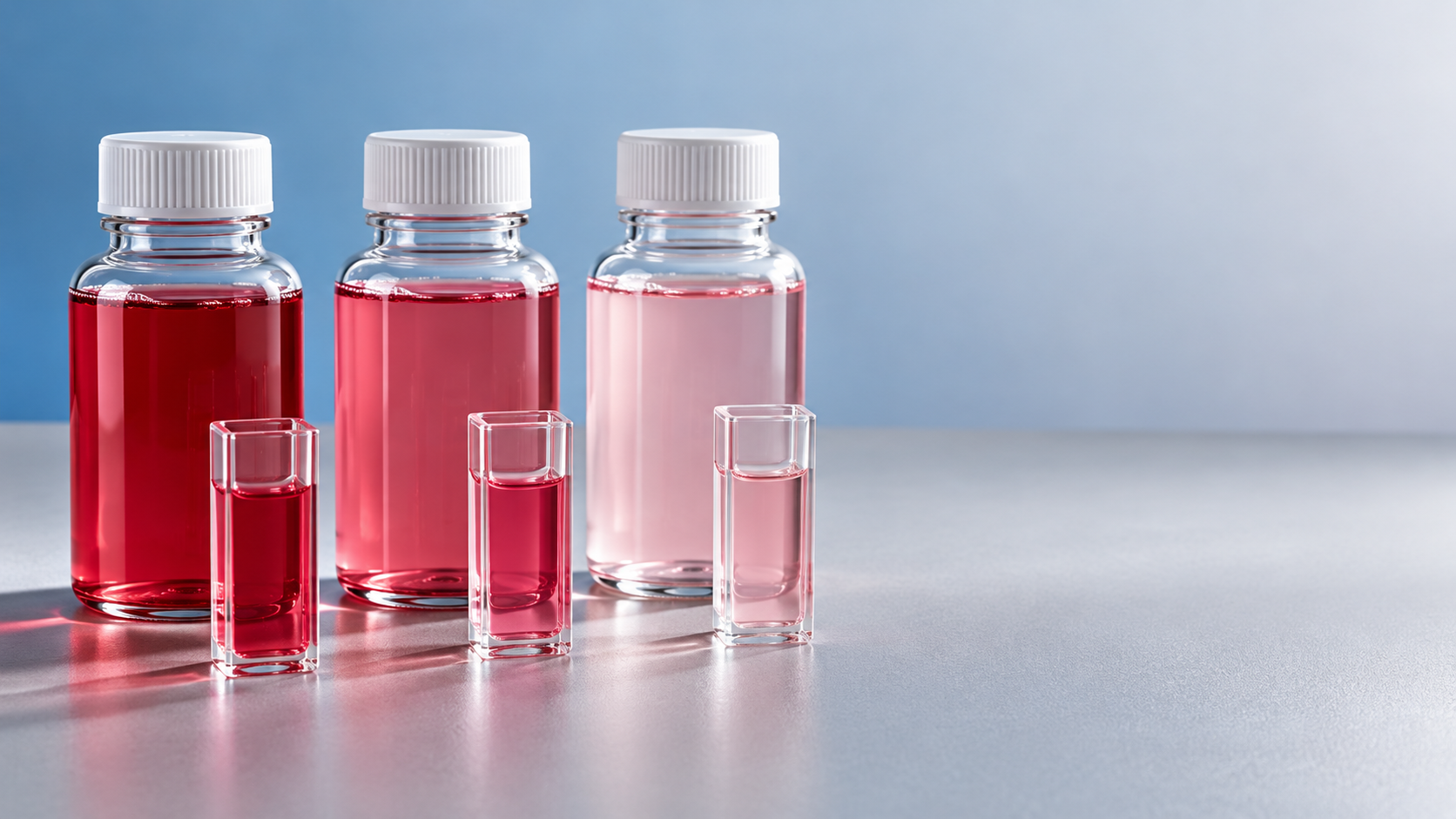
When an acidic drink fades during shelf-life testing, low pH is only one possible cause. Food colorants can lose intensity through oxidation, light exposure, heat damage, or reactions with other ingredients. A drink can also appear lighter because pigment has settled, separated, or changed its chemical form without being permanently destroyed. Each mechanism calls for a different corrective action.
Before increasing the color dose or replacing the colorant, establish when the change begins, whether the hue shifts, and whether the loss occurs throughout the liquid. Those observations help separate a formulation problem from a processing or packaging problem—and prevent a temporary visual improvement from masking continued instability.
Distinguish fading from a reversible color change
A paler sample does not automatically mean the pigment has degraded. Some pigments respond directly to acidity. Anthocyanins, for example, exist in different forms depending on pH, producing changes in hue and intensity. Their behavior also depends on the botanical source and surrounding formulation. Two drinks containing the same named color ingredient can therefore age differently.
Measure the pH of fresh and stored samples at a consistent temperature. For carbonated drinks, define a consistent measurement procedure because carbon dioxide loss during sample preparation can affect the result. Record titratable acidity separately: pH describes the immediate acidic environment, while titratable acidity helps characterize the acid system and its buffering behavior.
In a controlled laboratory comparison, adjusting fresh and aged samples to the same pH can help identify a pH-related contribution. Partial color recovery suggests that some change involves pigment equilibrium. It does not establish that degradation is absent or that the adjusted drink is suitable for sale.
Also inspect the bottle before mixing it. A pale upper layer with sediment below suggests physical instability. A colored ring, surface layer, or deposit on the container may indicate separation or adsorption. Compare standardized mixed and unmixed samples; otherwise, inconsistent sampling can look like chemical fading.
Why food colorants behave differently in acidic drinks
“Acid stable” describes only part of a colorant’s performance. It does not establish resistance to oxygen, retail lighting, pasteurization, or the complete beverage formula. Selection should reflect the combined stresses the drink will experience.
Anthocyanin colors often provide useful red shades in acidic beverages, but source, pigment structure, temperature, oxygen, and other ingredients influence their stability. A successful trial with one fruit-derived extract does not automatically qualify another extract carrying a similar color description.
Carotenoid colors require attention to oxidation and physical delivery. Many are supplied as emulsions or dispersions because the pigments themselves are poorly soluble in water. Loss of orange or yellow appearance may involve pigment degradation, droplet instability, or both. Acid tolerance alone cannot predict whether a particular emulsion will remain evenly distributed.
Betalain colors can deliver attractive shades in suitable acidic formulations, but heat exposure may limit their usefulness. A color that looks satisfactory in a cold laboratory blend may deteriorate during processing or warm storage.
Permitted synthetic colors can offer useful stability in some applications, but performance remains specific to the molecule and formulation. Certain colors are vulnerable to reducing ingredients, light, or other beverage components. Their permitted uses also depend on the destination market and beverage category.
Choose the required shade and labeling profile, then compare candidates in the finished beverage. Testing a colorant in acidified water is a useful screening step, but it leaves out interactions with vitamins, flavors, minerals, juice solids, and preservatives.
Oxygen, light, and vitamin C can work together
Oxygen enters through mixing, ingredient addition, transfers, filling, and package headspace. It may also enter through the package during storage. Where a pigment is oxidation-sensitive, these sources can contribute to progressive color loss even when the drink’s acidity remains unchanged.
Compare dissolved oxygen around the relevant processing stages rather than relying solely on a measurement taken long after filling. A low reading in an aged sample does not prove that oxygen exposure was low: oxygen may already have been consumed by reactions. Headspace conditions and closure performance also belong in the investigation.
Ascorbic acid deserves particular attention. Although it serves as an antioxidant in many systems, it can contribute to degradation of some pigments, including anthocyanins, under certain beverage conditions. Its effect depends on oxygen, trace metals, concentration, and the surrounding chemistry. Adding more vitamin C is therefore not a dependable general remedy for fading.
Trace iron and copper can accelerate oxidative reactions. Potential sources include water, mineral ingredients, botanical extracts, and product-contact equipment. Investigate them when ingredient changes, equipment condition, or analytical results support that direction. Any chelating ingredient considered as a remedy must be permitted for the intended use and evaluated in the complete formula.
Light can accelerate pigment degradation directly or through other light-sensitive ingredients. Riboflavin, for example, can promote photooxidation. A drink that remains stable in dark storage may fade in a clear bottle under display lighting. Compare light-exposed samples with dark controls while monitoring temperature so that lamp heating does not confuse the result.
Use the failure pattern to narrow the investigation
These patterns guide experiments; they do not establish a cause by themselves. For example, a package comparison may change both light exposure and oxygen transmission. Isolate the suspected factor wherever practical, and retain an unchanged control.
Build a stability trial that answers a specific question
Start with the current formula, intended package, and actual process. Retain samples from before and after major processing stages where practical. Record color, pH, appearance, and relevant oxygen measurements at baseline. Without a reliable starting point, storage results can mix initial processing damage with subsequent deterioration.
Use a small set of purposeful comparisons rather than changing several ingredients together. Depending on the suspected mechanism, compare:
- The current formula and a version without ascorbic acid, as a diagnostic comparison.
- Normal handling and a process designed to reduce oxygen pickup.
- Light exposure and dark storage in otherwise comparable conditions.
- The current colorant and a technically suitable alternative at comparable initial appearance.
A diagnostic formula does not automatically become a commercial option. Removing vitamin C may conflict with nutritional positioning; changing the package may affect cost or distribution. The trial first establishes which factor matters, allowing the eventual correction to address that cause.
Accelerated storage can reveal weaknesses and help rank candidates, but elevated temperature may change the dominant degradation pathway. It can also destabilize emulsions differently from normal storage. Avoid assigning a commercial shelf life from a simple high-temperature conversion unless that relationship has been established for the particular product and package. Maintain real-time testing under intended storage conditions.
Include realistic distribution stresses where relevant, such as warm transport or retail lighting. Keep them distinct from deliberately severe diagnostic conditions so that a useful stress test does not become an unsupported prediction of normal product behavior.
Measure the change consistently
Visual inspection matters because consumers judge appearance, but it should be supported by consistent instrumental measurements. Use the same sample preparation, measurement temperature, container or cuvette, optical path, and instrument settings. Bubbles, haze, and suspended material can alter readings independently of pigment concentration.
A single absorbance reading may miss a shift in the pigment’s absorption spectrum. Where appropriate, examine the spectrum alongside instrumental color measurements. Track hue and lightness as well as overall color difference. If turbidity changes substantially, assess it separately before interpreting the result as pigment destruction.
Define acceptance criteria before reviewing the study outcome. They should reflect the intended appearance and detectable changes in the actual package. A generic color-difference threshold may not describe what consumers notice in a transparent drink, an opaque bottle, or a strongly flavored beverage.
Correct the cause and qualify the replacement
If oxygen drives the failure, improving mixing, transfer, deaeration, filling, or package protection may be more effective than changing pigment. If the color drops during heating, review the complete time-and-temperature exposure, including holding and cooling. Reducing heat exposure must remain compatible with the validated preservation process.
Increasing the color dose can deepen the starting shade while leaving the degradation rate unchanged. It may also affect flavor, labeling, or permitted use levels. Treat dosage adjustment as a formulation decision after identifying the failure mechanism.
When sourcing a replacement, request the exact color identity, carrier composition, color-strength specification, batch documentation, storage requirements, and application data relevant to the intended beverage. Similar product names do not establish equivalent composition or stability. Botanical source changes and reformulations should trigger a defined review rather than an automatic substitution.
Color loss alone neither proves a safety failure nor establishes that a drink remains acceptable. Unexpected fading accompanied by pH drift, gas formation, swelling, off-odors, or unusual sediment requires broader investigation alongside the established microbiological and chemical controls.
The next production trial should address the strongest supported cause, retain an unchanged control, and use predefined acceptance limits. Release decisions should rest on the corrected formula, process, and package completing the relevant validation—not on a fresh sample looking the right shade.
Send Us Your Inquiry Today
