









Product Quick Navigation
Get a Quote
Sourcing Fipronil: Registration Status, Impurity Limits, and Batch Records
Sourcing Fipronil requires more than comparing prices and delivery schedules. For procurement teams, market-specific registration status, applicable impurity limits, and traceable batch records are essential checkpoints before placing an order. Gaps can delay clearance, prevent quality release, or leave stock unusable for its intended application.
The practical challenge is making the documents agree. A specification describes what the supplier promises; a certificate of analysis reports what was tested; registration documentation establishes whether the proposed source and product fit the intended market. None replaces the others. Buyers evaluating Shandong Huafeng Chemical or another export partner should resolve these connections before negotiating the final shipment schedule.
Define the purchase before checking the registration
Start with the destination, intended use, product form, and actual manufacturing site. Fipronil technical material and a formulated product are not interchangeable purchasing categories. A formulation also brings concentration, formulation type, stability, packaging, and labeling requirements into the review. A quotation that says only “Fipronil” is not detailed enough to approve.
Registration must be checked against the relevant national authority and product category. Agricultural pesticides, biocidal products, and veterinary products can follow different regulatory routes. Authorization for one use does not establish permission for another, and export availability does not establish import or sale eligibility.
Ask the supplier to identify the registrant or authorization holder, registration reference where applicable, approved product identity, and source manufacturer. Have your local regulatory specialist confirm whether the proposed shipment is covered. Where source approval or technical equivalence is required, a different factory may need additional assessment even when the active ingredient and nominal assay remain unchanged.
A useful question is: “If the factory changes after this quotation, what must be approved before shipment?” If the answer is unclear, the supply arrangement is not yet ready for a firm delivery commitment.
An assay result is not an impurity specification
High active-ingredient content does not, by itself, demonstrate an acceptable impurity profile. Two technical batches can meet the same assay minimum while containing different process-related impurities. That distinction matters where a registered specification or source assessment controls particular impurities.
Do not adopt a numerical impurity limit from an unrelated supplier sheet or another market. The applicable acceptance criteria should come from the relevant registration documentation, legally applicable requirements, and the agreed purchasing specification. Published reference specifications may help the review, but they do not automatically authorize a source or override local requirements.
For each controlled impurity, establish the name or identifier, maximum permitted level, reporting unit, analytical method, and reporting threshold. Where a reference specification identifies sulfones, sulfides, or other related compounds, confirm exactly which substances require control. Do not assume every degradation product is a manufacturing impurity, or that every related compound has the same regulatory significance.
“Not detected” deserves particular attention. It means little without a detection or quantification limit. If the method cannot reliably measure below the contractual maximum, the result cannot demonstrate compliance at that maximum. The laboratory should explain this capability before the first commercial batch is released.
Also confirm the assay basis. Results expressed on a dry basis are not directly interchangeable with results reported as received. Water content and calculation conventions can create apparent differences between laboratories without any actual change in the material.
Make the analytical method part of the agreement
A method reference on a certificate is a starting point, not sufficient evidence of suitability. For initial qualification, request enough information for your laboratory to assess selectivity, calibration, reference standards, and quantification capability. Proprietary details may require a confidentiality agreement; refusing all technical discussion is a different matter.
Agree how disputed results will be handled. Define sampling, sample sealing, storage, the independent laboratory, and the acceptance rule before a disagreement occurs. Otherwise, the supplier may test a retained factory sample while the buyer tests a poorly documented warehouse sample, leaving neither side able to explain the difference.
Follow the batch number through the shipment
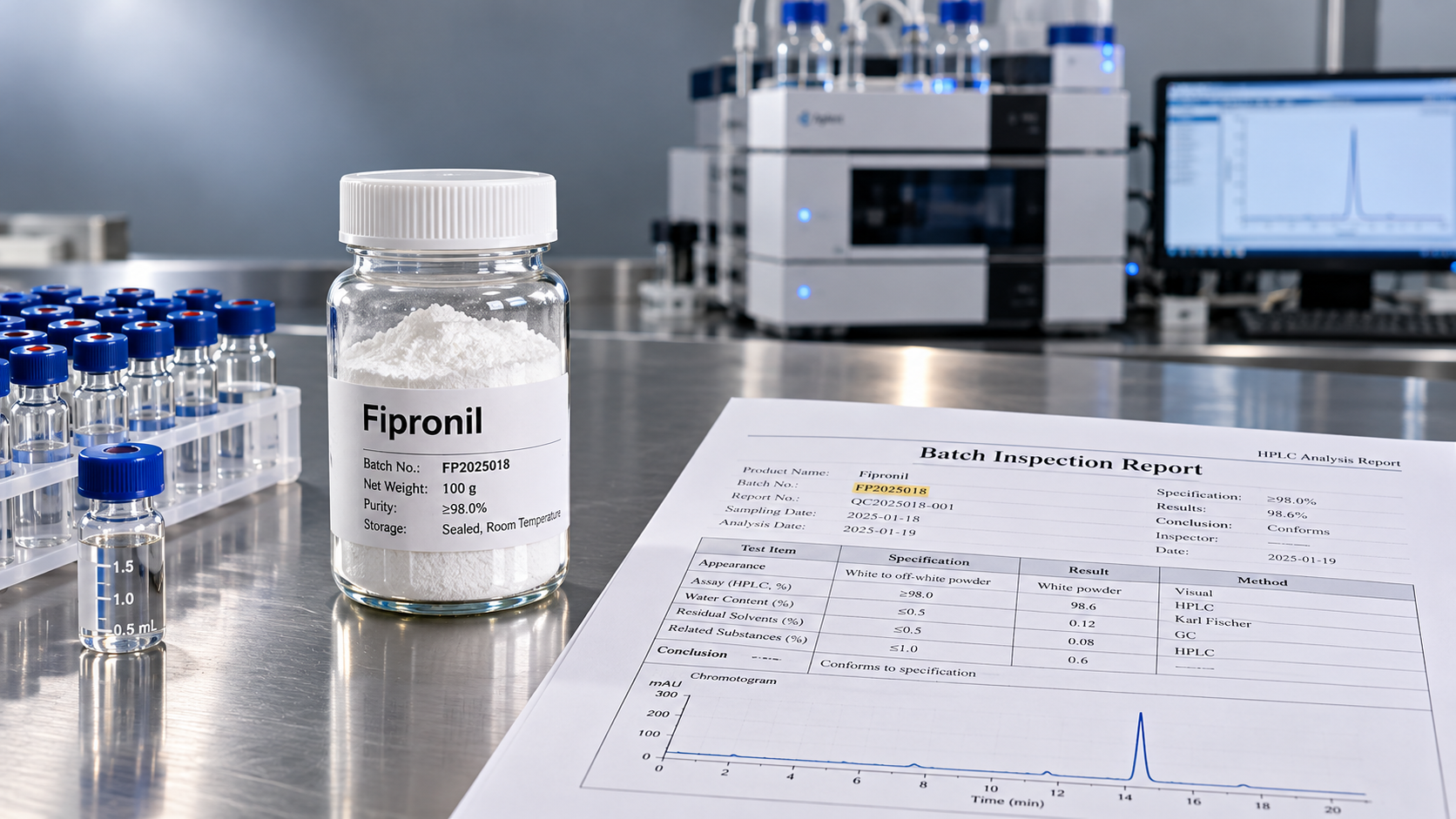
A certificate of analysis should belong to the material being shipped, not merely illustrate a typical production result. Request recent batch certificates during qualification and the actual shipment certificates before dispatch. Look for identifiable lots, testing dates, specification references, results, units, and authorized release.
The critical test is traceability across documents. Can each package be connected to a manufacturing lot, its release certificate, and the packing list? If several lots are supplied in one container, a single average result is not an adequate substitute for lot-specific evidence unless an expressly approved procedure permits it.
- Request the manufacturing site and production date for each lot, not just the exporter's name.
- Match package markings, lot quantities, net weights, and certificate numbers against the packing list.
- Record any repacking, including the responsible facility and the link to the original batch.
- Confirm retained-sample availability and the retention period relevant to your claims process.
- Require written notice before changes to the manufacturing site, process, specification, or test method.
Full manufacturing records may contain confidential process information and are not always released to buyers. A practical alternative is an agreed audit or controlled review covering production, deviations, testing, and release. The objective is verifiable traceability, not collecting documents that nobody will examine.
Separate the export service from the manufacturing evidence
An experienced trading partner can coordinate quotations, documentation, freight, and communication across factories. That is useful when procurement teams need responsive export support. However, a trader's service capability does not establish that a particular Fipronil source meets registration or impurity requirements.
Shandong Huafeng Chemical Co., Ltd., based in Shandong Province, presents itself as a chemical export service provider with a broad portfolio. When assessing such a partner, ask who manufactures the quoted material, who signs the quality agreement, and who must investigate an out-of-specification result. These responsibilities should remain clear even when the exporter manages all commercial communication.
Portfolio breadth also calls for product-specific qualification. For example, Barium Carbonate (Precipitated Barium Carbonate) CAS 513-77-9 is offered in industrial and electronic grades, where parameters such as iron, calcium, and particle size can influence suitability. Those grade-based checks cannot replace pesticide registration and impurity assessment. A supplier relationship may cover both categories; its approval criteria should not be copied from one to the other.
Compare the cost of usable stock, not the quotation alone
A lower price can be attractive when two offers cover equivalent material and responsibilities. It becomes misleading when one excludes independent testing, uses an unqualified source, or leaves registration support undefined. Procurement should compare the cost of material that can actually be released for use.
Include freight, insurance, destination charges, applicable duties, testing, financing, and expected inventory holding time. Keep uncertain costs visible rather than disguising them as precise forecasts. A possible source-approval delay, for instance, should be treated as a scenario requiring regulatory input, not assigned an invented standard duration.
Packaging and transport need separate confirmation. Obtain the current safety data sheet and verify dangerous-goods classification, packing requirements, carrier acceptance, and destination documentation for the actual product. Technical material and formulations may require different handling. Do not copy shipping details from another chemical in the supplier's catalog.
For a new source, a smaller qualification order may reduce exposure, provided it follows the same legal and quality controls as a commercial shipment. An approved sample is not enough if bulk production later comes from a different site or process.
Before issuing the purchase order, close three points in writing: the proposed source is acceptable for the intended market; the agreed specification includes applicable impurity controls and suitable methods; and every shipped lot will have traceable release records. Then define who pays for retesting, replacement, return, or lawful disposal if the material fails acceptance. Those terms are easier to negotiate before payment than after a container arrives.
Send Us Your Inquiry Today
