









Product Quick Navigation
Get a Quote
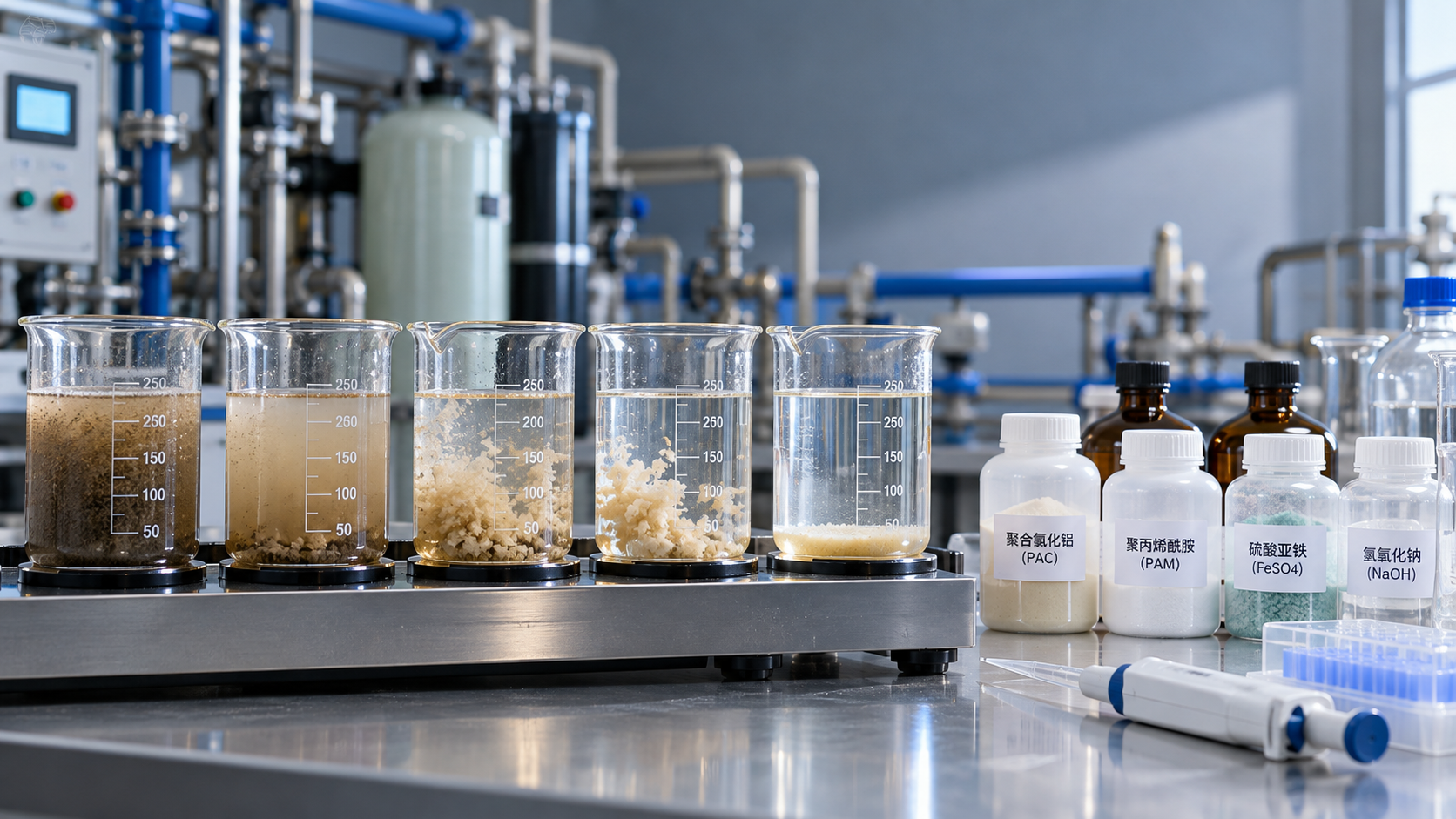
The right water treatment chemicals are those that consistently achieve the required effluent quality under the plant’s actual operating conditions—not necessarily those with the lowest price per tonne or the best result in a single laboratory test. A sound selection depends on what is present in the wastewater, where the chemical will be applied, and what happens to contaminants after treatment.
The decision also affects equipment sizing, sludge handling, operating costs and commissioning schedules. A coagulant that produces clear water in a jar test, for example, may still be unsuitable if its pH demand exceeds the neutralization system’s capacity or its sludge cannot be handled by the planned dewatering equipment.
Define the treatment endpoint before comparing chemicals
Start with the discharge or reuse requirements that apply at the point where performance will be measured. Direct discharge, discharge to a municipal sewer and internal water reuse can have different limits and acceptance conditions. Confirm not only numerical limits but also sampling frequency, averaging periods, monitoring methods and any restrictions on substances introduced by treatment chemicals.
Then distinguish the treatment objective from the contaminant measurement. A high chemical oxygen demand (COD) result indicates a need to investigate oxidizable material; it does not, by itself, identify the compounds responsible or prove that a particular coagulant will remove them. Likewise, a total metals result does not show how much metal is dissolved, precipitated or bound to complexing agents. Those distinctions affect whether separation, precipitation, biological treatment or another process is needed.
Establish an internal operating target below the applicable limit where appropriate. The margin should reflect influent variability, analytical uncertainty and the time operators need to detect and correct an upset. Selecting a chemical only to meet a limit under average conditions leaves little room for production changes or equipment downtime.
Characterize the wastewater that the plant will actually receive
A single composite sample can be useful for initial screening, but it can conceal short, concentrated discharges. Map the sources feeding the treatment system, including production streams, equipment cleaning, batch dumps, cooling-system blowdown and foreseeable changes in production. Identify which streams enter together and whether equalization is available.
At a minimum, the sampling plan should reflect flow, pH, temperature and the parameters relevant to the discharge target. Depending on the process, these may include suspended solids, COD, biochemical oxygen demand, oil and grease, dissolved and total metals, conductivity, alkalinity, nutrients and specific contaminants of concern. Sampling at different operating periods helps show whether the issue is a continuous load or an intermittent event.
Source information matters because visually similar wastewaters can behave differently. An emulsion stabilized by surfactants may not separate like free oil. Metals held in solution by chelating agents may not precipitate adequately through pH adjustment alone. High salinity can affect biological treatment and the suitability of downstream reuse, while variable alkalinity can change the amount of acid or alkali needed to control pH.
The manufacturing context can also guide sampling without predetermining treatment. In a polyester-related facility handling Purified Terephthalic Acid (PTA) CAS100-21-0, raw-material losses and cleaning operations are potential sources to investigate when mapping wastewater streams. The raw material itself is not a treatment chemical; its presence in a process does not establish a chemical dose or a treatment method.
Match chemical function to the separation problem
Most treatment programs combine functions rather than relying on a single product. The order of addition and the equipment available can be as important as the chemical family.
- pH adjustment and precipitation: Acids and alkalis bring wastewater into a range suitable for a downstream process or discharge. Alkali can also support precipitation of certain dissolved metals as hydroxides. The effective pH range depends on the metals and other constituents present; raising pH indiscriminately can increase chemical consumption or impair removal.
- Coagulation: Inorganic salts, such as iron- or aluminum-based coagulants, and some organic coagulants destabilize fine particles so they can aggregate. Selection depends on solids and colloid characteristics, pH, alkalinity and the separation process. Inorganic coagulants can consume alkalinity and increase sludge production.
- Flocculation: Polymers help form larger aggregates that can settle, float or be captured during dewatering. Polymer charge, molecular weight, dilution and mixing conditions matter. Overdosing can impair separation or create handling problems, so more polymer is not automatically better.
- Oxidation or reduction: These chemicals alter the chemical state of selected contaminants. Their effectiveness depends on reaction conditions and contact time. Assess by-products, residual oxidant and the effect on downstream biological treatment before adoption.
- Biological-process support: Nutrients, pH-control chemicals and, where justified, other additives can support biological treatment. They do not replace adequate biological capacity, oxygen transfer or control of toxic and inhibitory discharges.
Chemical treatment can transfer pollutants from water to sludge rather than eliminate them. Metals precipitation is an example: the dissolved metal becomes part of a solid stream that must be dewatered, characterized and managed under the applicable waste rules. This shift should be included in the decision, not treated as a separate problem after the chemical has been selected.
Use testing to compare complete treatment programs
Jar testing is a practical way to screen coagulants, polymers and dosing sequences, but its value depends on the test design. Use representative samples, define the target measurements in advance and compare alternatives under documented conditions. Record initial pH and alkalinity, chemical concentration, dose, mixing intensity, mixing duration, reaction time and settling time.
Test a range of doses rather than comparing products at one arbitrary addition rate. Where pH is important, evaluate it alongside dose: a chemical that performs well only after substantial pH correction may have a higher total cost than one with a higher unit price. Assess treated-water results against the relevant parameters, not clarity alone. Clear water can still contain dissolved metals, soluble organics or residual chemicals.
Observe floc formation, settling or flotation behavior, and sludge volume as screening indicators. These observations do not substitute for a dewatering test when sludge handling is a major cost or design constraint. Likewise, a jar test cannot reproduce every feature of a full-scale system, including hydraulic short-circuiting, pump shear, variable flow and the response of automatic controls.
Where the consequences of failure justify it, move promising candidates into pilot or controlled plant trials. The trial should cover representative operating conditions and define success before chemicals are introduced: effluent quality, chemical consumption, sludge characteristics, operator workload and any effects on downstream equipment. Establish who can authorize changes, how samples will be taken, and what conditions require a return to the existing program.
Check fit with the plant, not just the sample
A chemical’s physical form changes the installation requirements. Bulk liquid, drums, intermediate bulk containers and dry products require different unloading arrangements, storage space, containment, preparation equipment and operator procedures. Concentrated products can reduce freight volume but may require dilution systems and more careful control of preparation water and mixing.
Confirm the chemical is compatible with wetted materials in tanks, pumps, seals and pipework. Check the supplier’s recommendations for storage temperature, shelf life and agitation. Keep incompatible chemicals segregated, and design transfers and secondary containment in accordance with the applicable safety requirements and site procedures.
Dosing and control capacity also need attention. A program that depends on rapid correction of fluctuating pH requires reliable measurement, adequate mixing and a dosing system sized for peak demand—not just average consumption. Polymer performance can deteriorate if the product is inadequately prepared or exposed to unsuitable shear. Sufficient injection points and reaction time must be available before the next process stage.
For existing plants, consider the impact on processes that were not part of the original chemical trial. Higher dissolved salt load can affect reuse. Carryover of a treatment chemical can interfere with membranes, downstream biology or analytical measurements. Changes in sludge composition can affect dewatering performance and disposal classification. These interfaces should be checked before a supply contract commits the site to a particular formulation.
Compare cost on treated volume and performance
Price per kilogram is meaningful only after accounting for product concentration and the dose needed to meet the same treatment target. Compare the estimated chemical cost per unit of wastewater treated using a consistent basis, then add the consequences that differ between options: pH correction, dilution water, transport, storage, energy, sludge dewatering and disposal.
For a planning estimate, multiply the expected dose by the treated volume and the delivered cost per unit of usable product. Apply the calculation to both normal and high-load conditions. A low-dose product may still be expensive if it generates difficult sludge or requires additional neutralization; a lower-cost product may become unattractive if its use exceeds storage or dosing capacity.
Separate one-time implementation costs from recurring operating costs. New tanks, chemical-resistant pipework, instrumentation, containment and commissioning can dominate the economics of a change at an existing facility. For a new project, the same information should feed equipment sizing and the operating budget before design is frozen.
Qualify supply and compliance before final approval
Request a current safety data sheet, product specification and certificate of analysis or agreed batch-quality documentation. The specification should cover the properties that affect performance, such as active content, relevant impurities, physical form and shelf life. For proprietary blends, clarify what information can be disclosed to support compatibility, environmental review and safe handling.
Regulatory acceptance should be checked for the destination, intended use and discharge pathway. A document issued for another market or application does not automatically establish permission to import, handle or discharge a product. Confirm whether local authorities, the receiving utility or an offtaker impose specific conditions, including limits on residual constituents or notification requirements.
Supply assessment should address manufacturing source, typical lead time, available pack sizes, transport constraints and procedures for managing quality changes. Identify what happens if a batch falls outside specification or delivery is delayed. If continuity is critical, qualify an alternative against the same performance and safety criteria; a chemically similar substitute should not be assumed to have an interchangeable dose.
A defensible selection is therefore a documented operating envelope rather than a product name alone: acceptable influent conditions, dosing range, control points, expected effluent quality, sludge consequences and actions for an upset. That record gives commissioning and operations teams a basis for maintaining performance when production conditions change.
Send Us Your Inquiry Today
