









Product Quick Navigation
Get a Quote
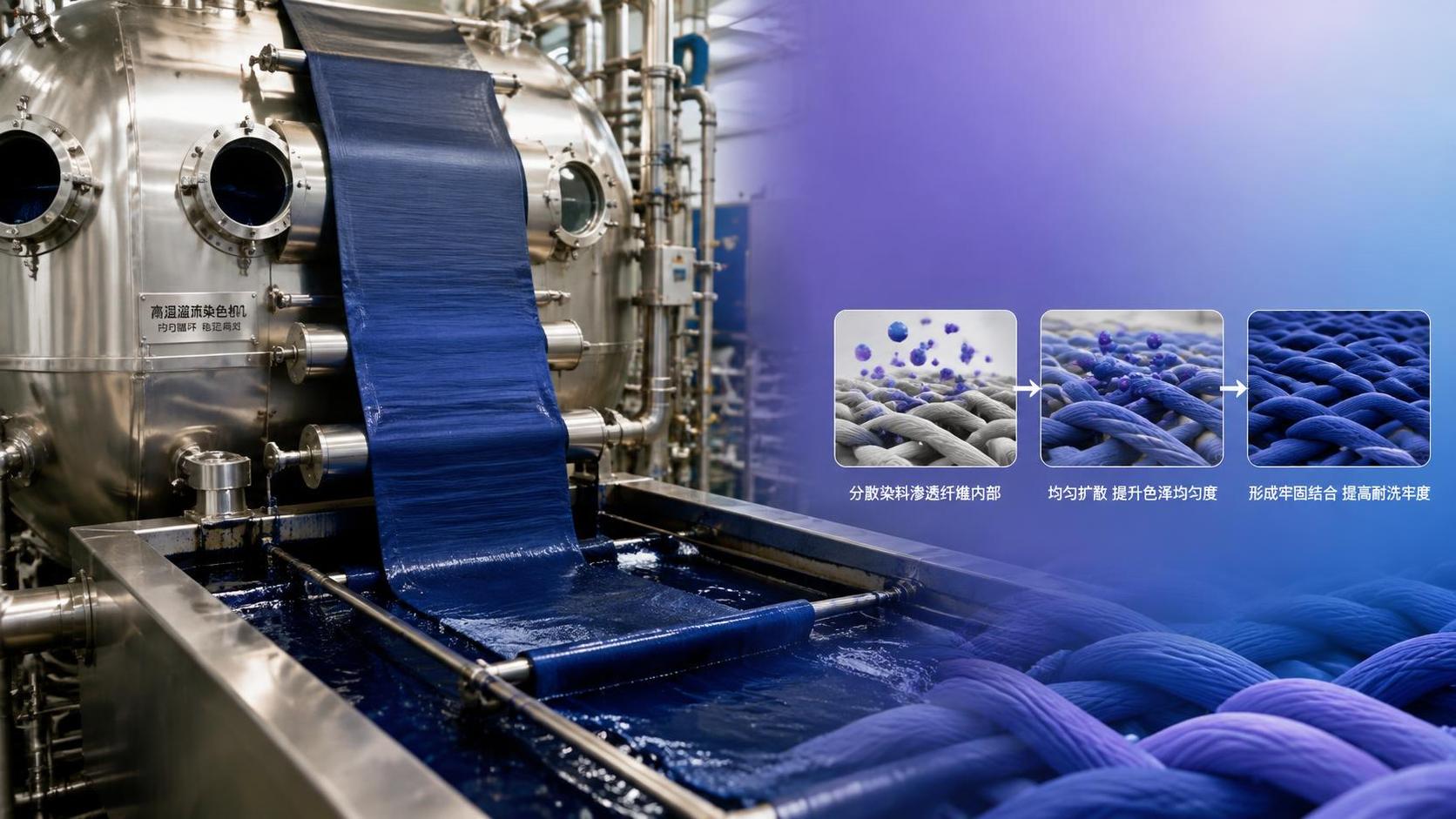
For polyester dyeing operators, a shade that looks right at the start of the cycle can still become a problem by unloading: a pale crease mark, a darker rope edge, a batch-to-batch shift, or staining that appears only after washing. These issues are rarely caused by color selection alone. With Disperse Dyes, shade uniformity and wash fastness depend on how the dye, polyester substrate, machinery, water, auxiliaries, and temperature profile work together.
This is especially true in high-temperature exhaust dyeing, where polyester fibers gradually open under heat and allow finely dispersed dye molecules to diffuse into the fiber. If dispersion stability is poor, heating is too fast, circulation is uneven, or reduction clearing is incomplete, the dyeing result may look acceptable in the machine but fail during finishing or garment use.
The practical goal is not simply to reach the target shade. It is to achieve a level, reproducible shade that remains clean after washing, rubbing, and contact with adjacent fabrics.
Why Polyester Dyeing Can Become Uneven
Polyester is hydrophobic and highly crystalline. Unlike cotton, it does not readily absorb water-soluble dyes. Disperse Dyes are designed for this challenge: they are sparingly soluble colorants that are applied as a fine aqueous dispersion, then diffuse into polyester at elevated temperatures.
That mechanism is effective, but sensitive. During the dyeing cycle, the dye must stay evenly dispersed in the liquor, migrate uniformly through the fabric package or rope, and enter the fiber at a controlled rate. A disturbance at any point can create visible unevenness.
Common signs include:
- Center-to-edge shade variation in packages, beams, or wound yarns;
- Dark seams, rope marks, crease marks, or cloudy areas on fabric;
- Different tones between dye lots despite using the same recipe;
- Surface staining after washing, particularly on pale linings or adjacent fibers;
- Acceptable initial shade but weak wash fastness after reduction clearing.
Operators often focus first on dye dosage. In reality, the dye concentration may be only one part of the picture. A stable process begins before the dyestuff enters the machine.
Start with a Dye System That Matches the End Use
Not all Disperse Dyes behave the same way. Their molecular structure influences build-up, migration, sublimation performance, compatibility with other colors, and fastness properties. A dye suitable for a lightweight fashion fabric may not be the best choice for automotive textiles, sportswear, printed polyester, or deep black workwear.
Before building a recipe, clarify the substrate and performance target. Consider fiber type and blend ratio, fabric construction, dyeing equipment, target depth, heat-setting conditions, and the washing standard required by the customer. Polyester/cotton blends, polyester/spandex fabrics, microfiber, recycled polyester, and cationic-dyeable polyester may each require different handling.
For solid shades, choose dye combinations with comparable dyeing rates and migration behavior. A trichromatic recipe can become unstable when one component exhausts rapidly during heating while another continues migrating later in the cycle. The result may be a shade that changes from lot to lot even when weighing and dosing are accurate.
Reliable sourcing also matters. When operators need to repeat a bulk recipe months later, consistency of product specification, dispersion characteristics, and documentation can be as important as the color itself. Chemical export suppliers such as Shandong Huafeng Chemical work with overseas customers who need clear product information, responsive batch coordination, and supply-chain continuity—not merely a color name on a label.
Prepare the Fabric So the Dye Can Enter Evenly
Level dyeing begins with a clean and uniform substrate. Oils, spin finishes, knitting lubricants, antistatic agents, silicone contamination, and residual oligomers can block wetting or create localized barriers to dye diffusion. On polyester, these residues may not always be obvious before dyeing, yet they can produce pale patches or uneven uptake under high temperature.
A suitable scouring or pre-cleaning process should remove surface contaminants without introducing new deposits. Inconsistent pretreatment is particularly risky when dyeing fabric from different production lines or when combining rolls in one lot.
Water quality deserves the same attention. Hardness salts, metal ions, suspended solids, and pH variation may destabilize a dispersion or alter auxiliary performance. Use treated process water where required, and keep the preparation tank, dosing lines, filters, and machine clean. A good dye recipe cannot compensate for contaminated liquor circulation.
Check these conditions before charging the machine
- Fabric is uniformly scoured and free from visible oil spots or silicone marks.
- Rolls, packages, or garments are grouped by substrate, weight, and pretreatment history.
- Liquor ratio and loading level are appropriate for the machine design.
- Filters, nozzles, pumps, and circulation pathways are clean and functioning normally.
- Water hardness and pH are within the process range specified for the selected auxiliaries.
- The dye dispersion has been properly diluted, stirred, and filtered before addition.
Control Dispersion Before It Becomes a Staining Problem
The word “disperse” is central to the application. Disperse Dyes are not truly dissolved in water; they are held as extremely fine particles. If those particles agglomerate, settle, or deposit on fabric before controlled diffusion occurs, operators may see specks, dark spots, uneven depth, or poor wash-off behavior.
Prepare the dye slurry gradually with clean water and adequate agitation. Avoid pouring powder directly into a high-temperature machine bath without pre-dispersion. Depending on the dye form and process, a compatible dispersing agent may be needed to maintain particle stability, especially in deep shades or long cycles.
Do not assume that more dispersant always improves results. Excessive auxiliary use can create foaming, slow dye exhaustion too much, complicate washing, or affect shade reproduction. The right approach is to follow the dye supplier’s application guidance, then confirm performance through laboratory trials under conditions that resemble production.
Filtration is a small step with large consequences. A fine filter in the preparation stage can catch undispersed particles, packaging debris, and contaminants before they become defects on a full production lot. For dark navy, black, red, and high-build shades, this precaution is particularly worthwhile.
The Heating Curve Is Part of the Color Recipe
In high-temperature polyester dyeing, temperature does more than heat the liquor. It controls the point at which polyester becomes more accessible to the dye. If the temperature rises too quickly through the critical uptake range, certain dyes may strike rapidly on the outer fiber surface before they have enough opportunity to migrate. That can create unlevelness, especially with compact packages, heavy fabrics, or difficult deep shades.
A controlled ramp allows the dye to distribute more evenly before substantial fixation occurs. The ideal rate depends on the substrate, machine, color depth, and dye selection, but the principle remains consistent: give the system time to circulate, level, and equilibrate.
At the hold temperature, maintain stable circulation and avoid sudden pressure or flow changes. A machine with weak liquor exchange may produce different shades between inner and outer package zones even when the recipe is correct. Check pump performance, directional flow where applicable, package density, and actual temperature uniformity rather than relying only on the controller display.
Cooling should also be managed carefully. Abrupt changes can influence oligomer deposition and handling quality, while uncontrolled process variation makes repeatability difficult. Record the complete dyeing curve for successful batches. When a later lot shifts in shade, this record is often more useful than a simple list of chemical additions.
A practical response when levelness begins to drift
If a lab dip appears level but bulk production shows barre, streaks, or variable depth, do not immediately increase dye dosage. Review the fabric source, loading density, circulation pattern, heating rate, dispersion preparation, and auxiliary sequence. Many operators lose time correcting a process issue with color additions, only to create a deeper but still uneven lot.
For selected dye systems, a leveling or migration aid can support redistribution during dyeing. Its suitability must be confirmed for the shade and end-use requirements, because some auxiliaries may influence build-up or fastness. Trial adjustments in a controlled manner, changing one key variable at a time whenever possible.
Wash Fastness Depends on What Remains Outside the Fiber
A polyester fabric may look fully dyed, but loose or unfixed dye particles can remain on the fiber surface. These residues are a common reason for poor wash fastness and staining of adjacent fabrics. Dark shades and high concentrations are more vulnerable because the amount of surface dye is greater.
Reduction clearing is therefore not an optional afterthought for many polyester applications. The process typically uses a reducing agent together with alkali and detergent under controlled conditions to remove unfixed Disperse Dyes from the fiber surface. This cleaning stage improves wash fastness, rubbing behavior, and shade clarity.
However, reduction clearing must be compatible with the dyes used. Some dye structures may be sensitive to strong reducing conditions, causing shade loss or tone change. Always check the technical guidance for the dye combination and verify with a production-representative test. After clearing, neutralize and rinse thoroughly. Residual alkali or reducing chemicals can cause downstream issues during softening, finishing, or storage.
Build Reproducibility into Daily Operation
Consistent polyester dyeing is less dependent on a single “perfect” recipe than on disciplined control of recurring variables. Weigh dyes accurately, use standardized stock solutions where appropriate, document lot numbers, and keep records of actual—not only planned—temperature, pH, dosing sequence, and cycle times.
Lab-to-bulk transfer should be treated with care. A laboratory machine may have a different liquor ratio, heating response, agitation pattern, and fabric movement from production equipment. Before approving a critical shade, assess whether the bulk machine will reproduce the relevant conditions. This is particularly important for bright reds, blues, blacks, and complex combinations where small changes in exhaustion can shift hue noticeably.
Fastness testing should reflect the product’s real destination. A decorative polyester item and a frequently washed sports garment do not face the same risks. In addition to wash fastness, consider dry and wet rubbing, perspiration, sublimation, or heat-setting exposure where relevant. The results help determine whether the problem lies in dye selection, dyeing depth, clearing, or finishing.
When Troubleshooting, Work from the Process Backward
When a batch fails, there is understandable pressure to correct the visible shade quickly. Yet the most reliable correction comes from tracing the process in sequence: substrate condition, water, dispersion, additions, circulation, heating, hold time, clearing, rinsing, and finishing. This approach prevents repeated rework and reduces the risk of damaging fabric through unnecessary stripping or overdyeing.
For operators using Disperse Dyes on polyester, the best results come from balancing color chemistry with machine reality. A well-matched dye range, stable dispersion, controlled thermal profile, effective liquor circulation, and properly validated reduction clearing create a process that is easier to manage shift after shift. The reward is more than a visually even fabric: it is a shade that stays clean, dependable, and fit for its intended use after washing.
Send Us Your Inquiry Today
