









Product Quick Navigation
Get a Quote
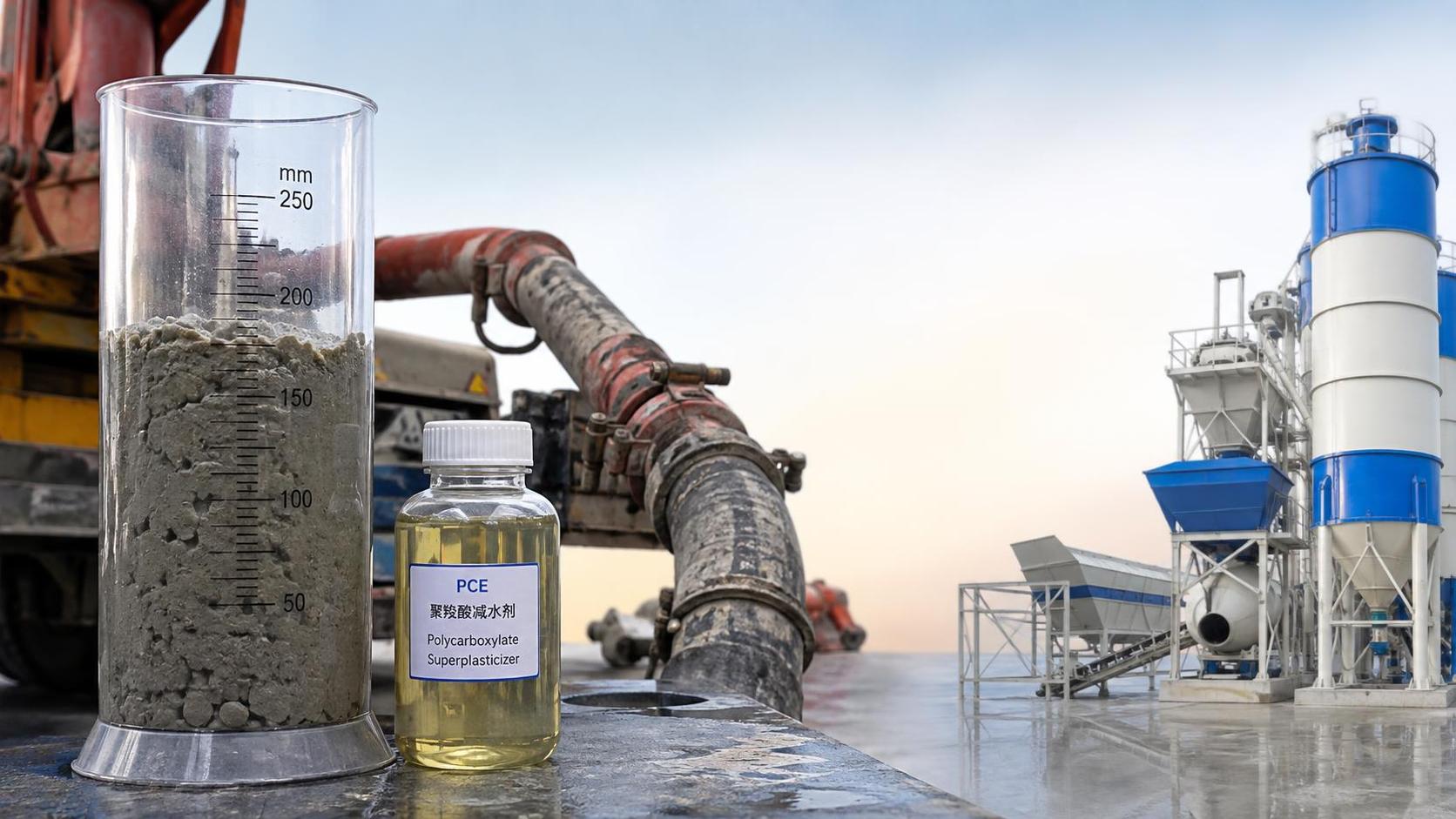
For a project manager, slump loss is rarely just a laboratory issue. It shows up as a pump that starts to struggle halfway through a pour, crews adding water at the last minute, finishing windows becoming unpredictable, or ready-mix trucks waiting longer than planned at a congested site. When the mix is designed around a Polycarboxylate Superplasticizer (PCE), those problems often trace back to compatibility rather than to the admixture dosage alone.
A PCE can provide strong water reduction and excellent flow at a relatively low dosage, but its performance depends on the cementitious system around it. A product that delivers stable slump retention with one cement source may behave very differently after a clinker change, a new fly ash supply, a finer limestone filler, or a shift in aggregate moisture. The practical question is not whether polycarboxylate technology works. It is whether the selected admixture, binders, production process, and placement conditions work together consistently enough for the project.
Why Polycarboxylate Superplasticizer Compatibility Changes Concrete Behavior
Polycarboxylate Superplasticizer molecules disperse cement particles through a combination of electrostatic effects and steric hindrance. In plain terms, the polymer helps keep particles apart so water can lubricate the mix rather than being trapped in cement flocs. That mechanism is highly effective, but it is also sensitive. Cement mineral composition, sulfate balance, alkali content, fineness, temperature, and the presence of supplementary cementitious materials can all change how quickly the polymer is adsorbed and how long its dispersing effect remains available.
This is why a fresh concrete mix can look good at the batching plant yet lose workability during transport. In some cases, the PCE is consumed too quickly by the cement surface. In others, the sulfate balance is not aligned with the cement’s early hydration behavior, leading to rapid stiffening or inconsistent setting. A mix may also show delayed slump development rather than immediate loss, which can be equally disruptive when pumpability is needed at a specific time.
It is tempting to call all of these outcomes “bad admixture performance.” That is usually too simplistic. Compatibility is a system property. The same admixture can be appropriate for one binder blend and unsuitable for another, even when both are sold under the same cement grade or strength class.
The Site Conditions That Commonly Trigger Slump Loss
The most difficult compatibility problems often appear after a change that seems minor in purchasing or production terms. A project may approve a substitute cement source to protect supply continuity. A concrete producer may receive a new shipment with different gypsum characteristics. Seasonal changes can increase concrete temperature, while a revised aggregate stockpile can alter the actual water demand. None of these changes automatically causes failure, but each deserves a fresh compatibility check.
Cement is usually the first variable to examine. Differences in C3A content, soluble sulfate availability, alkalis, particle-size distribution, and grinding aids can materially affect PCE response. The issue is not limited to different manufacturers. Cement from the same supplier can vary over time as raw materials, kiln conditions, or mill operation change. For projects with tight placement windows, assuming long-term consistency without periodic verification is a risky habit.
Supplementary cementitious materials add another layer. Fly ash may improve workability in one blend but vary in carbon content or fineness between shipments. Slag can influence early-age rheology and setting behavior. Silica fume raises water demand and often requires closer control of the entire admixture package. Limestone powder can change packing and flow, but its impact depends on particle shape, fineness, and the rest of the binder system. These materials should be assessed as part of the actual mix, not as isolated ingredients.
Temperature is a frequent culprit on site. Warm materials and high ambient temperatures accelerate hydration and can shorten the useful working time of a concrete mix. A dosage that is stable during a cool morning trial may not retain slump through an afternoon pour. Conversely, cold conditions can slow set and alter finishing decisions. Project teams should distinguish between a genuine chemical incompatibility and a predictable temperature-driven loss of workability; the corrective action may be different.
Do Not Diagnose Slump Loss from One Number
A single initial slump result is not enough to qualify a Polycarboxylate Superplasticizer. What matters is the workability profile over the time that concrete will actually be produced, transported, discharged, pumped, placed, and finished. A mix that reaches its target slump at five minutes but becomes harsh at 45 minutes is not compatible with a long-haul ready-mix operation, regardless of how good the first test looked.
The most useful trial sequence mirrors the project’s real timeline. Record fresh properties immediately after mixing, then at planned intervals that reflect expected delivery and placement conditions. Observe more than slump: look at slump flow where relevant, visual stability, air content, temperature, rate of stiffening, segregation tendency, pump response, and setting behavior. If the concrete will be placed in heavily reinforced members or by long boom pump, practical handling observations are as valuable as a laboratory reading.
When unexpected slump loss occurs, resist the instinct to add water first. Extra water may restore apparent workability temporarily, but it changes the water-to-binder ratio and can affect strength, durability, shrinkage, and surface quality. It also hides the underlying problem, making later batches harder to control. A controlled, approved re-dosing procedure may be appropriate in some operations, but it should be established through trials rather than improvised at the truck.
A practical investigation order
- Confirm the actual batch quantities, aggregate moisture corrections, mixing time, and concrete temperature.
- Check whether the cement, mineral additions, or admixture delivery batch changed before assuming a formulation problem.
- Review the dosing sequence. Adding PCE at a different stage can change its effectiveness, especially in mixes with low free water.
- Compare retained samples and fresh test records with a previously stable production period.
- Run controlled compatibility trials using the current materials, not retained materials from an earlier qualification.
This order matters because many field complaints are caused by process drift rather than a fundamental mismatch. A shorter mixing cycle, an uncorrected wet aggregate, or delayed discharge can make a proven mix look chemically unstable.
Prevention Starts Before the Pour Schedule Is Fixed
The most reliable approach is to establish a compatibility envelope, not simply one approved dosage. The envelope should cover the expected range of cement properties, binder proportions, temperatures, transport duration, and target workability. It does not need to become an academic research program. It does need to be realistic about the project’s operational risks.
For example, a structural pour with a short transport route and prompt placement may tolerate a mix optimized for high initial flow. A large foundation pour, remote infrastructure project, or urban site with uncertain truck access usually needs a more conservative retention strategy. In that setting, choosing the lowest possible PCE dosage for the initial target can be a false economy. The better decision may be a polymer design or admixture combination that gives slightly less dramatic early fluidity but a wider workable window.
Dosing sequence deserves attention as well. Depending on the mix design and plant process, a PCE may perform differently when introduced with mixing water, after initial wetting, or in split additions. There is no universal sequence that fits every concrete. The correct method should be verified with the actual mixer and materials, then written into the production instructions so that plant operators are not forced to rely on memory during a busy shift.
Storage and handling should not be overlooked. Admixture tanks need appropriate agitation where required by the product, protection from unsuitable temperature exposure, clear batch identification, and controls against accidental contamination. A well-designed Polycarboxylate Superplasticizer cannot compensate for an inconsistent dosing pump or an improperly maintained storage system.
Selecting a PCE for the Whole Concrete System
Not all PCEs are designed for the same job. Some formulations prioritize rapid dispersion and high water reduction. Others are developed for stronger slump retention, lower viscosity, precast production rhythms, or binder systems with substantial mineral additions. Selecting only by active content, appearance, or price per kilogram can lead to the wrong comparison. The relevant cost is the delivered concrete performance: consistency, rejected loads, placement delays, pumping interruptions, and the amount of corrective action needed during production.
A useful supplier discussion should therefore include the cement type, supplementary materials, target strength class, water-to-binder ratio, aggregate grading, desired placement time, ambient conditions, and any other admixtures in the mix. Air-entraining agents, retarders, accelerators, viscosity modifiers, and shrinkage-reducing admixtures may interact with the PCE package. Compatibility between admixtures should be checked rather than assumed from individual product data sheets.
For internationally supplied chemical materials, this technical dialogue also has a supply-chain dimension. Projects need stable product identification, responsive technical communication, appropriate shipping documentation, and traceability across deliveries. Huafeng Chemical, based in Shandong, operates in an export environment where overseas buyers often need more than a product quotation: they need clarity about specifications, delivery coordination, and the information required for local review. In practice, a supplier’s ability to respond when raw materials or project conditions change can be as useful as the original formulation recommendation.
Warning Signs That Should Not Be Ignored
Certain patterns deserve immediate review. Rapid loss of slump without a major temperature change may point to cement-PCE interaction or insufficient retention design. High initial slump followed by bleeding or segregation may indicate that the mix has been pushed beyond its stable range. Delayed stiffening followed by sudden rapid set can suggest an imbalance that needs laboratory confirmation. Wide batch-to-batch variation, meanwhile, often signals material or process inconsistency before it proves an admixture defect.
Also watch for the operational workaround becoming normal practice. If drivers routinely add water, if site teams request repeated re-dosing, or if pump operators consistently ask for a looser mix than the approved design provides, the mix design is not truly under control. These are production signals, not merely site preferences.
A Better Way to Manage Change
Concrete projects rarely remain static. Cement supply may change, weather shifts, logistics become less predictable, and different parts of the project demand different placement behavior. The practical defense against slump loss is a disciplined change-control process: identify the change, test the current materials, document the approved adjustment, and communicate it to batching and site teams before the next critical pour.
Polycarboxylate Superplasticizer compatibility is best treated as an ongoing quality-control issue rather than a one-time product selection exercise. When the concrete system is monitored as a whole, slump retention becomes far more manageable—and project teams spend less time reacting to a stiffening truck when they should be focused on placing sound concrete.
Send Us Your Inquiry Today
