









Product Quick Navigation
Get a Quote
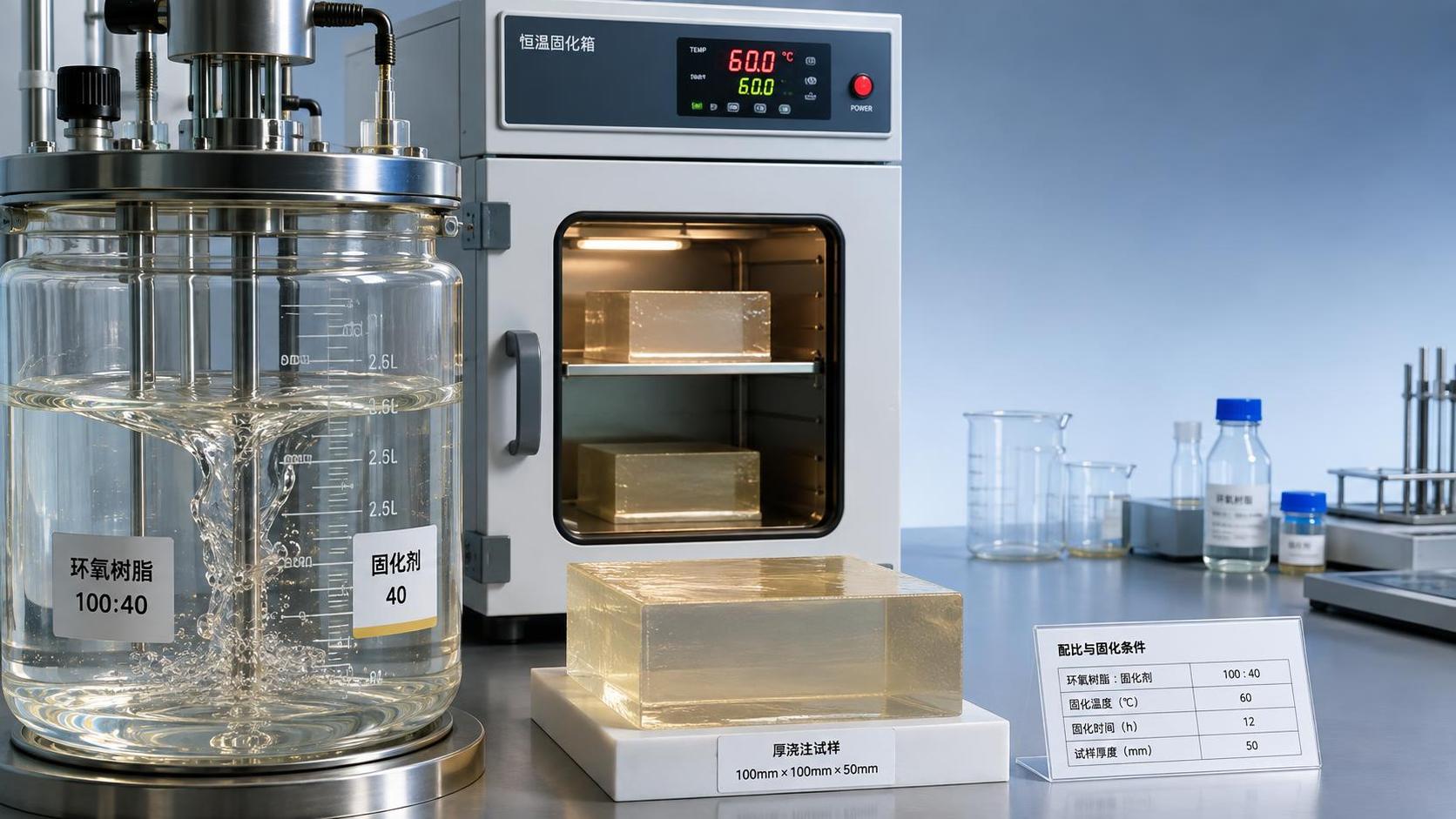
Epoxy resin performance is not defined by the resin alone. The curing system determines how far the epoxy network develops, how uniformly it forms, and whether the finished material delivers the required balance of strength, toughness, heat resistance, chemical resistance, electrical properties, and processability.
For a technical evaluation, the most useful question is not simply “Which hardener is better?” It is: which resin-hardener-temperature combination can reach the required cured state within the actual manufacturing constraints? A formulation that performs well after a long elevated-temperature cure may be unsuitable for a heat-sensitive substrate, a thick casting, a fast production line, or field application at low ambient temperature.
Temperature and hardener choice must therefore be evaluated together. Changing either one can alter gel time, pot life, viscosity development, exotherm, crosslink density, residual reactivity, and final service behavior.
What curing does to an epoxy resin
Most epoxy resin systems cure through a reaction between epoxy groups in the resin and reactive groups in a hardener. Before curing, the resin may be a liquid, a semi-solid, or a solid material that can be melted or dissolved for processing. After curing, it becomes a crosslinked thermoset network. Unlike a thermoplastic, it cannot be remelted and reshaped without degrading the material.
The practical consequences of this network formation are significant. A more complete and appropriately structured cure generally improves dimensional stability, solvent resistance, mechanical integrity, and resistance to creep under load. However, an overly rigid network can also reduce impact resistance or tolerance to thermal cycling. The target is not the highest possible crosslink density in every case; it is the right network structure for the application.
A curing schedule must allow enough molecular mobility for the reaction to proceed, then provide sufficient energy and time for the network to mature. If the material gels too early, unreacted groups may become trapped within a restricted network. If the cure is too slow, production throughput and contamination risk increase. If the cure is too aggressive, heat buildup, shrinkage stress, voids, or cracking may result.
Temperature controls both reaction speed and final network development
Higher curing temperature usually accelerates epoxy reactions. This can shorten cycle time and help the system reach a more complete cure, particularly when the formulation requires elevated temperature to achieve its intended thermal and chemical performance. That benefit has limits. The same temperature increase can sharply shorten workable life, raise viscosity faster than expected, and create excessive exotherm in large volumes.
It is useful to distinguish between curing temperature and service temperature. A coating may cure at ambient temperature but have limited heat resistance in service. Conversely, an epoxy designed for elevated-temperature service often needs a controlled post-cure to develop that capability. Assuming that a room-temperature cure will produce the same properties as a specified heat cure is a common evaluation error.
Ambient-temperature curing
Ambient-cure systems are often selected for maintenance coatings, construction adhesives, floor systems, repair compounds, and applications where oven curing is impractical. Amine-based hardeners are commonly used because they can react with epoxy groups at moderate temperatures.
The limitation is that ambient conditions are rarely constant. Low temperature can slow reaction substantially, extend tack-free time, reduce early strength, and leave the material under-cured during the period when it is exposed to moisture, dust, or handling. High humidity may also affect some amine-cured surfaces, producing surface films that interfere with intercoat adhesion or appearance. Formulation design, substrate preparation, and site conditions must be assessed as one system.
Elevated-temperature curing and post-curing
Heat curing is often used where the application requires higher glass-transition behavior, stronger chemical resistance, improved electrical performance, or more reliable long-term properties. Industrial composites, electrical encapsulation, high-performance tooling, and demanding protective systems may use elevated-temperature curing for this reason.
A staged schedule is frequently more reliable than immediately applying the highest temperature. An initial lower-temperature stage can allow wetting, flow, air release, and more uniform reaction. A later higher-temperature stage then advances network development. The appropriate profile depends on resin chemistry, hardener type, part geometry, filler loading, and the thermal tolerance of the substrate.
For technical approval, cure temperature should be specified as a complete profile: ramp conditions where relevant, dwell temperature, dwell time, allowable part thickness, and post-cure requirements. “Cure at high temperature” is not a usable process specification.
Hardener chemistry determines the processing window
Hardener selection changes far more than cure speed. It affects viscosity, pot life, cure temperature, adhesion, flexibility, moisture tolerance, chemical resistance, color stability, and heat resistance. Two formulations based on the same epoxy resin can therefore behave very differently.
These descriptions are directional, not substitutes for a formulation-specific technical data package. Within each hardener family, molecular structure and modification can substantially change behavior. A modified amine, for example, may be chosen to improve handling, reduce blush, increase flexibility, or adjust reactivity, but those gains can come with tradeoffs in heat resistance, cure speed, or chemical durability.
Stoichiometry is not a minor mixing detail
Epoxy systems are formulated around an intended ratio between epoxy functionality and hardener reactivity. An incorrect mix ratio does not merely change cure time. It can leave excess resin or excess hardener in the cured material, resulting in lower network integrity, softer surfaces, reduced chemical resistance, poor adhesion, or inconsistent mechanical properties.
Volume-based mixing can be acceptable only when the system is specifically designed and documented for that method. For technical work, mass-based control is usually more defensible because resin and hardener densities differ and can change with temperature. Mixing quality matters as much as ratio accuracy. Material near the walls and bottom of the vessel is a frequent source of incompletely mixed resin or hardener.
For filled compounds, the evaluation should also account for settling, temperature-dependent viscosity, and the effect of fillers on heat transfer. A nominally correct mix ratio may still yield variable properties if each component is not conditioned and homogenized consistently before mixing.
Part thickness changes the cure behavior
An epoxy cure reaction releases heat. In a thin coating film, much of that heat can dissipate into the substrate and surrounding air. In a thick casting, adhesive bond line, or large batch, heat can be retained inside the material. Internal temperature may therefore become much higher than the oven or room temperature.
This creates a feedback effect: rising internal temperature accelerates the reaction, which releases more heat. The result may be rapid gelation, discoloration, void formation, thermal stress, cracking, or a cure gradient between the center and the surface. A formulation suitable for a thin laminate may not be suitable for a deep pour at the same nominal curing schedule.
Technical evaluation should define the maximum application thickness or batch size, not only the resin and hardener grade. Where thick sections are unavoidable, a slower-reacting hardener, lower initial cure temperature, staged casting, or a reformulated system may be necessary.
Do not judge cure only by surface dryness
A dry or tack-free surface indicates that the material has progressed beyond an early stage of cure. It does not establish that the full section has reached the required crosslink density. This distinction matters when the material will face solvents, heat, electrical stress, immersion, repeated loading, or a secondary bonding operation.
Depending on the application, a validation plan may include hardness development, solvent resistance, thermal analysis, mechanical testing, dielectric testing, adhesion evaluation, or controlled exposure testing. The selected method should relate to the actual failure risk. A decorative coating and an electrical encapsulant do not require the same evidence of cure quality.
Post-cure conditions should also be separated from handling conditions. A part may be safe to demold or move before it has reached full service capability. Treating “handling strength” as “final performance” can lead to premature testing or field installation.
A practical evaluation sequence
When comparing epoxy resin curing systems, begin with the application boundary conditions rather than a preferred hardener family. The following sequence keeps the decision focused on performance and manufacturability:
- Define the service environment: expected temperature exposure, chemicals, moisture, electrical demands, load type, and required lifetime behavior.
- Define process constraints: ambient or oven cure, acceptable pot life, application thickness, available mixing equipment, ventilation, and allowable production cycle.
- Identify substrate limitations: heat sensitivity, surface condition, coefficient of thermal expansion, and whether the material must wet a porous or irregular surface.
- Compare complete cure schedules rather than nominal cure temperatures alone, including any required post-cure.
- Validate the selected system at representative thickness and under representative conditioning, not only on a small laboratory sample.
- Lock down incoming-material controls, component identification, mix-ratio instructions, storage conditions, and lot traceability before scale-up.
The final step is especially relevant in international sourcing. A technically suitable epoxy resin system can still create production risk if the resin and hardener are not consistently supplied, documentation is incomplete, or handling requirements are not communicated clearly across sites. For export-oriented chemical procurement, the useful supplier discussion covers product identity, packaging, storage, technical documentation, regulatory documentation required for the destination market, and the ability to maintain specification continuity.
Huafeng Chemical, based in Shandong, supports overseas chemical procurement through a broad product portfolio and foreign-trade service capability. In an epoxy project, the productive starting point is a specification-led inquiry: state the resin type, intended hardener chemistry, cure method, target application, packaging needs, and documentation expectations. This allows supply discussions to remain aligned with the actual curing system rather than treating epoxy resin as a single interchangeable commodity.
Where evaluations often go wrong
The first mistake is selecting a hardener solely because it cures faster. Fast cure is valuable when throughput or rapid return to service matters, but it may reduce working time, increase exotherm risk, or make wetting and air release more difficult. A slower system can produce a more reliable result for large castings, complex composite layups, or manual applications.
The second is assuming that a higher cure temperature always improves performance. Higher temperature can improve conversion and thermal properties when the chemistry supports it, but excessive heat can damage a sensitive substrate, distort a composite part, create internal stress, or drive an uncontrolled reaction in thick sections.
The third is treating resin and hardener as independently interchangeable. Compatibility, ratio, cure profile, additives, and intended end use form a package. Replacing one component without re-evaluating the system can invalidate earlier performance assumptions.
A sound epoxy curing decision is therefore a controlled match between chemistry, temperature profile, geometry, and service demand. Once those conditions are defined, hardener selection becomes more than a catalogue comparison: it becomes a defensible choice that can be translated into repeatable production and reliable field performance.
Send Us Your Inquiry Today
