









Product Quick Navigation
Get a Quote
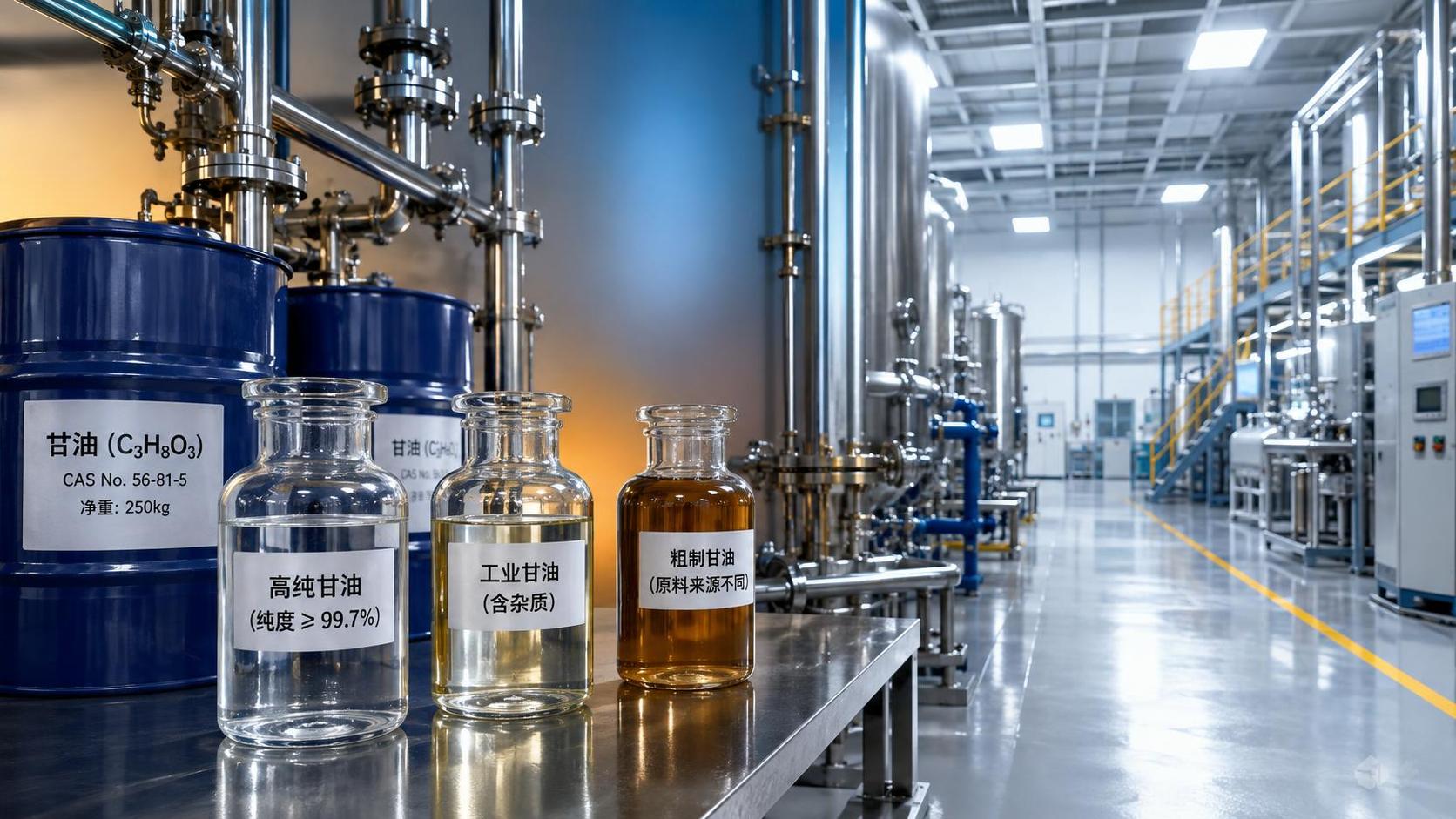
The lowest-priced Glycerol is not automatically the lowest-cost purchase. A grade that is chemically acceptable on paper can still create problems in blending, odor control, finished-product approval, export documentation, or batch consistency. The practical question is not simply “What purity can we buy?” but “What impurities, source characteristics, and documents can our process tolerate?”
For industrial buyers, Glycerol selection usually comes down to four connected decisions: required purity, feedstock source, contaminant limits, and the level of traceability needed for the final application. Technical grade may be entirely appropriate for one process and an expensive source of rework in another. Refined, food, and pharmacopeial grades can reduce downstream risk, but only when their specifications match a real production or compliance need.
Start with the application, not the grade name
Grade labels are useful shorthand, but they are not a complete purchasing specification. “Technical grade,” “refined grade,” “food grade,” and “USP grade” may indicate different quality positions, yet suppliers can use different internal specifications under similar commercial descriptions. A buyer should therefore treat the certificate of analysis, agreed specification, and supporting documents as the purchasing baseline.
Glycerol is valued for properties such as humectancy, viscosity, solvency, compatibility with water, and its role as an intermediate. Those functions do not all demand the same material quality. A formulation that is sensitive to color, odor, salts, residual organics, or trace contaminants needs a tighter specification than a process where Glycerol is consumed in a non-sensitive reaction or used as a utility additive.
A useful first filter is the consequence of a quality deviation. If an off-spec batch only changes process economics slightly, a fit-for-purpose industrial grade may be sensible. If it can delay a customer release, invalidate a finished-product claim, affect organoleptic quality, or require disposal of a blended batch, the apparent saving from a lower grade can disappear quickly.
What Glycerol grades usually mean in purchasing practice
These categories overlap in chemistry more than they overlap in purchasing risk. A high-purity technical product is not automatically interchangeable with food-grade material. Conversely, paying for pharmacopeial-grade Glycerol in a non-sensitive industrial reaction may add cost without improving the result. The correct comparison is between the requirements of the finished product and the supplier’s committed specification, not between grade names alone.
Purity matters, but the impurity profile matters more
Purity is often the first number requested in a quotation, because it is easy to compare. It is not always the most useful number. Two Glycerol lots with a similar assay can behave differently when their impurity profiles differ. For many industrial users, water content, ash or salt residues, color, odor, acidity or alkalinity, organic residues, and insoluble matter can matter as much as the headline assay.
In resin, coating, and chemical-intermediate applications, excess water can alter reaction balance, viscosity, drying behavior, or the practical dosage of the active material. In applications involving heating, color stability and residual organic material may influence discoloration or odor. In clear liquid formulations, even small differences in appearance or insoluble matter can become a customer-facing issue.
Procurement should ask production and quality teams a direct question: which incoming Glycerol parameters have previously caused adjustments, rejects, filtration issues, odor complaints, or variable yields? Those parameters should become contractual controls. A generic “high purity” request is weaker than a specification that identifies the properties actually affecting the plant.
Do not confuse assay with usable content
Glycerol is hygroscopic, meaning it readily interacts with moisture. This makes water control commercially important. A lower active Glycerol content may require a higher addition rate to achieve the same formulation effect. In a bulk purchase, that can affect freight efficiency, storage capacity, blending time, and unit cost in use.
The relevant cost comparison is therefore not only price per tonne. It is price per usable Glycerol content, adjusted for process loss, quality risk, and any extra handling. This is especially important when comparing offers that appear close in price but differ in assay, water, packaging, or lot consistency.
Feedstock source changes the risk conversation
Commercial Glycerol may come from oleochemical routes, including biodiesel-related production, or from synthetic production routes. Neither source is automatically better for every application. The source matters because it can influence the expected impurity pattern, traceability needs, supply dynamics, and suitability for customer claims or internal sourcing policies.
Oleochemical Glycerol is commonly associated with vegetable or animal-fat processing routes. It can be a practical fit for many applications, but buyers should understand the upstream source and purification route when the final product has dietary, ethical, allergen-related, origin-related, or customer-specific constraints. For some buyers, the concern is not performance but whether the supplied material supports a declared source position in the finished product.
Synthetic Glycerol may be considered where source consistency or a non-animal route is relevant. Yet it still needs the same discipline around impurity limits and documentation. Source designation does not replace a product specification, and a source preference should not lead a buyer to overlook color, odor, moisture, or process compatibility.
For industrial applications without a source-sensitive finished-product claim, the more practical issue is often supply continuity. Crude and refined Glycerol availability can be influenced by upstream production patterns. A purchasing strategy based on one preferred source without an approved alternative can expose the plant to avoidable disruption. Where the formulation allows it, qualifying more than one source route or supplier can improve resilience.
Where buyers most often overpay or under-specify
Over-specification usually occurs when a buyer adopts a high-grade material because it “feels safer,” without identifying a corresponding technical or regulatory need. This can lock a plant into unnecessary cost, longer qualification cycles, and fewer sourcing options. A non-sensitive industrial process may need consistent water, color, and ash limits, not a full pharmacopeial documentation package.
Under-specification is more expensive when the final product is regulated, consumed, applied to the body, or evaluated by a demanding downstream customer. Buying a general refined grade and expecting it to satisfy food or pharmaceutical requirements later creates a documentation gap that cannot be solved by a favorable assay result. Material quality and documentation must be aligned before shipment, not after blending.
Another common mistake is approving a sample while purchasing against an incomplete bulk specification. A sample may look and perform well, but routine supply must be controlled through agreed limits, lot-level certificates, packaging requirements, and a process for handling deviations. For recurring purchases, consistency is usually more valuable than an occasional exceptionally good batch.
Build a specification that supports cost control
A workable Glycerol purchase specification should be short enough to administer but specific enough to protect production. It normally includes the grade and intended use, minimum assay, limits for the properties that affect the process, appearance expectations, packaging, storage conditions, lot identification, and certificate requirements. If source is relevant, define what must be disclosed rather than relying on informal descriptions in sales correspondence.
- Define the application and identify whether the material contacts food, pharmaceutical products, personal-care products, or only industrial equipment and intermediates.
- Convert plant sensitivities into measurable incoming controls, such as water, color, ash, odor, or insoluble matter where relevant.
- State the required document package before requesting quotations: certificate of analysis, origin information, source declaration, safety documents, and any customer-specific statements.
- Compare delivered cost on a like-for-like basis, including concentration, packaging, freight terms, inspection needs, and the cost of holding safety stock.
- Set a clear acceptance process for first shipments and define how specification changes or out-of-range results will be handled.
For export purchasing, responsiveness has practical value. Delays in certificates, unclear batch identification, inconsistent shipping documents, or late notice of a specification change can hold up customs clearance or downstream production. A supplier should be assessed not only on quoted material cost but also on its ability to provide consistent documentation and communicate quickly when a shipment issue arises.
Huafeng Chemical, based in Shandong, supports overseas chemical buyers with a broad export-oriented portfolio and comprehensive foreign-trade services. For Glycerol procurement, the useful discussion is not a generic request for the “best grade.” It is a defined requirement covering application, target quality parameters, source expectations, packaging, shipment terms, and documentation. That gives both buyer and supplier a clearer basis for matching available material to the real cost and compliance demands of the order.
Before issuing a purchase order
Ask for the current specification and a representative certificate of analysis, then compare them against the conditions that matter in your own production process. Confirm whether the offered grade is suitable for the final application, whether the stated source meets any downstream requirement, and whether the supplier can maintain the same specification across future lots. For a new source, a controlled trial should focus on the properties that create operational risk, rather than treating the assay result as the entire qualification.
The best Glycerol grade is the one that meets the finished product’s requirements with the least total cost of ownership. That may be technical grade for a tolerant industrial process, refined material for a quality-sensitive formulation, or food or pharmacopeial grade where documentation and controlled quality are integral to the application. The decision becomes simpler once purity, impurity profile, source, and supply documentation are evaluated as one purchasing package.
Send Us Your Inquiry Today
