









Product Quick Navigation
Get a Quote
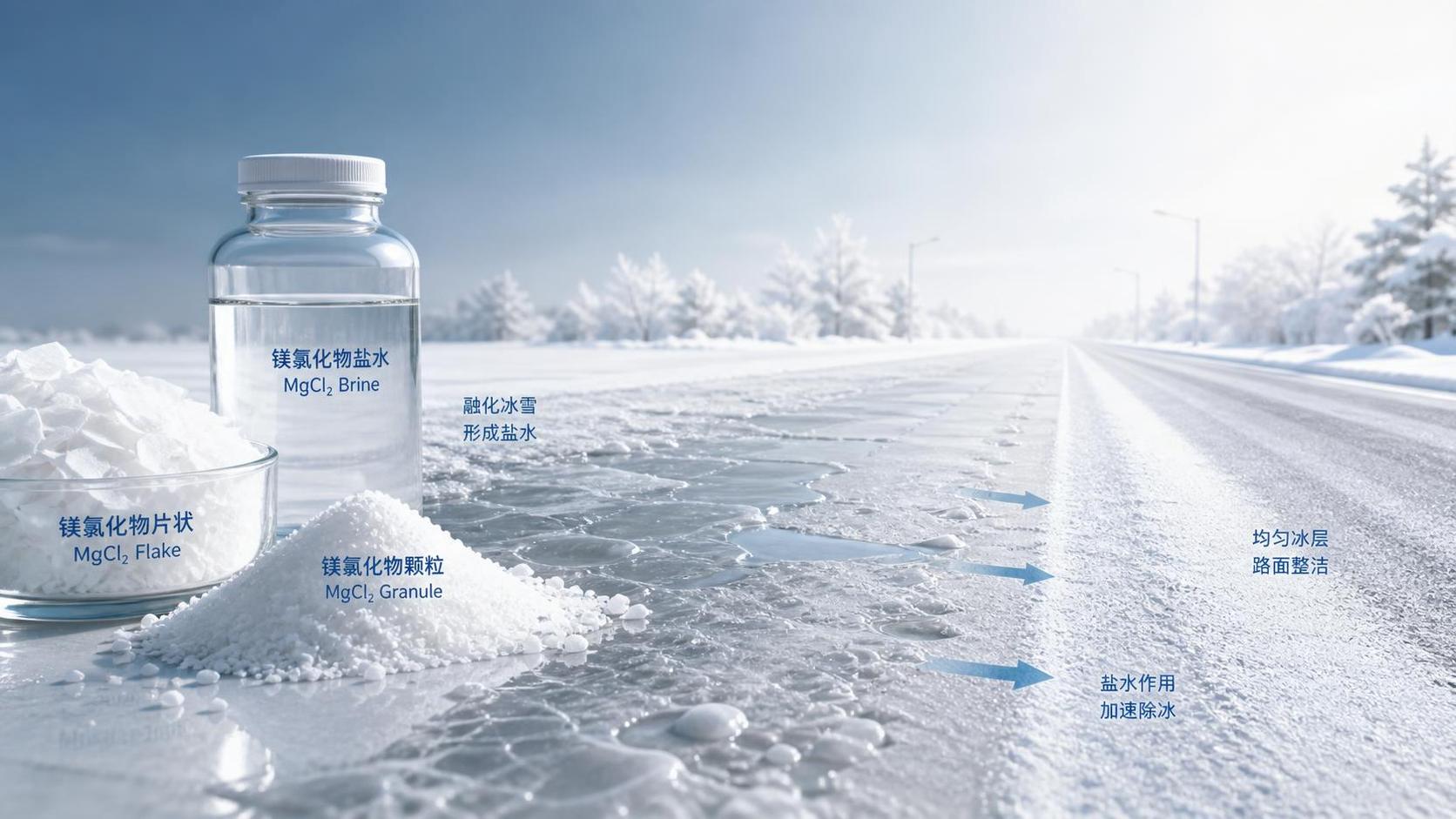
Magnesium chloride is often selected for winter deicing because it begins dissolving readily, forms brine quickly, and remains useful at temperatures where sodium chloride becomes slow. Yet reliable performance depends less on the product name than on two operational decisions: choosing a material grade that fits the spreading method and calculating dosage from actual magnesium chloride content, temperature, ice condition, and surface area.
A bag of flakes, a pellet product, and a liquid brine may all be sold as magnesium chloride, but they do not deliver the same active chemical mass per kilogram or per litre. Applying the same nominal rate to each can lead either to weak melting performance or unnecessary chloride loading. The practical objective is not to use the highest possible quantity. It is to establish and maintain a thin, effective brine layer that breaks the bond between ice and pavement, then remove the resulting slush before it refreezes.
Choose the grade by application method, not by appearance alone
For winter maintenance, “grade” usually refers to formulation, concentration, physical form, and impurity control rather than a single universal standard. A product suitable for bulk deicing should be evaluated differently from magnesium chloride intended for industrial processing, dust suppression, food use, or laboratory work.
The first question is whether the material will be applied as a liquid, as a solid, or as a pre-wetting agent for another deicer.
Liquid brine is generally the most controllable option when applied before precipitation or before a predictable freeze. It stays where it is sprayed more effectively than dry particles, begins working immediately, and can prevent a strong ice-to-pavement bond. It is not a substitute for snow removal. Once snow accumulation covers the treated surface, plowing or mechanical clearing remains necessary.
Flakes are appropriate where operators need a material that can be spread by hand or through equipment designed for relatively light, irregular solids. Their fast moisture uptake can be an advantage on thin ice, but it also means they should not be treated like dry rock salt. Damp flakes bridge in hoppers, clump in bags, and produce uneven distribution. For walkways, this unevenness is more than an efficiency issue: concentrated piles can create wet, slippery patches while adjacent areas remain icy.
Pellets or screened granules are usually easier to meter consistently. Their value is operational rather than cosmetic. A more uniform particle-size range can improve spreader calibration, reduce fines that drift or stick to equipment, and make application rates more repeatable. However, a hard, coarse pellet may take longer to dissolve than a flake. On thin black ice, rapid brine formation can matter more than handling convenience.
Active content matters more than the product’s gross weight
Magnesium chloride is commonly supplied as hydrated material. A flake marketed as 46% MgCl2 does not contain 46 kg of magnesium chloride in every 46 kg of product by accident; the remaining mass is largely associated water and, depending on specification, small amounts of other salts or insoluble matter. A 94% or 96% pellet product, by contrast, delivers far more active material per kilogram.
This difference must be reflected in the application calculation. If a work instruction calls for 10 kg of actual MgCl2, the amount of product required is:
Product required = target active MgCl2 ÷ product MgCl2 fraction
For example, a target of 10 kg active material requires about 21.7 kg of a 46% flake product, but only about 10.6 kg of a 94% pellet product. The same logic applies to liquids, although liquid calculations also require density when converting between kilograms and litres.
For liquid brine, operators should work from the supplier’s certificate of analysis and density specification rather than assuming that one litre equals one kilogram. A 30–32% solution contains roughly one-third active magnesium chloride by mass, but its density is higher than water. A spray system calibrated only by litres per lane-kilometre can therefore misstate the active chemical dose when brine concentration changes between deliveries.
A deicing-grade specification should normally identify at least the following:
- Magnesium chloride assay or concentration;
- Moisture content for solids, or density for liquids;
- Water-insoluble matter;
- Particle-size range for flakes, pellets, or granules;
- Levels of sodium, calcium, potassium, sulfate, and other relevant constituents where consistency is needed;
- Anti-caking treatment, where solid-flow performance is important;
- Packaging integrity and storage requirements.
Higher assay is not automatically the best choice. A high-purity pellet may be more concentrated, but it can be uneconomical for a low-risk parking area if a hydrated flake provides sufficient response at the expected temperature. Conversely, a low-assay product with excessive fines, insolubles, or variable moisture may create spreader problems that outweigh its lower purchase price.
Dosage should begin with the weather event and surface condition
There is no single application rate that works across dry frost, packed snow, glazed ice, wet pavement, and freezing rain. Temperature affects how quickly brine forms and how much melting capacity is available. Ice thickness determines how much material is required to create a workable slurry. Traffic can help break treated ice on roads, but pedestrian areas receive no such mechanical assistance and need closer attention to coverage.
The ranges below are practical starting points expressed as delivered product, not as pure MgCl2. They should be adjusted through site-specific calibration, weather records, pavement observation, and the product’s actual assay.
These figures are not a guarantee of performance at every temperature. They are a control point for field adjustment. A sheltered concrete walkway at -3°C with a thin glaze does not behave like an exposed bridge deck at -10°C under wind and ongoing freezing precipitation. Bridge decks lose heat from above and below, shaded areas retain ice longer, and porous or rough surfaces hold more brine and debris than smooth asphalt.
For solid products, the conversion from g/m² to site quantity is straightforward:
Required kilograms = area in m² × application rate in g/m² ÷ 1,000
A 2,000 m² parking area treated at 40 g/m² requires 80 kg of delivered product. If the same site has isolated hard-packed zones, treating the entire area at 100 g/m² is often less efficient than applying a moderate broad rate, allowing time for action, mechanically removing loosened material, and spot-treating the remaining bonded ice.
Temperature determines both speed and realistic expectations
Magnesium chloride has a lower eutectic point than sodium chloride; the magnesium chloride-water system can remain liquid at very low temperatures under ideal conditions. That laboratory property should not be interpreted as a promise of rapid field melting at extreme cold. As pavement temperatures fall, dissolution slows, available moisture becomes limited, and the amount of ice that a given mass of deicer can melt decreases.
Near 0°C, low application rates can be effective because little ice needs to be melted to change surface conditions. Between roughly -5°C and -10°C, magnesium chloride can still provide useful performance, but uniform distribution and sufficient contact time become more important. At lower pavement temperatures, especially when approaching approximately -15°C or below, operators should avoid relying on a routine rate to solve heavy ice. Mechanical removal, abrasives for immediate traction, and a deicer strategy matched to the actual temperature range become more important.
Pavement temperature is the relevant measurement, not only air temperature. An infrared thermometer can help identify cold bridge approaches, shaded loading zones, north-facing paths, and surfaces cooled by wind. Readings should be taken on representative pavement rather than from snow-covered or sun-warmed areas that do not reflect the actual treatment zone.
Use magnesium chloride differently for anti-icing and deicing
Anti-icing prevents or weakens bonding before snow or freezing precipitation arrives. Deicing addresses ice that has already formed. Confusing the two leads to overapplication.
In anti-icing, liquid magnesium chloride is applied as a thin, continuous film. The goal is coverage, not a visible wet layer. Excess liquid can be displaced by traffic, diluted by rain, or carried toward drains. Treatment should be delayed or reconsidered when significant rain is expected before freezing, because much of the material may wash away before it can act.
In deicing, solid magnesium chloride or liquid brine must reach the ice-pavement interface. On compacted snow or thick ice, this requires time and often mechanical assistance. A common mistake is to spread a heavy dose over a snow layer that should have been plowed first. The material then works mainly at the top surface, producing wet snow while leaving the bonded layer below intact.
For roads, pre-wetting dry salt with magnesium chloride can reduce bounce and improve particle retention, particularly on dry pavement or at higher vehicle speeds. The performance of this approach depends on the base salt, pre-wet percentage, spreader configuration, and weather conditions. It should be calibrated as a separate treatment, not assumed to behave like a full magnesium chloride application.
Spreader calibration is part of chemical performance
An accurate product choice cannot compensate for poorly calibrated equipment. Solid spreaders should be checked for gate opening, conveyor speed, auger condition, spinner speed, deflector position, and actual spread width. Material flow changes when flakes absorb moisture or when pellets differ in size and bulk density from the previous load.
A simple tarp test is useful: operate the spreader over a measured area at the intended settings, collect the material, weigh it, and compare the result with the target kg/m². Repeat at the normal operating speed. The purpose is not merely to confirm total output; the distribution pattern must also be even. A high rate concentrated in the centre of a path is not equivalent to a lower, uniform rate across the full walking width.
Liquid systems need comparable discipline. Confirm nozzle condition, pump output, pressure, vehicle speed, spray width, and brine density. Plugged nozzles and worn spray tips create missed strips or overdosed bands that may not be visible until icing occurs.
Control corrosion, vegetation exposure, and slip risk
Magnesium chloride is a chloride salt. It should not be described as non-corrosive. Its hygroscopic nature can keep metal surfaces damp, extending the time during which corrosion processes can occur. Vehicles, spreaders, handrails, door thresholds, concrete reinforcement exposure points, and nearby metal equipment should be considered in the maintenance plan.
Cleaning application equipment after use is essential. This includes hopper interiors, conveyors, spinner assemblies, pumps, nozzles, chassis areas exposed to overspray, and electrical connections. Residual product can retain moisture during storage and accelerate damage. Corrosion inhibitors may be present in some formulations, but their presence does not eliminate the need for rinsing and preventive maintenance.
Chloride runoff can also affect soils, vegetation, and receiving water. Application near landscaped areas, tree pits, storm drains, wells, and sensitive drainage routes should be minimized through accurate placement rather than broad overapplication. Dry material should never be left in piles near drains or building entrances. After melting has occurred, removal of slush and residue reduces both refreezing risk and chloride transport.
On pedestrian surfaces, the final condition matters more than the initial melting response. Magnesium chloride can create a wet brine film, especially when temperatures fluctuate around freezing. If the loosened ice and meltwater are not removed or managed, the surface may remain slick. Treatment should therefore be paired with inspection, drainage checks, and re-treatment only where the surface condition justifies it.
Storage quality can change field results
Solid magnesium chloride should be kept sealed, dry, and protected from direct ground moisture. Once exposed to humid air, flakes may soften and agglomerate; pellets may develop surface moisture and lose flowability. Open bags should be resealed promptly, and bulk material should not be stored where condensation can drip into the pile.
Liquid brine requires compatible tanks, secure secondary containment where appropriate, and protection from contamination. Sediment, diluted return material, or mixing with an unknown product can alter concentration and affect spray calibration. Periodic density checks are more useful than relying on appearance, because a diluted brine can look normal while delivering a materially lower active dose.
The most effective magnesium chloride program is therefore a controlled operating practice: specify the actual concentration and physical form, match it to the application equipment, set a rate based on pavement temperature and ice condition, verify coverage in the field, and remove slush rather than repeatedly adding material. When those controls are in place, magnesium chloride can provide efficient winter deicing without turning dosage into a guesswork exercise.
Send Us Your Inquiry Today
