









Product Quick Navigation
Get a Quote
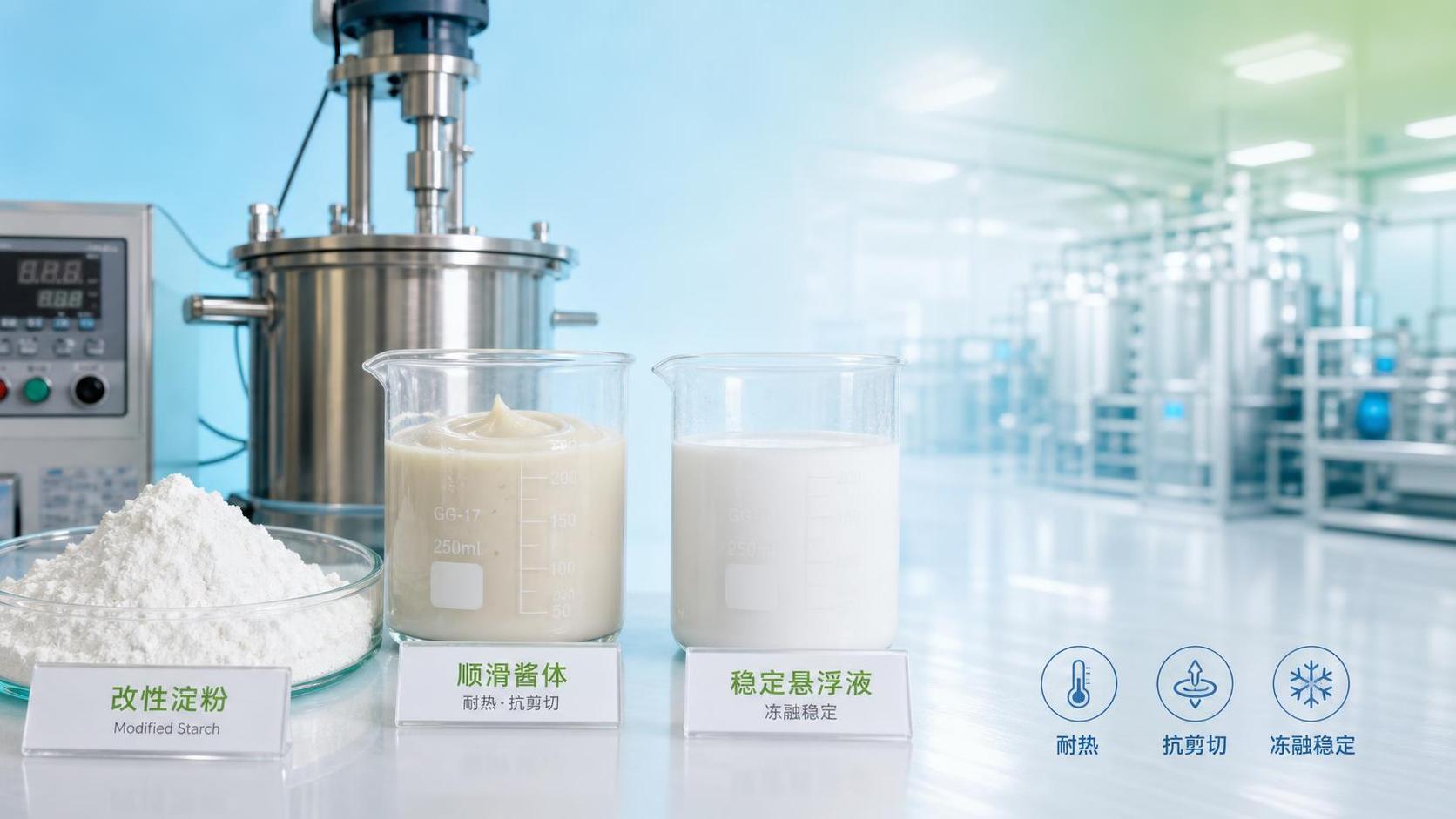
Food Industry Modified Starch: Selecting Texture and Stability Functions
Modified starch is often discussed as a single ingredient category, but technical evaluation rarely works that way. A starch that gives a smooth, short texture in a chilled dairy dessert may fail under the shear and thermal load of a retorted sauce. A grade that holds water well in frozen bakery filling may create an undesirable pasty body in a clear beverage. The practical task is not to find “the best” Food Industry Modified Starch; it is to match a defined functionality to the product’s processing route, eating experience, shelf-life target, and regulatory destination.
For formulators and technical procurement teams, the decision becomes more demanding when products are manufactured in one country, packed in another, and sold across several markets. Texture must remain consistent after transport and storage, while specifications, traceability documents, food-contact expectations, and permitted food additive uses must be checked market by market. A low unit price does not compensate for a starch that behaves differently from one lot to the next or requires costly changes to a production line.
The most useful approach is to start with the failure mode. Is the concern serum separation, viscosity loss after heating, poor freeze-thaw performance, weak coating adhesion, excessive gel firmness, or an opaque appearance? That question narrows the starch chemistry and test plan more effectively than beginning with a generic request for “food-grade modified starch.”
Modification Changes Function, Not Just the Label
Native starch is valued for availability and familiarity, but it has predictable limitations. Granules can swell excessively during cooking, break down under mechanical shear, retrograde during storage, or release water after freezing and thawing. Modification is used to alter those behaviors. Depending on the type and degree of modification, a starch can become more tolerant of heat, acid, shear, cold storage, or repeated freeze-thaw cycles. It can also disperse more easily, contribute a different viscosity profile, or act more effectively at an oil-water interface.
The source material still matters. Waxy maize, standard maize, tapioca, potato, rice, and wheat starches do not begin with identical granule structure or amylose-to-amylopectin balance. Two products described broadly as “cross-linked starch” may therefore produce different body, clarity, gelatinization behavior, or processing tolerance. A technical review should ask both what modification has been applied and what botanical source is being modified.
It is also worth separating functional language from chemical nomenclature. Terms such as thickener, stabilizer, texturizer, binder, encapsulation aid, and emulsifier describe the job expected in the finished food. A specification should identify the precise material, its intended use level, applicable food additive status, and relevant purity or contaminant criteria. Broad commercial descriptions are not enough for a regulatory or quality-release decision.
Start with the Product Stress Map
A productive selection brief records the stresses imposed before the consumer opens the package. Heat treatment, pH, solids level, salts, sugar, proteins, enzymes, homogenization, filling temperature, storage conditions, and expected reheating all influence starch performance. If any of these variables are left undefined, bench trials can appear successful while commercial batches become inconsistent.
This is why a viscosity value on a certificate of analysis should not be treated as a complete performance guarantee. Viscosity depends on the test method: concentration, water quality, heating profile, instrument, spindle, shear history, and measurement temperature all matter. It is useful as a lot-control parameter only when the supplier’s method is understood and linked to the buyer’s own process conditions.
Choosing the Functional Direction
Cross-linked starches are frequently considered where process resilience is the priority. Cross-linking can strengthen granules and reduce breakdown during cooking, pumping, homogenization, or retorting. The trade-off is that a highly resilient starch may develop more slowly or provide a texture that is less clean than a less robust alternative. The desired outcome is not maximum resistance in isolation; it is sufficient resistance without sacrificing the finished product’s eating quality.
Substituted starches are commonly evaluated where cold storage and freeze-thaw stability matter. By reducing reassociation of starch chains, they can limit the water release associated with retrogradation. This is particularly relevant for foods that may experience distribution temperature variation. Yet freeze-thaw testing should be done in the actual formula. Sugar, salt, protein, hydrocolloids, fat level, and packaging headspace can all change the result.
For dry beverage systems, soups, bakery premixes, and convenience products, pregelatinized or instant starches may be appropriate because they hydrate without conventional cooking. Their convenience can become a processing risk if powder addition is poorly controlled: rapid surface hydration may create fisheyes or lumps. Evaluation should include the planned addition sequence, agitation intensity, and the operator reality of production—not only a carefully prepared laboratory beaker.
Some modified starches are selected less for bulk thickening than for emulsification, encapsulation, or film-forming behavior. In these uses, particle size, oil phase, drying method, flavor load, and final water activity can be as important as the starch itself. A grade that works in an oil-in-water emulsion may not automatically be suitable for spray-dried flavor protection or a crisp coating system.
Texture Is a Sensory Decision with Processing Consequences
Technical teams sometimes screen starches primarily by peak viscosity and cost per kilogram. Those are necessary inputs, but they do not capture mouthfeel. A sauce may be thick enough yet still seem pasty, elastic, chalky, or short. A dairy-style dessert may look stable while lacking the creamy breakdown expected on the palate. The same apparent viscosity can produce noticeably different sensory impressions because the flow curve, particle character, interaction with protein or fat, and temperature response differ.
A useful trial compares candidates at equivalent finished-product targets rather than at identical starch dosage. One sample may need less inclusion to achieve the required body, while another may provide better stability at a modestly higher dosage. The relevant cost is formulation cost per accepted batch, including process time, yield losses, rework exposure, and the risk of sensory rejection. Technical evaluators should also check whether a change in starch shifts flavor release, color opacity, or seasoning perception.
Compliance Should Be Built into Selection, Not Added Later
Food additive rules differ by jurisdiction, and acceptance of a starch category in one market does not establish suitability in another. The needed review usually includes the modification type, intended food category, use conditions, carry-over considerations where relevant, labeling language, allergen implications of the source, and documentation required by the importing customer or authority. The final determination should be made against the current requirements of the destination market and the exact food application.
This review becomes especially important when starch sits beside acids, flavors, preservatives, mineral salts, or processing aids. For example, formulation teams may consider organic acids for pH adjustment or processing functions while developing a food system. Materials such as Glycolic acid CAS#79-14-1 have applications listed in food processing as well as many non-food industries, but their suitability must never be assumed from a broad application list. Glycolic acid is a corrosive chemical material and is incompatible with bases, oxidizing agents, and reducing agents according to the supplied safety information. Any food-related use requires a separate assessment of local authorization, food-grade specification, formulation purpose, handling controls, and labeling obligations.
That distinction is not merely administrative. Acidity affects starch hydration and cooking behavior. A starch that performs well in a neutral system can thin substantially when exposed to acid at elevated temperature, particularly when the acid is added early in the cook. Process sequence can therefore be as decisive as the starch type: adding acid after starch has fully cooked may give a different outcome from adding it at the start.
What a Meaningful Supplier Review Looks Like
A modified starch supplier should be evaluated as part of the technical system, not only as a source of material. The first review should cover specification consistency, botanical source, modification identity, microbiological and contaminant information where applicable, packaging, storage conditions, lot traceability, sample representativeness, and change-notification practice. If the starch is intended for a sensitive application, request the analytical methods behind key values rather than relying only on reported limits.
Supply continuity also deserves early attention. Lead times, export documentation, origin, port options, packaging durability, palletization, and contingency arrangements can affect whether a formulation remains practical at scale. Amid deepening global trade, chemical supply chains face higher expectations for responsiveness, compliance support, and stable delivery. Based in Shandong Province, a major Chinese chemical industry hub, Huafeng Chemical serves overseas buyers through comprehensive foreign-trade capabilities and a broad product portfolio. For buyers assessing ingredients and related process chemicals across several markets, the value of such support lies in clearer product documentation and coordinated communication—not in treating technical approval as a purely commercial exercise.
Samples should be tested against a written protocol that reflects the actual product. At minimum, record formulation, addition order, hydration temperature, heating profile, shear conditions, fill temperature, packaging, and storage regime. Compare fresh viscosity with end-of-shelf-life behavior, and evaluate syneresis, appearance, and sensory texture after abuse conditions that are realistic for the product. A single “pass” result from an accelerated test should not replace routine production validation, but it can eliminate clearly unsuitable candidates early.
Avoid the Common Shortcuts
One shortcut is selecting by modification name alone. Another is assuming that the highest-viscosity sample delivers the strongest product. Both can lead to over-thickening, poor flavor release, inconsistent filling, or unexpected loss of viscosity after processing. A third mistake is treating freeze-thaw stability as a universal requirement. If a product is never frozen, a premium freeze-thaw-stable grade may solve a problem that does not exist while compromising texture or economics elsewhere.
The better decision framework is specific: define the desired texture in consumer terms, identify the harshest production and distribution condition, confirm the legal pathway in every destination market, and test selected grades at commercial-relevant conditions. Food Industry Modified Starch is most effective when it is selected as a response to a real formulation constraint rather than as a generic thickener.
Before final approval, align the supplier specification with the internal control plan and confirm what will happen if a raw-material source, processing route, or analytical method changes. That final discipline helps protect not only texture and stability, but also the reproducibility that technical teams need when a food product moves from a successful trial to international production and distribution.
Send Us Your Inquiry Today
