









Product Quick Navigation
Get a Quote
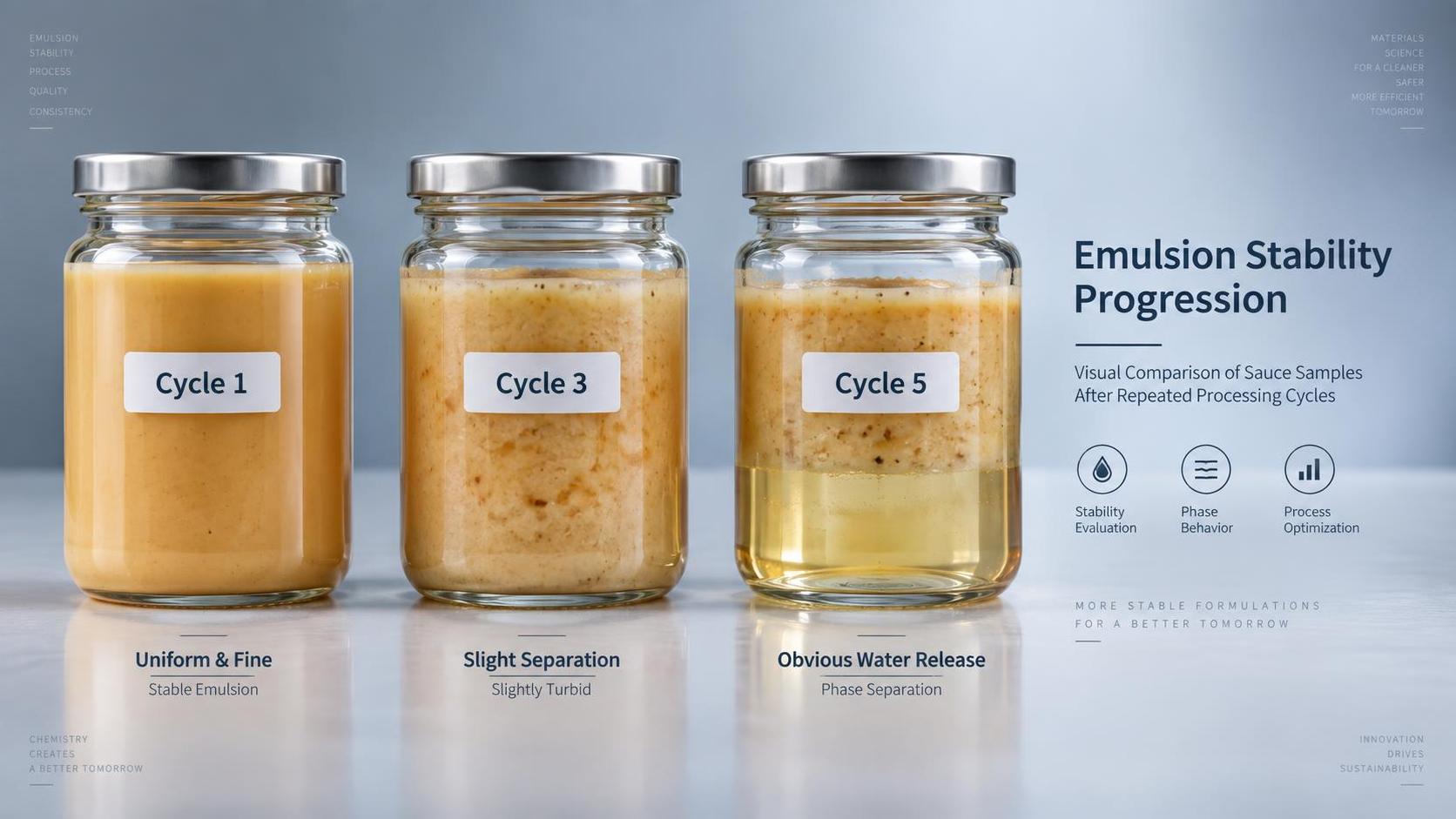
For sauce manufacturers operating under chilled distribution—especially those supplying retail chains or foodservice partners across regions with variable cold-chain infrastructure—repeated freeze-thaw cycling isn’t an edge case. It’s routine thermal stress embedded in logistics: pallets held at -18°C during ocean freight, warmed to 0–4°C in regional distribution centers, then briefly exposed to ambient temperatures during store replenishment. Each cycle risks syneresis, graininess, viscosity collapse, or phase separation—symptoms that don’t always appear on day one, but accelerate with cumulative thermal shocks.
The question isn’t whether modified starch for sauces can withstand freezing—it’s which modifications deliver *predictable, batch-to-batch resilience* under real-world chill-and-thaw repetition, without forcing trade-offs in mouthfeel, clarity, or heat stability during final preparation.
Not all “freeze-thaw stable” claims hold up beyond the lab
Many formulators assume cross-linked (CL) or hydroxypropylated (HP) starches are inherently robust against freeze-thaw degradation. That’s partially true—but only within narrow processing and formulation boundaries. In practice, performance hinges less on modification type alone and more on three interdependent variables: molecular architecture post-modification, residual moisture content in the dry starch, and interaction with co-solutes in the sauce matrix.
Take cross-linked waxy maize starch: its high amylopectin content resists retrogradation, and cross-linking adds shear resistance. Yet if residual moisture exceeds 12%, ice crystal nucleation during freezing disrupts granule integrity—even before thawing begins. The result? A sauce that thickens initially but rapidly weeps water after two cycles, especially in low-pH applications like barbecue or tomato-based sauces where acid accelerates hydrolysis of ether bonds.
Hydroxypropylated tapioca behaves differently. Its substitution shields hydrogen bonding sites, delaying recrystallization. But it’s highly sensitive to ionic strength. In soy-based or fermented sauces with elevated sodium or potassium levels, HP-tapioca often shows accelerated breakdown after just three cycles—not from granule rupture, but from colloidal destabilization of the swollen network.
What actually breaks down—and when
Freeze-thaw damage in starch-thickened sauces rarely stems from a single failure mode. Instead, it unfolds in stages:
- Cycle 1–2: Minor syneresis; viscosity drop ≤15% (often masked by sensory adaptation or blending during QA sampling).
- Cycle 3–4: Onset of micro-phase separation—visible as localized cloudiness or slight graininess near container walls; viscosity loss becomes non-linear.
- Cycle 5+: Irreversible network collapse: granules fragment, leach amylose, and form insoluble aggregates that resist redispersion—even with vigorous stirring or reheating.
This progression is not uniform across batches. Small variations in native starch source (e.g., cassava vs. potato origin), degree of substitution (DS), or even storage humidity pre-blending can shift the threshold where degradation accelerates. That’s why accelerated testing at -18°C/25°C (24h each) over five cycles often underestimates real-world failure: field conditions involve slower cooling/warming rates and temperature plateaus that promote larger, more destructive ice crystals.
Stabilizer synergy matters more than standalone starch selection
No modified starch works in isolation. Its behavior is modulated by other functional ingredients present—notably calcium ions. In low-pH sauces (pH < 4.5), calcium can bridge phosphate groups on starch molecules, reinforcing the gel network. But free calcium also catalyzes hydrolysis of glycosidic bonds under thermal stress. The net effect depends on bioavailability: chelated calcium (e.g., from Calcium phosphate dibasic CAS#7757-93-9) delivers controlled release, buffering ionic activity without triggering rapid depolymerization. This is particularly relevant in ready-to-heat sauces fortified with minerals or designed for extended chilled shelf life—where uncontrolled calcium mobility contributes to texture drift across freeze-thaw events.
Similarly, xanthan gum isn’t just a viscosity booster here—it acts as a cryoprotectant. Its helical structure impedes ice crystal growth and stabilizes starch granules during freezing. But excessive xanthan (>0.3%) increases sauce elasticity to the point where thawed product feels “gummy” rather than smooth, especially after repeated cycling. Optimal synergy typically falls between 0.15–0.25% xanthan paired with 3.5–4.5% CL-waxy maize—provided pH stays above 3.8 and salt content remains below 0.8%.
Practical checks before scaling
Before locking in a starch system for chilled-distribution products, run these validation steps—not as pass/fail tests, but as diagnostic probes:
- Real-time thermal profiling: Embed data loggers inside production-scale sauce containers during actual distribution simulations—not just in environmental chambers. Note time spent at critical transition zones: -5°C to 0°C (where ice recrystallization peaks) and +2°C to +6°C (where microbial risk rises alongside texture instability).
- Post-thaw rheology at service temperature: Measure viscosity at 60°C—not room temperature—since most sauces are consumed warm. Many starches recover apparent viscosity at 25°C but fail catastrophically at serving temp after cycling.
- Sensory correlation: Train panelists to detect early-stage texture fatigue—grittiness, chalkiness, or “slipperiness”—not just outright separation. These cues often precede measurable viscosity loss by 1–2 cycles.
Also, verify supplier consistency on two often-overlooked specs: granule size distribution (narrower distributions resist fracture better) and residual sulfate (from sulfonation reactions), which accelerates acid-catalyzed degradation in tomato-based systems.
When to reconsider starch altogether
If your sauce routinely endures >5 freeze-thaw cycles—or must maintain texture integrity after being frozen solid then thawed at ambient temperature—modified starch alone may be insufficient. In such cases, hybrid systems gain traction: enzymatically debranched amylose (E-amylose) forms thermoreversible gels with superior freeze-thaw recovery, though it requires precise pH and temperature control during cooking. Alternatively, some manufacturers shift toward clean-label hydrocolloid blends (e.g., konjac-glucomannan + locust bean gum), accepting slightly higher cost for guaranteed cycling resilience and no synthetic modification concerns.
But for most chilled-distribution sauces facing 2–4 cycles, the right modified starch—selected with attention to moisture control, ionic environment, and co-stabilizer balance—remains the most scalable, cost-effective solution. The key is treating freeze-thaw stability not as an inherent property of the starch, but as an emergent behavior of the entire formulation under defined thermal history.
Send Us Your Inquiry Today
