









Product Quick Navigation
Get a Quote
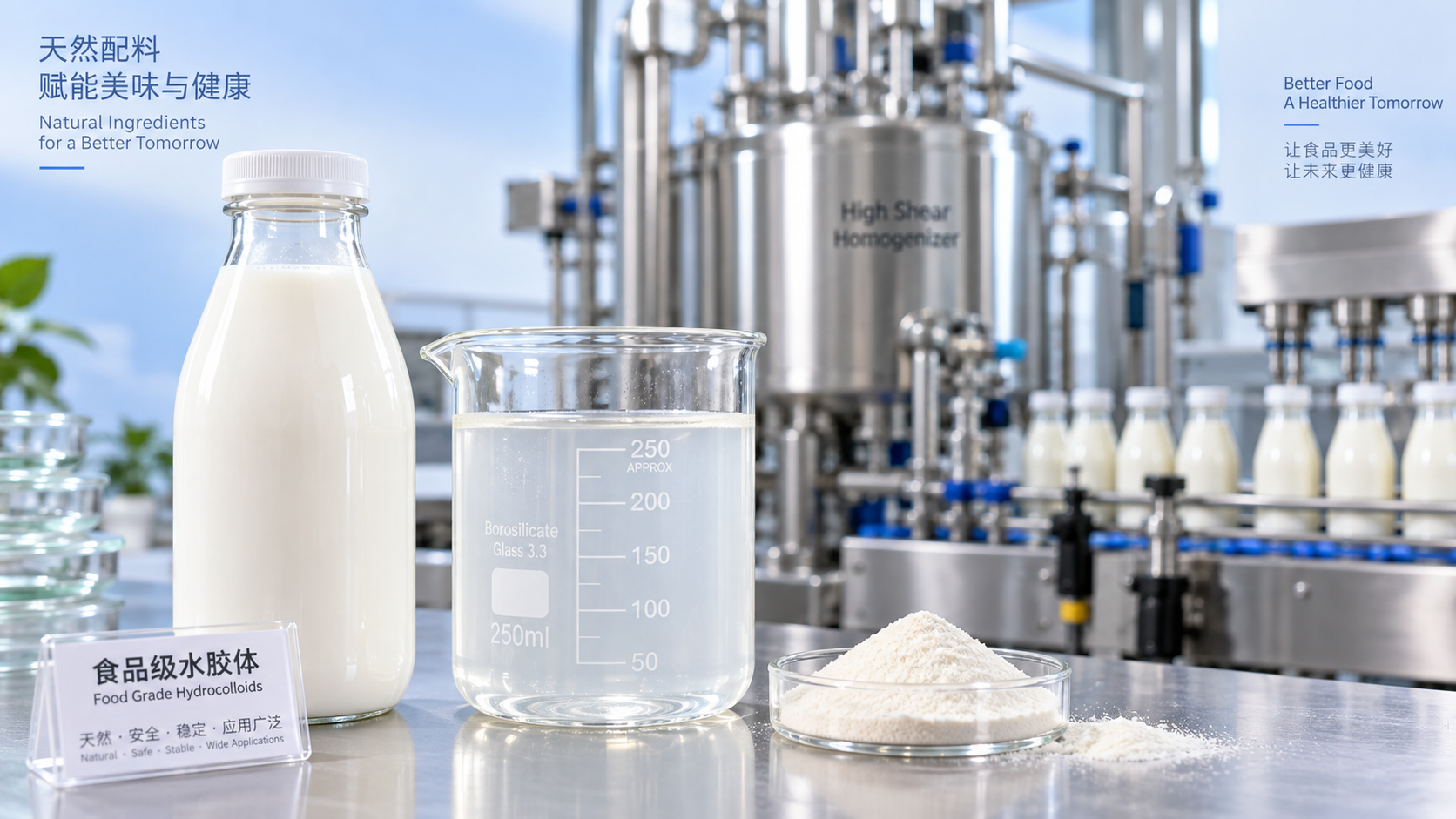
Whey separation in a dairy drink is usually a formulation failure before it becomes a visual defect. Once a clear serum layer forms at the bottom or top of the package, the product can appear diluted, unstable, or poorly processed even when it remains microbiologically safe. The immediate cause is the movement of water out of the protein-rich phase, but the underlying reason may involve acidification, heat treatment, mineral balance, insufficient protein stabilization, or a hydrocolloid system that does not match the beverage process.
Food hydrocolloids can reduce or prevent this separation, but they do not work simply by making a drink thicker. A useful hydrocolloid system must manage water mobility, protein-particle suspension, and the interactions that occur during homogenization, heating, filling, and storage. For technical evaluators, the question is therefore not which gum has the highest viscosity. It is which hydrocolloid provides stable performance in a specific dairy matrix without creating excessive body, sediment, gel particles, or processing difficulty.
Why whey separates from dairy beverages
Dairy drinks are dispersed systems. Casein micelles, whey proteins, fat droplets, minerals, sugars, flavor ingredients, and added solids must remain sufficiently uniform throughout the intended shelf life. Whey separation occurs when the protein network contracts, particles settle, or water migrates away from the suspended solids. The result may be a watery serum phase, protein sediment, flocculation, or an uneven texture after shaking.
Acidified dairy drinks are especially sensitive because casein becomes less stable as pH approaches its isoelectric region. At that point, the electrical repulsion between protein particles decreases and aggregation becomes more likely. Heat treatment can intensify the problem by changing whey-protein behavior and protein-protein interactions. Calcium and other minerals can also influence colloidal stability, particularly in formulations containing milk solids, fruit preparations, cocoa, coffee extracts, or fortified ingredients.
Neutral-pH milk drinks are not automatically immune. High-protein beverages can sediment when protein concentration rises beyond what the process and stabilizer system can support. Low-fat drinks may lack the mouthfeel that masks weak suspension performance. UHT treatment, long distribution cycles, vibration during transport, and temperature fluctuations can expose a formula that looked acceptable immediately after production.
Hydrocolloids help because they modify the continuous water phase and, in some systems, interact directly with dairy proteins. Their contribution can be divided into three practical functions:
- Increasing serum-phase viscosity to slow particle settling and water migration.
- Binding or immobilizing part of the free water so the protein phase is less likely to release serum.
- Providing steric or electrostatic stabilization around protein particles, depending on the hydrocolloid chemistry and pH of the drink.
These functions overlap, but they should not be confused. A gum may produce a large viscosity increase while offering poor acid-protein protection. Another may stabilize casein effectively at low dosage yet contribute relatively little body. Good formulation work begins by identifying which failure mechanism is dominant.
Choose the hydrocolloid around the beverage system
In acidified milk drinks, pectin is often assessed first because certain pectin grades can associate with positively charged casein surfaces under acidic conditions. This association can reduce protein aggregation and help maintain a more uniform dispersion. The performance depends on pectin type, degree of esterification, molecular characteristics, dosage, pH, calcium level, total milk solids, and thermal history. A pectin grade that performs well in one cultured or fruit-flavored beverage may fail in another if the acidification profile or protein source changes.
Carboxymethyl cellulose can be used in some dairy applications to improve suspension and control serum separation, particularly where a smooth, stable drink is required without strong gel structure. Its suitability depends on local regulatory permissions and the exact product category. In practice, its behavior must be evaluated with the complete formulation because protein interactions can shift with pH, ionic strength, and processing conditions.
Gellan gum is often considered where efficient suspension at low use levels is needed. It can create a weak fluid-gel structure that helps keep cocoa, protein particles, minerals, or pulp-like inclusions suspended. That same structural efficiency can become a drawback if the beverage develops a brittle gel, visible gel fragments, or an unnatural break on shaking. The selected gellan type, salt balance, heating profile, and homogenization sequence all affect the outcome.
Guar gum, locust bean gum, xanthan gum, and modified starch systems are more commonly evaluated for viscosity, body, and water management. They can be valuable in blended stabilizer systems, especially when the objective includes mouthfeel improvement or suspension of non-dairy particulates. However, thickening alone does not guarantee stable proteins. Some gums can also create a slimy texture, poor flavor release, excessive shear sensitivity, or a viscosity profile that changes during storage.
A stabilizer blend is often more practical than relying on a single hydrocolloid. One component may protect the protein phase, while another supports suspension or improves texture. Blends should have a clearly defined purpose. Combining multiple gums without understanding their individual roles can hide the source of a defect and make subsequent adjustments difficult.
Dosage is a balance, not a target to maximize
Increasing hydrocolloid dosage often reduces visible whey separation in short-term samples, but overuse can create a different commercial problem. A beverage may become overly viscous, pasty, ropey, or difficult to pour. Higher gum levels can suppress flavor release and alter the perception of sweetness or acidity. In UHT systems, excessive viscosity can also complicate pumping, heat transfer, homogenization, and filling consistency.
The most useful dosage is the lowest level that gives stable performance through the expected process and shelf-life conditions. That requires testing beyond a freshly prepared laboratory sample. A formula should be assessed after thermal treatment, after repeated temperature cycling where relevant, and after enough storage time to reveal sediment, serum release, viscosity drift, or phase separation. Visual evaluation should be paired with practical handling checks: pourability, shake recovery, mouthfeel, and the appearance of the beverage after distribution-like agitation.
Hydrocolloid hydration is frequently responsible for misleading dosage conclusions. If a gum is not fully dispersed and hydrated before it contacts protein or acid, the batch may show fisheyes, inconsistent viscosity, or local gel formation. Adding dry hydrocolloid directly into a high-solids or protein-rich phase can be particularly difficult. Many systems benefit from preblending the hydrocolloid with sugar or another dry carrier, using controlled powder addition, and allowing sufficient hydration time before sensitive ingredients are introduced.
For acidified dairy drinks, the order of addition matters as much as the selected grade. The stabilizer is commonly hydrated in the aqueous phase before milk solids and acid are fully combined, although the preferred sequence depends on the hydrocolloid and process design. Rapid acid addition can create localized low-pH zones that destabilize protein before the stabilizer has established protection. Controlled acidification, adequate mixing, and a stable homogenization profile reduce that risk.
Processing conditions can defeat a sound gum choice
A hydrocolloid should be evaluated as part of the manufacturing system, not as an isolated ingredient. Shear can reduce the molecular structure of certain gums, lowering viscosity or changing suspension behavior. Conversely, insufficient shear may leave poorly dispersed material. Heat can be required for hydration, but prolonged or severe thermal exposure may alter viscosity, interact with proteins, or affect flavor and color in the finished beverage.
Homogenization influences both fat-droplet size and the distribution of the stabilizer-protein network. Inadequate homogenization can leave cream separation or uneven body that is mistaken for whey separation. Excessive or poorly timed homogenization can stress a partially formed protein network. The appropriate pressure and temperature depend on fat level, protein source, solids content, and whether the product is acidified before or after a specific process stage.
Mineral additions deserve special attention. Calcium fortification, dairy-derived mineral ingredients, and water hardness can all change the behavior of hydrocolloids and proteins. A formulation that remains stable with one water source may behave differently after production is transferred to another site. Rather than treating water as a minor utility input, technical teams should include its mineral profile in formulation risk assessment.
For a technical evaluation, a practical trial design should compare a control formula with a limited set of stabilizer candidates under the intended manufacturing conditions. It should examine more than a single separation observation. Useful observations include serum-layer development, sediment height, viscosity after processing and storage, pH drift, particle appearance, resistance to shaking, and sensory texture. The objective is to identify a stable operating window rather than to find a laboratory result that works only at one exact dosage.
Common assumptions that lead to unstable products
One common assumption is that more viscosity always means better stability. It can slow movement of particles, but it does not necessarily stop protein aggregation. A thick beverage may still produce a clear serum layer or a dense sediment if the protein phase is unstable. It may also become unacceptable to consumers because it no longer drinks like a dairy beverage.
Another assumption is that a hydrocolloid grade can be transferred directly between products. A stabilizer selected for a standard flavored milk may not perform in a high-protein drink, an acidified yogurt beverage, or a calcium-fortified formulation. Changes in protein type, solids level, sweetener system, flavor acidity, and heat process can all move the formula outside its stable range.
Technical teams should also avoid judging stability solely by a static package photograph. Some beverages are designed to be shaken, but a product that requires vigorous shaking to redisperse a compact sediment has not achieved the same performance as one that remains uniformly suspended. The expected consumer handling instruction should be considered, but it should not be used to excuse avoidable phase instability.
Compliance and supply specifications should be part of selection
Food hydrocolloids used in dairy drinks must be permitted for the intended food category and market. Permitted use conditions, labeling requirements, purity criteria, and maximum-use restrictions can vary by destination. This is particularly relevant for export-oriented formulations, where a stabilizer system accepted in one market may require a different declaration or may not be suitable for the target category elsewhere.
Specifications also need to support consistent formulation performance. Beyond the product name, evaluators should review viscosity range, particle size where relevant, moisture, microbiological limits, pH behavior, hydration requirements, and batch-to-batch consistency. For blends, a clear specification is especially important because a minor shift in component ratio can affect beverage texture or storage stability.
Whey separation is best addressed by treating the hydrocolloid as part of a protein-stability strategy. The chosen material must fit the drink’s pH, protein and mineral composition, process sequence, target texture, and regulatory destination. When those conditions are aligned, Food Hydrocolloids can do more than hide separation: they can help maintain a beverage that remains visually uniform, pourable, and technically consistent from production through consumption.
Send Us Your Inquiry Today
