









Product Quick Navigation
Get a Quote
Why Rheological Stability Fails in High-Temperature, High-Salinity Drilling Environments
Oilfield modified starch functions as a cost-effective viscosifier in water-based drilling fluids—especially in onshore, low-temperature, and low-salinity formations. Its mechanism relies on hydrated polymer chains forming transient networks that resist flow under shear. However, this network is thermally labile and ionically sensitive. At bottom-hole temperatures exceeding 120°C, glycosidic bond hydrolysis accelerates, reducing molecular weight and disrupting chain entanglement. Simultaneously, high concentrations of divalent cations (Ca²⁺, Mg²⁺) and monovalent ions (Na⁺, K⁺) compress the electrical double layer around starch molecules, promoting aggregation and irreversible precipitation rather than reversible swelling. The result is not gradual thinning but abrupt viscosity collapse—often within hours after entering the reservoir zone. Field reports from deep offshore wells in the South China Sea and the Gulf of Mexico consistently document fluid loss spikes and cuttings suspension failure when bottom-hole static temperatures exceed 135°C and total dissolved solids surpass 180,000 ppm.
Three Critical Failure Modes—Not Just “Viscosity Drop”
It’s inaccurate to treat performance loss as a single metric decline. Three distinct failure mechanisms occur at different stages and require separate mitigation strategies:
- Shear-thinning hysteresis loss: Under continuous high-shear conditions (e.g., during circulation through narrow annuli), modified starch exhibits poor recovery after shear cessation. This impairs cuttings transport during static periods, increasing settling velocity by up to 40% compared to baseline at 90°C/100,000 ppm NaCl.
- Thermal gelation reversal: Some starch derivatives undergo partial gelation near 70–90°C, temporarily boosting viscosity—but beyond 105°C, the gel structure collapses irreversibly. This creates a non-monotonic response: viscosity rises then plummets, misleading real-time rheology monitoring.
- Salt-induced phase separation: In saturated brines, starch particles coalesce into micron-scale aggregates that settle rapidly or plug filtration media. Unlike polymer degradation, this is often reversible upon dilution—but not in situ, where dilution is operationally impossible.
Next-Generation Alternatives: Matching Chemistry to Reservoir Constraints
No universal substitute exists. Selection depends on whether thermal stability, ionic tolerance, or shear recovery dominates the operational risk profile. Three chemistries demonstrate measurable improvements—each with defined boundaries:
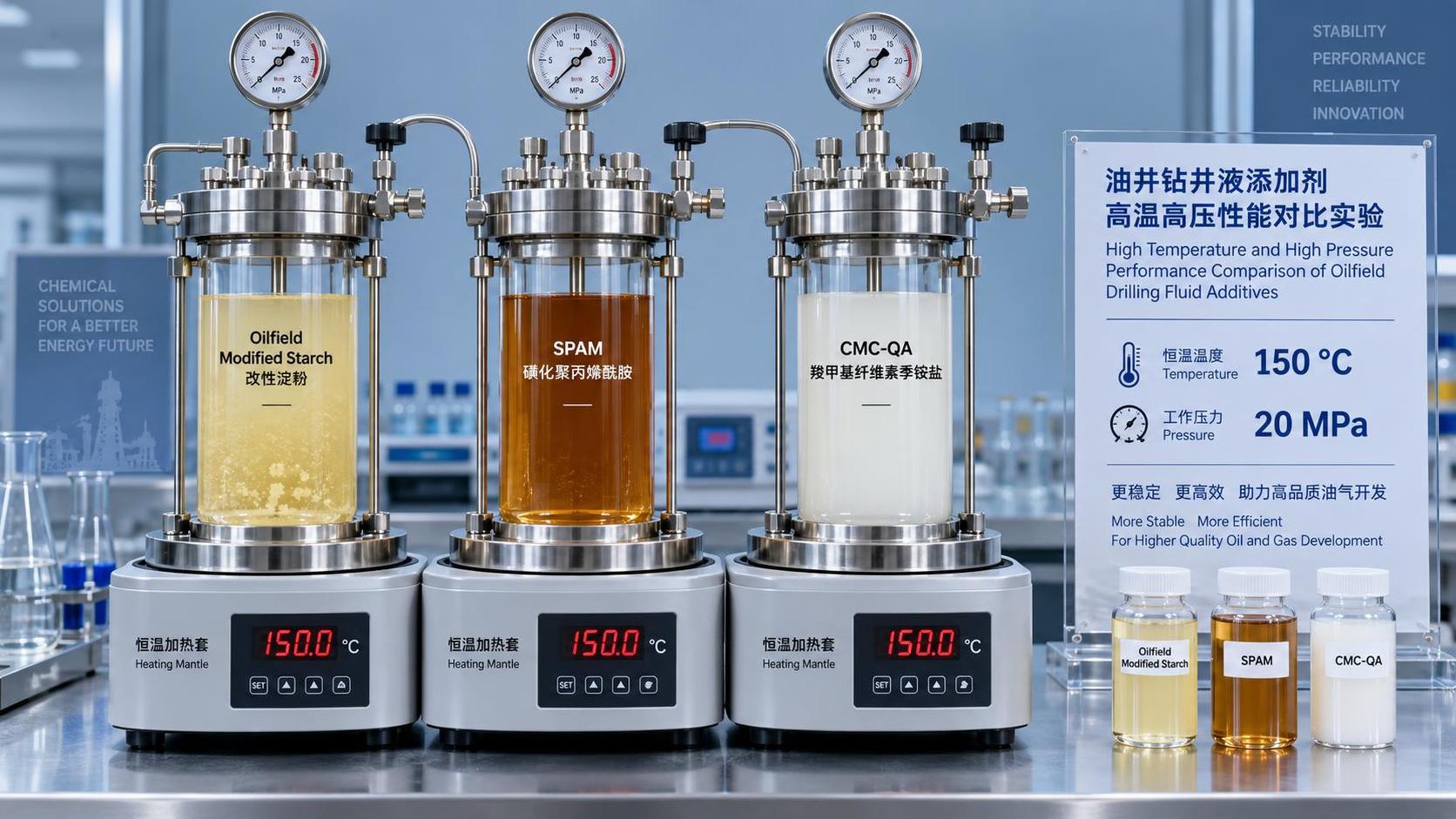
Sulfonated polyacrylamide (SPAM)
SPAM introduces sulfonate groups (–SO₃⁻) along the backbone, enhancing charge density and steric repulsion against multivalent ions. It maintains >85% of initial yield point at 150°C and 200,000 ppm TDS for 16 hours—provided pH remains between 8.5 and 10.5. Below pH 7.5, hydrolysis accelerates; above pH 11, oxidative degradation increases. SPAM also requires strict oxygen exclusion during storage and mixing—dissolved O₂ above 50 ppb triggers free-radical chain scission.
Hydrophobically modified alkali-soluble emulsions (HASE)
HASE polymers incorporate short hydrophobic side chains (C₈–C₁₂) that form physical crosslinks via micellar association. These associations persist at elevated temperature because they rely on entropy-driven hydrophobic effect—not hydrogen bonding. HASE retains elastic modulus (G′) better than starch above 140°C but shows reduced solubility in CaCl₂-dominant brines (>80,000 ppm Ca²⁺), where calcium bridges disrupt micelle integrity. Pre-dissolution in low-salinity water followed by gradual brine addition mitigates this—yet adds complexity to field blending procedures.
Carboxymethyl cellulose with quaternary ammonium substitution (CMC-QA)
This hybrid modifies CMC’s carboxyl groups with permanently charged quaternary ammonium moieties, eliminating pH-dependent ionization. CMC-QA resists viscosity loss in both NaCl- and CaCl₂-rich systems up to 160°C, with minimal sensitivity to pH shifts. However, its thickening efficiency drops sharply below 40°C due to reduced hydration—making it unsuitable for surface-mixed fluids that must remain stable during transit through cooler risers. Dual-polymer systems (e.g., CMC-QA + low-MW xanthan) compensate, but introduce compatibility screening requirements before deployment.
Operational Trade-offs You Can’t Ignore
Switching away from oilfield modified starch isn’t just about chemistry—it reshapes logistics, quality control, and real-time decision windows:
- Dissolution time varies significantly: SPAM requires 60–90 minutes of high-shear mixing for full dispersion; starch achieves equivalent hydration in under 15 minutes. Delayed dissolution risks incomplete activation before reaching target depth.
- Filtration behavior differs: Starch contributes to low-HTHP fluid loss primarily through colloidal plugging; SPAM and CMC-QA reduce fluid loss via improved cake integrity—but generate finer filter cakes that may impair wireline tool passage if cake thickness exceeds 2 mm.
- Compatibility testing is non-negotiable: Starch rarely interferes with common shale inhibitors (e.g., KCl, glycol ethers). HASE and SPAM, however, can destabilize encapsulated inhibitors or trigger flocculation with certain amine-based lubricants—requiring full-fluid-system validation, not just base-fluid tests.
How Material Specifications Translate to Field Performance
Product datasheets list “thermal stability to 150°C”—but that value means little without context. Two parameters determine actual in-well behavior:
- Static aging duration: A claim of “stable at 150°C” based on 4-hour aging says nothing about 24-hour performance. Thermal degradation follows exponential kinetics; 10–15% additional viscosity loss typically occurs between hour 4 and hour 24 under constant conditions.
- Salinity composition specificity: Stability in 200,000 ppm NaCl ≠ stability in 200,000 ppm CaCl₂. Divalent ions accelerate hydrolysis 3–5× faster than monovalent equivalents at identical ionic strength. Always verify test conditions match your reservoir’s dominant ion species—not just total salinity.
Selecting With Confidence—Not Just Compliance
When evaluating alternatives, prioritize functional equivalence over chemical novelty. Ask: Does this material maintain both yield point and plastic viscosity across the full expected temperature gradient? Does its filtration profile align with planned logging and completion sequences? Does its mixing protocol fit existing rig equipment—without requiring retrofitting or new training? Oilfield modified starch remains viable where conditions stay within its envelope; replacing it prematurely adds cost and complexity without benefit. But where reservoir data confirms sustained exposure to >130°C and >150,000 ppm TDS, delaying alternative qualification risks non-productive time far exceeding any procurement premium. Huafeng Chemical supplies rigorously tested, export-compliant batches of SPAM and CMC-QA formulations—each batch accompanied by full rheological aging reports under client-specified temperature/salinity profiles—enabling direct correlation between lab data and downhole performance expectations.
Send Us Your Inquiry Today
