









Product Quick Navigation
Get a Quote
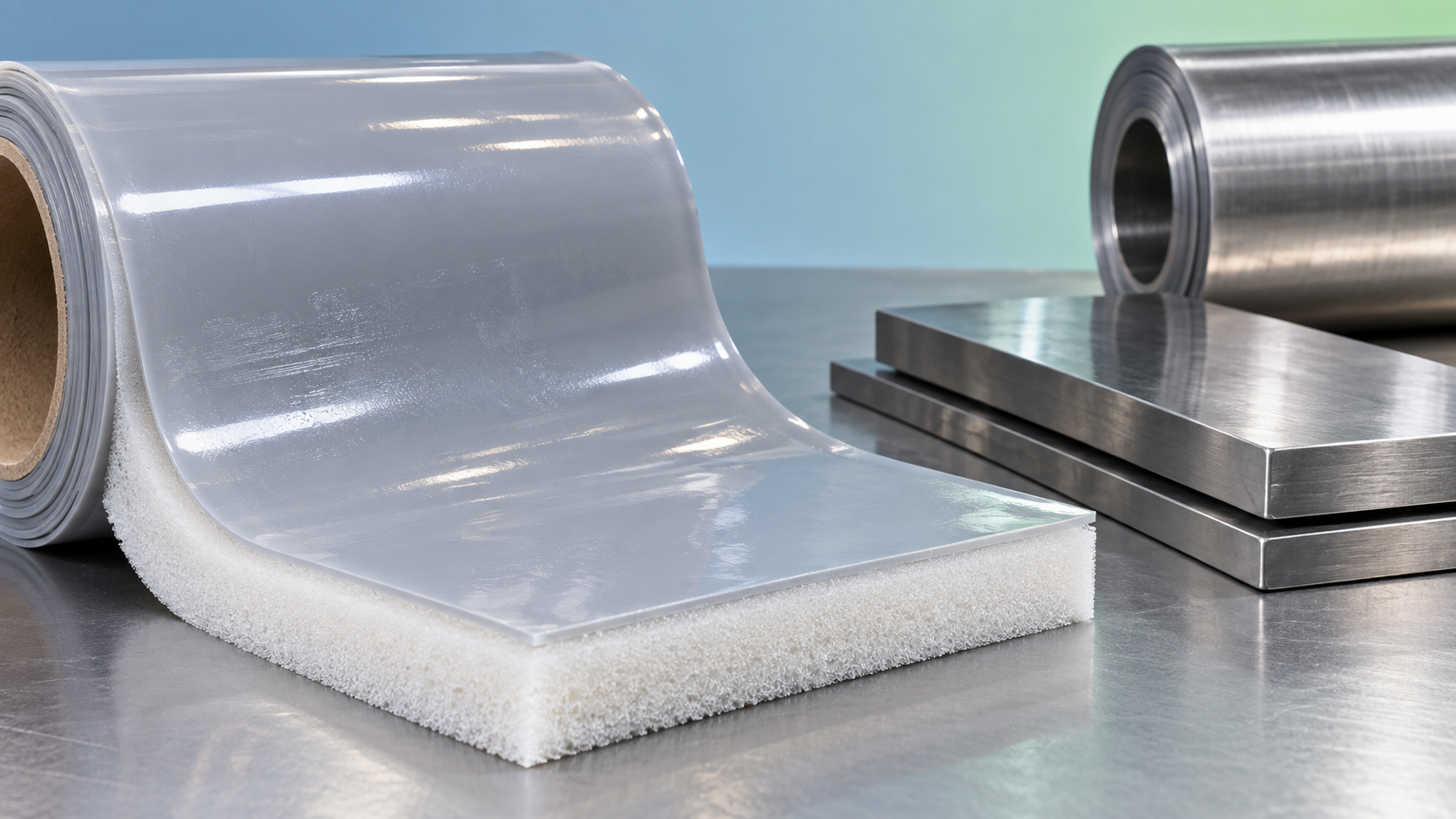
Plasticizer migration changes flexible PVC from the surface inward. The earliest signs are often a tacky feel, gloss loss, staining, print transfer, or a greasy film on a contacting material. As migration continues, the PVC compound loses part of the ingredient that keeps its polymer chains mobile. Hardness rises, elongation falls, low-temperature flexibility declines, and repeated bending can begin to produce whitening or cracking. A product can still pass an initial dimensional or tensile check while already carrying a migration-related durability problem.
Migration is not a single material property. It is the result of a concentration gradient, the mobility of the plasticizer within PVC, and the ability of the surrounding environment to receive it. Heat, pressure, contact time, surface area, liquid exposure, and the composition of adjacent materials all alter the result. A formulation described as low-migration in one assembly can perform poorly when pressed against foam, coated fabric, adhesive, paint, cable insulation, or an absorbent paper package.
Why loss of plasticizer changes durability
Flexible PVC is a blend rather than a permanently uniform material at the molecular level. Plasticizers occupy space between PVC chains and reduce the intermolecular forces that would otherwise make the resin rigid. When part of that plasticizer leaves the compound, the remaining PVC-rich region behaves more like a higher-glass-transition material. The effect is usually strongest near exposed surfaces, which is why a thin film, gasket, or coated textile may become brittle at the surface before a bulk hardness test reveals a large shift.
The resulting damage is often progressive. A hardened surface concentrates strain during flexing, winding, sealing, or assembly. Small surface cracks create paths for dirt, moisture, cleaning agents, and further mechanical damage. In cable jackets, this can reduce resistance to handling and bending. In flooring, upholstery films, and coated fabrics, it can lead to dirt pickup, color change, or loss of surface integrity. In seals and tubing, extraction or transfer can alter compression behavior and create leakage risk even when the part retains its original shape.
Plasticizer loss should also be separated from other mechanisms that produce a similar appearance. Heat aging can cause PVC dehydrochlorination, which may show as discoloration and embrittlement without substantial plasticizer transfer. Incomplete fusion can leave a weak, rough surface that feels dry from the start. Excess lubricant, processing aid, or incompatible stabilizer can bloom to the surface and be mistaken for plasticizer migration. A reliable investigation distinguishes mass loss, surface chemistry, hardness change, and contact-material staining rather than treating any oily or brittle surface as proof of one cause.
Four routes by which migration occurs
Volatilization occurs when a plasticizer evaporates from an exposed PVC surface. Higher temperature, air movement, long service time, and a large exposed area increase the driving force. Low molecular weight materials are generally more vulnerable than larger, less volatile alternatives, but molecular weight alone is not enough to predict performance. A plasticizer can be nonvolatile yet still readily transfer into a compatible contacting polymer.
Contact migration is the movement of plasticizer from PVC into another solid. It becomes significant when the adjacent material has affinity for the plasticizer, such as some rubbers, polyurethane foams, coatings, adhesives, and polymeric packaging films. Pressure improves intimate contact, while elevated temperature increases diffusion in both materials. A stacked-sheet test can therefore reveal a serious issue that an open-air oven test misses. Contact migration may produce staining, softening, swelling, adhesive failure, or print offset in the receiving material rather than an obvious defect on the PVC itself.
Extraction takes place when a liquid removes plasticizer from PVC. Oils, fuels, detergents, disinfectants, solvents, perspiration simulants, and certain cleaning formulations can all be relevant, depending on the end use. The important distinction is that extraction is governed by liquid compatibility and renewal. A brief splash of a weakly interacting liquid has a different effect from repeated cleaning, immersion, or a liquid held under a compressed seal. Measuring the liquid uptake or mass change of PVC after exposure is useful only when the test liquid and exposure cycle resemble the intended service condition.
Surface exudation or bloom appears when an ingredient moves to the surface because its solubility in the compound is exceeded or changes during cooling and aging. This may be a plasticizer, but it can also involve additives with limited compatibility. Bloom is often most visible after storage at low temperature followed by warming, or after a process change shifts fusion quality. A surface deposit that can be wiped away does not automatically indicate bulk migration; its composition needs to be identified before reformulating the plasticizer package.
Variables that alter the migration result
Plasticizer polarity and molecular structure strongly influence compatibility with PVC and with the contacting substrate. A highly PVC-compatible plasticizer tends to remain better distributed in the resin, while a low-affinity material can separate more readily. Yet a formulation optimized only for retention in PVC can still fail when the adjacent material is an efficient sink. The correct comparison is not “which plasticizer migrates least” in isolation; it is which formulation maintains required flexibility after exposure to the specific temperature, liquid, pressure, and contact material of the finished construction.
Processing history also matters. Poor dry blending, inadequate mixing, inconsistent feed, incomplete gelation, or excessive thermal history can create nonuniform additive distribution. A part may then have local regions with different migration behavior even though the batch-average composition meets specification. Calendered sheet, plastisol coatings, extrusion, and molded articles have different thermal and shear histories, so a compound approval based on one process should not be transferred automatically to another geometry or production route.
Reading test results without false confidence
Migration testing works best when it tracks a defined failure mode. For a printed flexible film, visual transfer and ink adhesion may be primary endpoints. For a gasket, compression set, hardness, mass change, and sealing performance have greater relevance. For wire and cable materials, bend performance, surface condition, and dielectric properties after aging may matter alongside weight loss. A single test number rarely captures all of these effects.
Before testing, record the PVC formulation, specimen thickness, processing conditions, conditioning period, contact substrate, contact pressure, exposure orientation, and whether the system is open or enclosed. These details often explain contradictory laboratory results. An open specimen can lose volatile components to air, while a closed package can retain vapor but encourage transfer into the packaging film. A horizontal stack under load does not represent a freely hanging curtain or a ventilated cable run.
Useful measurements include mass before and after exposure, Shore hardness, tensile strength and elongation, surface tack, color or gloss change, microscopy of cracks, and analysis of the contact material. Mass loss alone can understate the problem when the plasticizer moves into a neighboring polymer but remains within the test assembly. Conversely, total mass loss can include moisture, residual volatiles, or degradation products. Where the cause is disputed, analytical comparison of the PVC surface, the bulk, and the receiving substrate gives much stronger evidence than a visual assessment.
Accelerated aging should preserve the mechanism being evaluated. Excessively high temperature can change PVC chemistry, distort diffusion relationships, or soften the contact substrate to a degree that never occurs in service. It remains useful as a screening tool, but it should not be treated as a direct prediction of field life without confirming that the observed defect matches the expected service mechanism.
Formulation and assembly controls
A durable approach begins by defining the dominant exposure. Indoor decorative film with no direct polymer contact has different needs from a flexible PVC component held against foam, a coated metal panel, or an elastomeric seal exposed to cleaners. The formulation can then be evaluated for volatility, contact transfer, extraction resistance, and low-temperature retention in the order relevant to that use.
- Use a plasticizer system with demonstrated compatibility with the PVC resin and the required processing window. High initial softness is not evidence of long-term retention.
- Assess the complete construction, including adhesives, inks, release liners, foam, protective films, and packaging. A stable PVC compound can still damage an incompatible neighboring layer.
- Control fusion and additive dispersion through defined processing conditions. Surface defects caused by poor gelation should be resolved before attributing the issue to plasticizer selection.
- Where direct contact cannot be avoided, a suitable barrier layer or changed contact material can reduce transfer more effectively than a minor reformulation.
Storage and handling can introduce exposure conditions before installation. Coiled flexible PVC under load, hot warehouse storage, tightly packed rolls, or protective films left in place beyond their intended interval can create contact migration that is absent from the final application. Samples taken only after unpacking may conceal the source because transferred material remains on discarded packaging or separators. Retaining representative packaging and mating materials during failure analysis prevents that evidence from being lost.
Safety and contamination boundaries
Migration control also limits unintended chemical contact. The receiving material may become tacky, release an odor, interfere with a coating, or contaminate a surface that must remain clean. Materials used around food-contact, medical, consumer, or sensitive electronic assemblies require application-specific evaluation of the finished article and its foreseeable exposures; a generic claim about a plasticizer category is not an adequate substitute for that evaluation.
Segregation is especially important where flexible PVC, organic solvents, and reactive chemicals are handled in the same facility. Chromium(VI) oxide CAS#1333-82-0 is a strong oxidizer and should not be treated as a compatible contact material for PVC compounds, plasticizer-containing waste, or organic-contaminated packaging. Separate storage, controlled cleanup procedures, and correct waste identification prevent a migration investigation from creating an unrelated chemical incompatibility hazard.
The most dependable durability judgment comes from linking a visible symptom to the actual transport route. Once the receiving medium, temperature history, contact pressure, and formulation state are known, plasticizer migration becomes a testable materials problem rather than a vague explanation for a surface defect.
Send Us Your Inquiry Today
