









Product Quick Navigation
Get a Quote
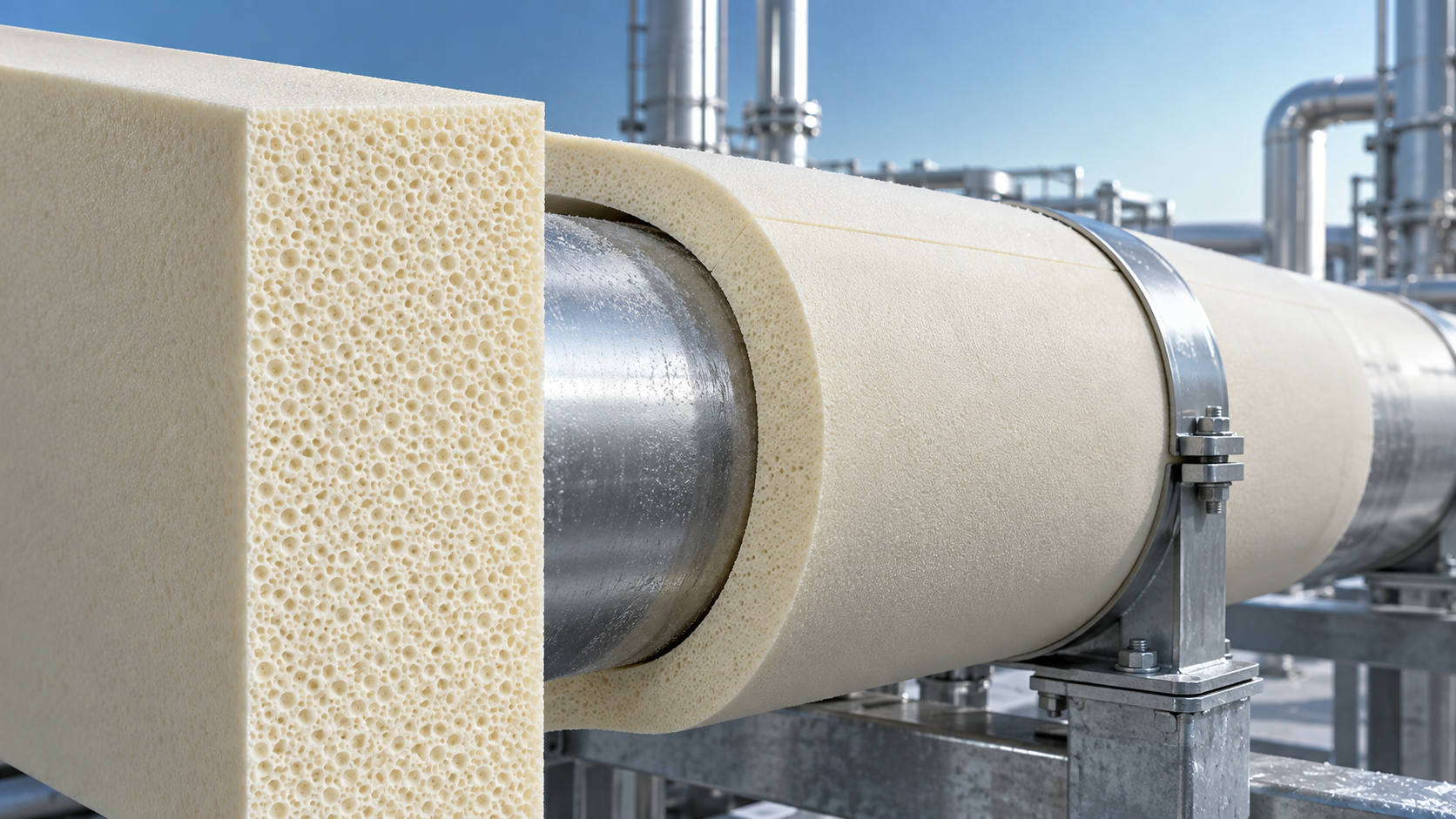
Polyurethane foam density affects insulation performance, but it is not a simple “higher density equals better insulation” relationship. Density changes the foam’s cell structure, strength, moisture resistance, dimensional stability, and material yield. Thermal performance can improve within a suitable formulation range, then level off or even become less efficient if extra polymer replaces insulating gas-filled cells.
The practical question is therefore not which polyurethane foam has the highest density. It is whether the specified density supports the required thermal resistance throughout the service life while also meeting the load, moisture, fire, installation, and temperature demands of the assembly.
Density is a structural property, not a stand-alone insulation rating
Polyurethane foam density describes mass per unit volume. In rigid polyurethane insulation, a higher density generally means more polymer is present in the same volume and the cellular structure is often more resistant to crushing or damage. That matters for roof systems, floor insulation, cold-storage panels, pipe supports, insulated tanks, and other locations where the insulation must carry or resist mechanical forces.
However, insulation works mainly because millions of small cells limit heat transfer. In closed-cell polyurethane foam, those cells contain blowing-agent gases and are separated by polymer cell walls. Heat moves through the gas, through the solid polymer, and by radiation across the cells. The formulation, cell size, closed-cell content, and condition of the foam all influence the final thermal conductivity.
Density is related to these factors, but it does not define them. Two foam products with the same nominal density can deliver different thermal results because their formulations, blowing agents, processing conditions, and cell structures differ. A density value should therefore be treated as one control point in a material specification, alongside declared thermal conductivity, compressive behavior, water-related performance, and dimensional stability.
How density changes the thermal balance
At very low density, polyurethane foam may have thin cell walls, a less uniform structure, or a greater proportion of open or imperfect cells. The foam can be more vulnerable to mechanical damage and moisture entry. It may also be less stable during manufacture or installation. These weaknesses can undermine insulation performance even when an initial laboratory value appears attractive.
As density increases into the range intended for a given insulation product, cell integrity and consistency often improve. A more uniform closed-cell structure can help maintain the intended insulation thickness and reduce damage from handling, fastening, or service loads. In this range, selecting adequate density supports thermal performance indirectly: the foam stays intact, remains properly bonded, and is less likely to develop gaps or compression.
Beyond that point, adding polymer does not automatically create a better insulator. Solid polymer conducts heat more readily than the gas held in well-formed foam cells. If density rises mainly because the foam contains more solid material rather than a better cell structure, the thermal advantage may be limited. This is why a high-density structural foam should not automatically replace a purpose-designed insulation foam.
The most useful specification approach is to ask for the thermal conductivity or thermal resistance at the intended service condition, then confirm that the density is appropriate for the mechanical and environmental exposure. Thickness and thermal conductivity together determine the resistance of the insulation layer. Density helps indicate whether that layer is likely to survive its job without excessive deformation or degradation.
Initial performance is different from aged performance
Rigid polyurethane foam often begins service with gases in its cells that contribute to its low thermal conductivity. Over time, gas diffusion and air ingress can change the cell-gas composition. The thermal conductivity can therefore change from its initial state. This process is often described as thermal aging.
Density can influence the robustness of the foam structure, but it cannot be used as a shortcut for long-term thermal performance. A dense foam with an unsuitable formulation or poorly controlled manufacture may not retain performance as well as a properly engineered insulation product at a lower density. For projects where energy use, process temperature, or condensation risk is critical, specify the declared or aged thermal value required by the project rather than relying on an initial-value claim alone.
Installation quality also becomes part of aged performance. Irregular substrate contact, incomplete adhesive coverage, crushed board edges, voids around penetrations, and poorly sealed joints can create heat-flow paths that dominate the real result. Raising foam density does not correct these defects. A continuous insulation layer with well-designed joints is frequently more valuable than a marginal material upgrade applied inconsistently.
Where higher-density polyurethane foam earns its place
Higher density is justified when insulation is exposed to forces that could compress, crack, puncture, or permanently deform a lighter foam. The thermal benefit in these situations is often preservation of the designed thickness. Once foam is compressed, its thickness is reduced and the assembly loses thermal resistance. Damage can also create local air paths or allow moisture to reach interfaces.
For low-load wall cavities or protected building-envelope areas, specifying a substantially higher density than necessary may add material cost and weight without improving the overall thermal design. The correct choice depends on exposure. A wall board protected by cladding has a different risk profile from an insulation layer under a loaded slab or on an industrial vessel.
Moisture behavior can outweigh a small density difference
Water is a serious threat to insulation systems because it changes heat transfer and can damage surrounding components. Polyurethane foam is often selected for its predominantly closed-cell structure, but no foam should be treated as a complete moisture-management system by density alone.
A denser closed-cell foam may be more resistant to water uptake than a lower-density or more open structure, but water can still enter through joints, damaged facings, penetrations, poor transitions, or imperfect adhesion. In low-temperature systems, vapor can move toward colder surfaces and condense where the vapor-control layer is discontinuous. The resulting problem is usually an assembly-design issue, not merely a foam-density issue.
For exterior insulation, below-grade applications, tanks, pipelines, and cold-service equipment, review the full moisture path: surface water, water vapor, joint geometry, drainage, protective coatings, and the chance of mechanical damage. A foam product with suitable density but exposed seams can perform worse than a lighter product installed as a continuous, protected system.
Density also affects installation decisions
Board handling, cutting, fastening, spraying, and transport all expose polyurethane foam to practical risks. A low-density board can be easier to damage at corners and edges. A very dense board may resist handling damage but be more difficult to cut cleanly or may require adjustments to fastening and support details. In spray polyurethane foam work, density is influenced by the mix ratio, temperature, pressure, substrate condition, and application technique. The target density is meaningful only if the installed foam is uniform and properly cured.
Thickness control deserves equal attention. A material that has a strong thermal rating on paper cannot deliver the specified assembly resistance if the installed layer is thinner than designed. For spray foam, measure installed thickness at representative locations and examine for voids, pull-away, scorching, poor adhesion, or irregular lifts. For board systems, inspect joints, edge damage, staggered layout, and continuity around steel, concrete, pipework, and structural penetrations.
Do not use a density number to compare products with different formats. A rigid board, a spray-applied foam, a sandwich-panel core, and a structural foam may all use polyurethane chemistry but serve different functions. Their density ranges, thermal values, and acceptance criteria are not interchangeable.
A practical specification sequence
Material selection becomes more reliable when the design team starts with service conditions and works backward to the foam properties. This prevents density from becoming an isolated procurement target.
- Define the thermal duty. Identify the operating temperature range, target assembly resistance, insulation thickness limits, and consequences of heat loss or gain.
- Map the load condition. Consider dead loads, maintenance traffic, equipment loads, fastener pressure, impact risk, and any sustained compression that may occur during service.
- Assess the moisture and vapor environment. Determine whether the system faces rain, groundwater, washdown, humidity, condensation risk, or cold-side vapor migration.
- Select the insulation format. Decide whether board, panel core, spray foam, pipe section, or another engineered form best suits access, geometry, sequencing, and repair requirements.
- Set performance requirements before density. Specify the relevant thermal value, thickness, mechanical behavior, dimensional stability, and environmental resistance. Then use density as a supporting requirement consistent with the product design.
- Verify the installed assembly. Confirm product identity, thickness, continuity, joint treatment, protection layers, and workmanship at interfaces where heat bridges are likely.
This sequence also helps procurement teams compare quotations correctly. A lower-density foam may appear less expensive per volume but may require greater thickness, more protection, or tighter handling controls. Conversely, paying for high density where loads are minimal can reduce material yield without producing a meaningful lifecycle benefit.
Common specification mistakes
Using density as a proxy for R-value. Density alone cannot establish thermal resistance. Ask for the thermal property relevant to the product and service condition, then calculate the required thickness for the assembly.
Ignoring compression under real loads. A foam can meet an initial strength figure yet still be unsuitable for sustained loading if long-term deformation is not considered. The insulation must retain enough thickness for its thermal function.
Assuming closed-cell foam eliminates vapor detailing. Penetrations, edges, joints, and interfaces remain potential moisture routes. The system must be detailed as a complete thermal and moisture-control layer.
Substituting by density during procurement. Replacing a specified foam with another product that has a similar density can change thermal performance, facings, adhesion, fire behavior, or dimensional stability. Equivalent density is not equivalent product performance.
Overlooking temperature effects. Industrial insulation may operate far from room temperature. Thermal performance, movement, coating compatibility, and vapor-control needs should be reviewed at the intended operating range.
What to request from a polyurethane foam supplier
A useful submittal package identifies the foam type and intended use, nominal density, declared thermal conductivity or thermal resistance, installed-thickness guidance, and relevant mechanical and dimensional properties. It should also make clear whether the reported thermal value reflects initial or aged performance and whether a facing, coating, or protective layer is part of the tested configuration.
For projects involving international material sourcing, documentation consistency and response time matter as much as the headline product data. Suppliers should be able to provide batch identification, safety information, transport classification where applicable, and documentation aligned with the project’s purchasing and compliance requirements. This reduces the risk of receiving a material that is chemically similar but unsuitable for the designed insulation system.
FAQ
Does a higher polyurethane foam density always provide a higher R-value?
No. Density may improve durability and resistance to compression, but thermal resistance depends mainly on thermal conductivity and installed thickness. Excess solid polymer can limit the thermal advantage of increasing density.
Can low-density foam be used for insulation?
Yes, where the product is designed for the application and is protected from loads, impact, and moisture exposure. It should not be selected solely because it uses less material per unit volume.
Why can insulation performance fall after installation even when the correct foam was purchased?
Common causes include insufficient thickness, gaps at joints, compression, water entry, poor adhesion, and thermal bridges at structural connections. Product selection and installation control must work together.
Should density be listed in the project specification?
It can be useful as a quality and application-control requirement, especially where load resistance matters. It should accompany, not replace, requirements for thermal performance, thickness, mechanical behavior, and environmental suitability.
The defensible choice is the polyurethane foam system that maintains its specified thickness, thermal resistance, and moisture-control function under actual service conditions. Density is essential to that decision when structure and durability are involved, but it becomes meaningful only when read with the rest of the product and assembly data.
Send Us Your Inquiry Today
