









Product Quick Navigation
Get a Quote
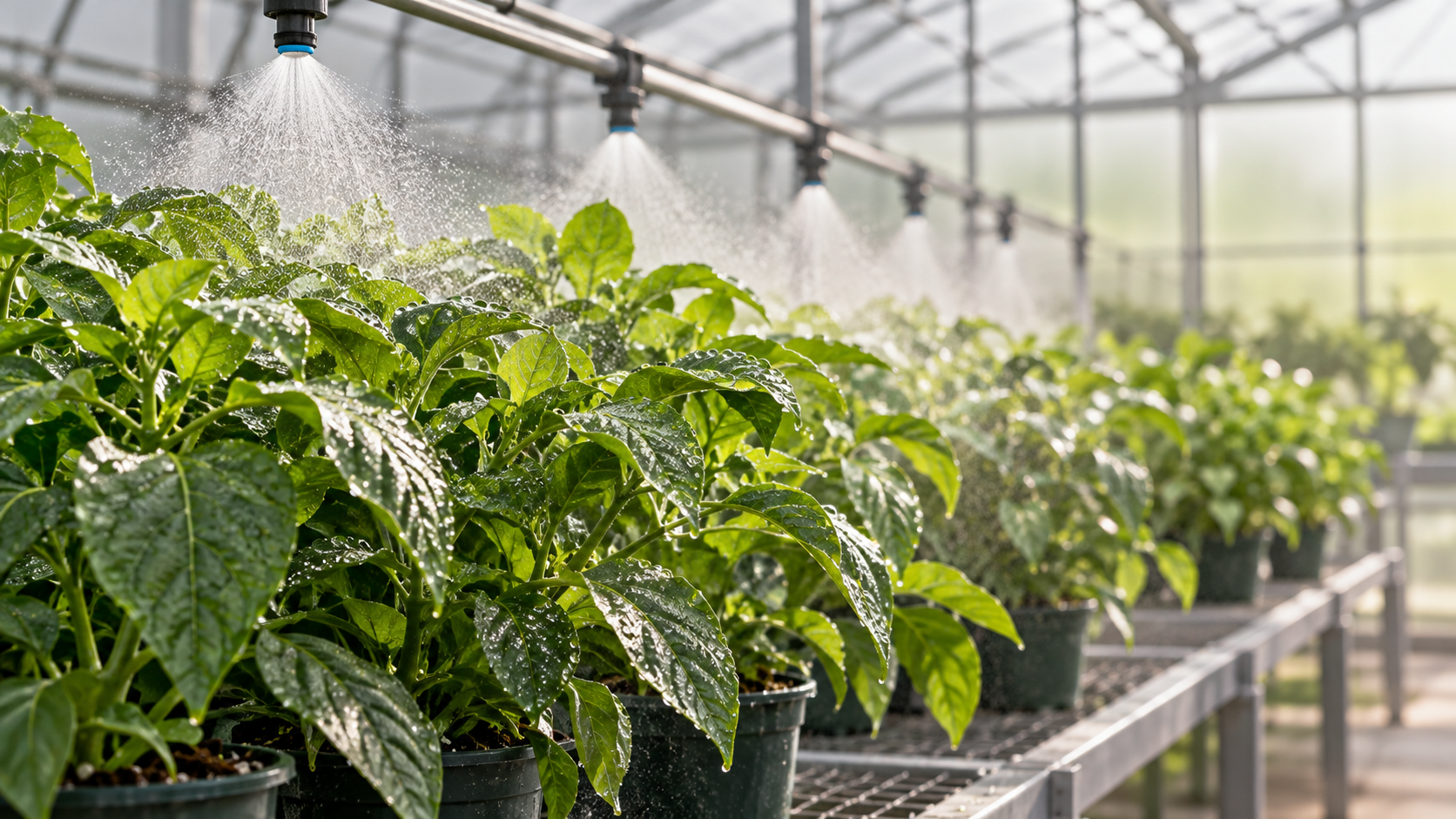
Protectant fungicides are a practical foundation when a greenhouse can maintain thorough coverage before infection. Products with movement into plant tissue become useful when disease biology, rapid crop growth, or difficult spray access creates a specific need for internal protection. Many greenhouse programs benefit from both. The choice depends on the pathogen, where infection occurs, and whether the application can reach that site at the right time.
Two distinctions should guide the evaluation. “Systemic” does not guarantee movement throughout the plant or recovery after symptoms appear. “Protectant” describes preventive activity, while “contact” describes surface retention; a systemic product can also work preventively. For technical comparison, evaluate surface coverage, plant movement, infection timing, and mode of action separately. Treating these as one protectant-versus-systemic decision can lead to unsuitable product choices.
Start with the infection site and the coverage problem
Contact protectants act principally where the spray deposit remains. They can prevent susceptible pathogens from establishing infection on treated surfaces, provided the deposit is present before infection and remains effective. Their performance therefore depends heavily on application quality. An effective active ingredient can deliver disappointing control if lower leaves, stem junctions, leaf undersides, or tightly packed foliage receive insufficient coverage.
Greenhouse conditions make that limitation consequential. Dense benches restrict access, overlapping leaves intercept droplets, and crop architecture changes during production. A spray setup that covers young plants adequately may leave substantial gaps after canopy closure. Before concluding that a protectant has failed, evaluators should examine deposition within the canopy, nozzle selection, spray volume, travel speed, and the accessibility of the infection site.
Systemic products offer different degrees of movement. Some remain locally within treated tissue. Translaminar activity allows movement through a leaf, which can improve protection across that leaf but does not establish whole-plant distribution. Other active ingredients move mainly upward with water flow through the xylem. Broader redistribution is product-specific and should be supported by technical evidence rather than inferred from the word “systemic.”
These differences matter when evaluating claims about new growth. A product absorbed by an existing leaf may provide little protection to a leaf that emerges later. Upward movement also does not establish adequate delivery to roots, flowers, or every growing point. Ask which tissues receive biologically effective concentrations, through which application route, and under what growing conditions. A general mobility claim is insufficient for that decision.
For a relatively open canopy with predictable disease pressure, reliable surface coverage may make a contact protectant an efficient choice. For dense foliage, a product with suitable translaminar or systemic activity may help address a specific coverage limitation. However, absorption still requires successful delivery to an appropriate surface or root zone. Internal movement cannot compensate for an application that misses its uptake site.
Match the product to the pathogen and infection window
The disease diagnosis should precede the mobility comparison. Similar symptoms can arise from fungal pathogens, oomycetes, bacterial diseases, or environmental injury. A fungicide selected for foliar fungal disease may have no useful activity against an oomycete root pathogen. Likewise, a product effective against one leaf disease should not be assumed effective against another because both occur under humid conditions.
For recurring problems, laboratory diagnosis can prevent an entire program from being built around the wrong target. Where resistance is suspected, sensitivity testing may also help distinguish reduced pathogen sensitivity from poor application or unsuitable timing. While a diagnosis is being established, sanitation, removal of affected material, and correction of irrigation or condensation problems can reduce pressure without depending on an uncertain chemical choice.
Timing then determines what protection is still achievable. Preventive applications place an effective residue or tissue concentration at the infection site before the pathogen becomes established. Some fungicides have limited post-infection activity against particular diseases, but that activity is bounded by the pathogen’s development, the active ingredient, and treatment timing. It should not be interpreted as a general ability to cure visible disease.
By the time lesions, blight, or root damage become apparent, infection may be well advanced. Treatment may protect healthy tissue or suppress further disease development where supported by the label and efficacy evidence. It will not restore dead tissue. Evaluating a systemic product as a rescue treatment therefore requires evidence for that disease and infection stage, rather than reliance on its mobility classification.
Consider a greenhouse with recurring leaf wetness and a history of a susceptible foliar disease. A protectant may perform well if applied before infection periods with adequate coverage and lawful intervals. If symptoms are already spreading through a dense canopy, the decision changes: identify the pathogen, remove major inoculum sources where practical, and select an effective labeled treatment. Simply replacing a contact product with any systemic fungicide leaves the central questions unresolved.
Root disease requires a separate assessment. A foliar application should not be expected to protect roots unless that use and delivery pathway are supported. For an authorized drench or other root-zone treatment, substrate moisture, distribution through the container, root condition, and irrigation practices affect exposure. Waterlogged substrates and persistent contamination can continue driving losses even when the selected active ingredient has appropriate activity.
Build resistance management around mode of action
Mobility does not determine resistance risk. Many familiar contact protectants act at multiple biochemical sites, and many systemic products act at a single site, but these associations do not replace checking the actual mode of action. Use the Fungicide Resistance Action Committee, or FRAC, classification alongside the product label and disease-specific resistance guidance when designing a sequence.
Changing trade names is not necessarily a rotation. Two products may contain the same active ingredient, share a FRAC group, or have relevant cross-resistance. A premix also requires closer inspection: both components must be considered when planning subsequent applications. Repeatedly switching between a premix and one of its components may continue exposing the pathogen to the same mode of action.
A useful program assessment asks:
- Which active ingredients and FRAC groups will the pathogen encounter across the production cycle?
- Does each proposed rotation partner provide effective control of the target disease?
- Do application limits include earlier treatments on incoming plants or treatments made elsewhere during propagation?
- Are proposed mixtures authorized, compatible, and supported by relevant resistance-management guidance?
A mixture only contributes meaningful resistance protection when its components meet the relevant efficacy and use conditions. Adding an ineffective partner does not reliably protect a vulnerable active ingredient. Similarly, a lower-resistance-risk product cannot undo repeated selection caused by excessive use of another mode of action. Follow applicable limits on consecutive treatments, total applications, rates, and intervals.
Application records should connect products to disease observations. Record crop stage, treated area, active ingredient, FRAC group, application method, and subsequent disease development. This makes it easier to distinguish a recurring coverage gap from declining control across well-treated plants. When performance deteriorates, avoid responding automatically with shorter intervals or repeated applications of the same chemistry; investigate the cause before increasing selection pressure.
Compare usable protection and total application cost
Purchase price alone gives an incomplete comparison. A lower-priced protectant may require substantial labor to cover a mature canopy, while a more expensive mobile product may still require careful spraying and repeat treatment as growth continues. Compare the cost of achieving an acceptable protection level over the relevant production stage, including application labor, equipment, crop access, and consequences of treatment failure.
Persistence should also be assessed under actual greenhouse conditions. Overhead irrigation can affect surface deposits, while new growth creates untreated tissue. Systemic uptake depends on the product and conditions around application; absorption does not occur instantly. Product-specific instructions on drying, irrigation, and application timing matter. A persistence claim from another crop or production setting is a weak basis for extending treatment intervals.
Crop safety can determine whether an otherwise effective option is usable. Species, cultivar, growth stage, temperature, formulation, and tank-mix partners can influence injury. Ornamentals present an additional constraint because visible deposits or minor spotting can reduce marketability even when disease control is acceptable. Assess compatibility on a limited representative group before broader use, following label directions and allowing enough observation time for injury to develop.
Legal suitability belongs in the initial screen. Verify authorization for the crop, disease, greenhouse setting, application route, and jurisdiction. Check worker reentry requirements, harvest restrictions where relevant, seasonal application limits, and any restrictions affecting treated produce or plants entering the destination market. An active ingredient’s availability through international trade does not establish permission to use a particular formulation in a greenhouse.
Supplier documentation should support this evaluation with an identifiable formulation, active ingredient concentration, batch traceability, safety data sheet, and specifications consistent with the registered product. A certificate of analysis can support batch-quality assessment, but it does not establish disease efficacy, crop safety, or legal use. Technical claims about mobility and post-infection activity need evidence relevant to the proposed application.
The final selection should fit a defined disease scenario: the target pathogen, vulnerable tissue, expected infection period, achievable coverage, and permitted treatment sequence. Where preventive surface coverage is dependable, protectants can carry substantial responsibility. Where internal movement solves a demonstrated delivery problem, an appropriate systemic product earns its place. Continued infection under either approach calls for reassessing diagnosis, application quality, and greenhouse moisture conditions before adding another treatment.
Send Us Your Inquiry Today
