










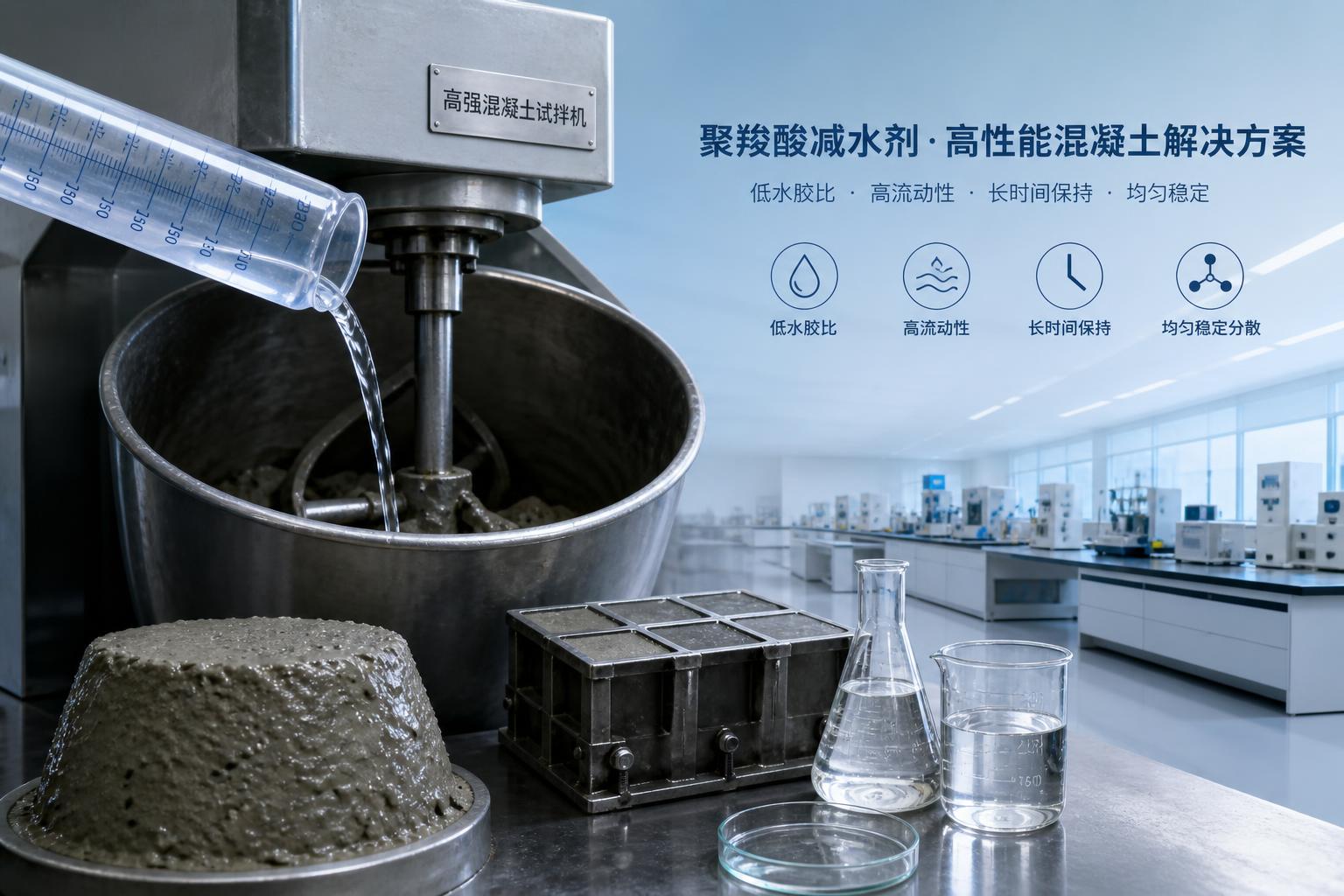
Selecting Polycarboxylate Superplasticizers for High-Strength Concrete Mixes
Selecting the right Polycarboxylate Superplasticizer is critical for project managers delivering high-strength concrete under demanding performance, scheduling, and quality-control requirements.
The appropriate admixture improves workability, reduces water demand, and supports reliable strength development while helping teams manage material consistency across complex construction projects.
For project leaders, the best choice is rarely the product with the highest advertised water reduction. It is the product that performs predictably with approved materials and site conditions.
Start With the Project Decision, Not the Admixture Label
High-strength concrete projects typically need more than a lower water-cement ratio. They need placement reliability, stable air content, workable delivery windows, and repeatable compressive strength results.
A Polycarboxylate Superplasticizer should therefore be selected against the project’s actual performance risks, including pumping distance, reinforcement congestion, temperature, curing method, and production capacity.
For a precast operation, early strength and short demolding cycles may control the decision. For a high-rise pour, slump retention and pumpability usually deserve greater weight.
Bridge decks, transfer slabs, foundations, and industrial floors also create different priorities. A single admixture specification cannot automatically serve every high-strength concrete application within one project.
Project managers should define measurable acceptance targets before suppliers propose a dosage. These targets should include water reduction, initial slump, retention period, air content, set time, and strength.
This approach prevents procurement decisions from being driven by unit price alone. A lower-cost admixture can create expensive delays when it requires additional water, rework, or rejected loads.
Ask each supplier to explain how its product will be evaluated with your cementitious system. A credible technical partner welcomes comparative trials and clearly documented acceptance criteria.
Confirm Cement and Supplementary Material Compatibility First
Cement compatibility is the foundation of successful Polycarboxylate Superplasticizer selection. Different cement chemistries can alter adsorption behavior, dispersion efficiency, setting response, and slump retention significantly.
Alkali content, sulfate balance, fineness, clinker mineral composition, and soluble sulfate availability all influence how a superplasticizer performs in fresh concrete.
Compatibility risks increase when projects use blended binders. Fly ash, ground granulated blast-furnace slag, silica fume, limestone powder, and calcined clay each affect water demand differently.
Silica fume is especially relevant in high-strength mixes because it improves particle packing but can increase cohesion. The admixture must provide flow without causing segregation.
Do not rely only on historic results from another plant or region. Even nominally identical cement grades may vary due to quarry sources, grinding conditions, or production changes.
Require laboratory trials using the exact proposed cement, supplementary cementitious materials, aggregates, mixing water, and target binder content. This is more valuable than a generic technical data sheet.
When a project has multiple ready-mix plants, test each source separately. Plant-level batching practices and material variations can create performance differences that are invisible in centralized specifications.
Set Water Reduction and Strength Targets That Reflect Construction Reality
The central purpose of a Polycarboxylate Superplasticizer in high-strength concrete is to achieve required workability at a low water-binder ratio without sacrificing placement control.
Higher water reduction can support greater compressive strength, lower permeability, and improved durability. However, an aggressive reduction target may reduce robustness if aggregate moisture changes.
Instead of requesting maximum water reduction, specify the water reduction needed to meet design strength while retaining a workable safety margin for normal production variation.
Strength should be reviewed at relevant ages, not only at 28 days. Early-age strength may affect formwork removal, post-tensioning, lifting operations, or the release of subsequent construction activities.
Also verify later-age strength where durability or structural design requires it. Some binder systems develop strength more slowly, particularly when larger proportions of slag or fly ash are used.
Trial records should compare a control mixture and candidate admixture mixtures at equivalent slump or spread. Comparing mixes at unequal consistencies can create misleading conclusions.
Record the actual water added during batching, including moisture corrections. A promising laboratory result has limited value if it cannot be repeated under realistic plant control.
Evaluate Slump Retention Across the Full Delivery and Placement Window
Many high-strength concrete failures are operational rather than structural. Concrete may meet its initial slump target but lose workability before pumping, placing, or finishing is complete.
Evaluate slump retention at the times that matter for the project. For local placements, this may be sixty minutes; for urban delivery constraints, it may be ninety minutes or longer.
Retention testing should represent anticipated ambient temperatures. Results from a climate-controlled laboratory may not predict behavior during hot-weather transport or extended truck waiting periods.
Measure workability consistently using slump, slump flow, or another approved test method. Pair those measurements with visual observations of cohesion, bleeding, segregation, and surface finish.
Long retention is not automatically beneficial. Excessive set delay can interfere with finishing, joint construction, formwork turnover, and the coordination of follow-on trades.
Ask whether the supplier offers separate product families for immediate dispersion, controlled retention, or extended-haul concrete. A tailored solution is often more dependable than overdosing one product.
Define a clear field protocol for authorized adjustments. Adding water at the site to recover slump usually undermines strength, durability, and the validity of quality-control records.
Control Dosage, Mixing Sequence, and Interaction With Other Admixtures
Dosage is not a fixed number that can be copied from a brochure. It must be established as a range that accounts for normal material and environmental variation.
A narrow operating range creates production risk. If minor aggregate moisture or cement changes require frequent intervention, the mix may not be suitable for high-volume project execution.
Confirm whether dosage is expressed by binder mass, cement mass, or product volume. Procurement documents should state the basis clearly to avoid errors between laboratories and batching plants.
Mixing sequence also matters. Adding a Polycarboxylate Superplasticizer at a different stage can change dispersion, slump development, entrained air, and the amount of required mixing energy.
Document the approved batching sequence during trials, including aggregate charging, initial water addition, binder loading, admixture timing, and final mixing duration.
Review interactions with retarders, accelerators, viscosity-modifying agents, air-entraining agents, shrinkage reducers, and corrosion inhibitors before authorizing combined use on site.
Combination effects are not always additive. One admixture may amplify another product’s set delay or reduce air-control stability, requiring a revised dosage strategy.
Assess Pumpability, Finishability, and Fresh-Concrete Stability
High-strength concrete often contains elevated binder contents and fine materials. These characteristics can improve density but also increase viscosity and complicate pumping through long pipelines.
A suitable superplasticizer creates dispersion while preserving enough cohesion to prevent segregation. The target is stable movement through the system, not simply the highest measured slump.
Where pumping is critical, conduct a realistic pump trial whenever practical. Monitor pressure, discharge consistency, line blockage risk, and changes in workability after pumping.
Finishing requirements deserve equal attention for slabs and exposed surfaces. Some mixes remain fluid yet become sticky, difficult to strike off, or prone to delayed finishing windows.
Review bleeding behavior carefully. Very low bleeding can be beneficial for durability, but it can also increase plastic-shrinkage risk when evaporation conditions are severe.
Site teams should prepare curing materials and wind-control measures before placement. Admixture selection cannot compensate for poor hot-weather or evaporation management practices.
Capture feedback from pump operators, finishers, quality technicians, and concrete producers. Their observations often reveal practical problems before they appear in compressive-strength reports.
Specify Quality Consistency and Supply Assurance
For project managers, a technically successful trial is only the first step. The selected Polycarboxylate Superplasticizer must be available with consistent quality throughout the construction program.
Evaluate the supplier’s manufacturing controls, batch traceability, product identification, storage recommendations, and ability to provide certificates of analysis for each delivery.
Request information about active solids content, density, pH range, chloride content, and recommended storage conditions. These properties support receiving inspections and production troubleshooting.
Supply continuity should be reviewed before contract award, especially for projects with phased pours or remote locations. Delayed admixture deliveries can disrupt concrete production immediately.
Import arrangements require additional scrutiny. Confirm packaging formats, lead times, shipping documentation, customs requirements, regulatory status, and contingency inventory before mobilization begins.
For chemical procurement programs involving broader formulation needs, products such as Sodium polyacrylate CAS#9003-04-7 should be assessed according to their intended industrial application rather than treated as substitutes for concrete admixtures.
This distinction is important because chemically related water-management functions do not establish equivalent concrete performance. Every material used in a concrete system needs application-specific technical validation.
Build Compliance and Documentation Into the Selection Process
Admixture selection should include standards compliance from the beginning. Depending on the market, relevant requirements may include ASTM C494, EN 934-2, or project-specific specifications.
Compliance documentation should confirm the product category and relevant performance properties, but it should not replace mixture-specific testing under actual project materials.
Review safety data sheets before site delivery. Confirm worker handling procedures, spill response, storage compatibility, personal protective equipment, and local labeling requirements.
Environmental and regulatory requirements may also affect procurement decisions. International projects can require declarations relating to chemical inventories, restricted substances, transport classification, and regional registration obligations.
Create a submittal package that combines technical data, trial results, certificates, safety documents, mix designs, and approved field-adjustment procedures in one controlled record.
This documentation gives project teams a defensible basis for decisions. It also reduces confusion when staff, plants, or suppliers change during a long construction schedule.
Assign ownership for admixture approval and change control. No substitution, dosage modification, or material-source change should occur without a defined technical review process.
Use Structured Trials to Compare Value, Not Just Price
A disciplined trial program turns admixture selection into a measurable commercial decision. It allows project managers to compare total installed value rather than purchase price per kilogram.
Build a comparison matrix covering dosage, water reduction, slump retention, strength, air content, set time, pumpability, finishing response, and observed sensitivity to variation.
Include operational costs in the assessment. These may include additional mixing time, rejected loads, pumping interruptions, labor requirements, curing measures, and schedule impacts.
For large placements, simulate the full operational cycle. Produce multiple batches, hold representative loads, test after transport time, and place material using anticipated field equipment.
Test at normal and adverse temperatures where project conditions justify it. A product that performs well only in mild conditions introduces avoidable schedule and quality risk.
Review results jointly with the concrete producer, supplier, quality team, and construction manager. Selection decisions are stronger when technical performance and field practicality are evaluated together.
Document the final approved range, not merely a single optimum dose. This provides batching personnel with practical boundaries for daily production control.
Establish Field Controls Before the First Major Pour
Successful selection must be followed by disciplined implementation. The project team should hold a pre-pour review before major high-strength concrete placements begin.
Confirm approved material sources, target moisture corrections, admixture batch numbers, dosage settings, mixing times, delivery routes, testing frequency, and communication responsibilities.
Calibrate batching equipment and verify dispensing accuracy. Small errors in high-range water reducer dosage can cause substantial changes in slump, set behavior, and air content.
Set clear escalation criteria for unexpected fresh-concrete behavior. The team should know who can authorize adjustments and when a load must be held or rejected.
Monitor early placements closely and compare field results with trial benchmarks. Prompt review helps identify drift before it affects a large pour volume.
Maintain records that connect concrete test data with material batch numbers and site conditions. Traceability is essential when investigating strength variation or finishing concerns later.
Use lessons from initial pours to refine operating instructions, while preserving formal approval controls. Continuous improvement is valuable only when changes remain documented and repeatable.
Conclusion: Select for Predictability Across the Entire Project
The right Polycarboxylate Superplasticizer is the one that delivers required strength and workability consistently with the project’s approved cementitious system, logistics, equipment, and quality controls.
Project managers should prioritize compatibility testing, realistic slump-retention evaluation, practical dosage ranges, supply reliability, and documented field procedures over simple headline performance claims.
By comparing total operational value instead of unit cost alone, teams can reduce placement risk, protect schedules, and achieve more dependable high-strength concrete outcomes.
A well-managed selection process creates confidence before the first major pour and provides a stronger basis for quality control throughout the project lifecycle.