









Product Quick Navigation
Get a Quote
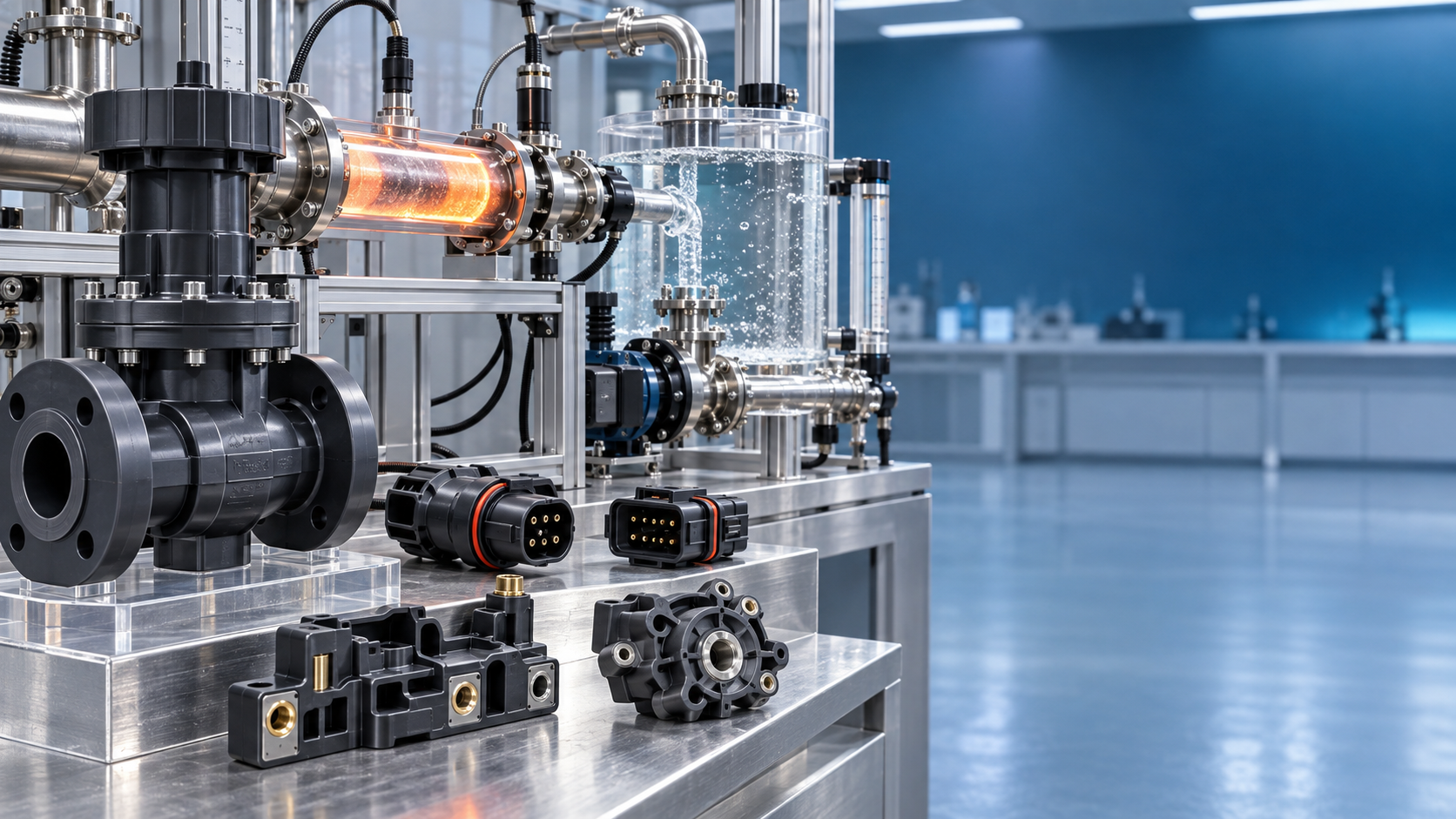
A high-temperature plastic part should be selected against its actual service envelope, not against the highest temperature shown on a data sheet. A polymer may tolerate a brief temperature excursion yet lose stiffness, crack under sustained stress, or degrade rapidly when heat is combined with moisture, oxygen, process chemicals, or repeated thermal cycling. For housings, valve components, electrical connectors, pump elements, retainers, seals, and machine guards, the material decision must begin with the failure mode that is unacceptable in service.
Start by defining the temperature at the polymer itself. Fluid temperature, oven setpoint, and ambient air temperature are often poor substitutes for part temperature. A dark component near a radiant heater, a thin section beside a hot metal insert, or a bearing cage exposed to friction may run substantially hotter than the surrounding process. Record normal temperature, peak temperature, ramp rate, dwell time at peak, expected service life, and the number of thermal cycles. These conditions determine whether the dominant concern is softening, creep, oxidation, hydrolysis, thermal fatigue, or distortion caused by differential expansion.
Separate short-term heat resistance from long-term retention
Several thermal properties are useful, but they answer different questions. The heat deflection temperature indicates resistance to deformation under a specified load during a short laboratory test. It is useful for screening, especially where dimensional stability under moderate loading matters, but it does not predict years of service under a constant clamp load or internal pressure. A melting point is equally easy to misuse. Semi-crystalline materials retain useful performance well below their melting range, while their modulus, creep resistance, and chemical resistance can still change materially as temperature rises.
For long-duration duty, examine thermal aging data at the intended temperature range. The relevant question is whether tensile strength, elongation, impact resistance, dielectric properties, and dimensional control remain adequate after exposure. A part that remains strong in a tensile test may already have become too brittle for vibration or assembly loads. Conversely, a material that retains tensile strength may creep enough to relax a seal or reduce thread engagement.
Glass transition temperature also needs careful interpretation. Above the glass transition, amorphous polymers experience a pronounced reduction in stiffness. This can make polycarbonate, polysulfone, polyetherimide, or similar materials suitable or unsuitable according to load, geometry, and permitted deflection, rather than according to temperature alone. Semi-crystalline polymers such as polyamide, polyphenylene sulfide, polyether ether ketone, and liquid crystal polymer behave differently, but they too lose modulus with heat. The design review should use elevated-temperature modulus and creep curves whenever dimensional accuracy or sustained loading is involved.
Match the polymer family to the failure mechanism
There is no universal “best” engineering plastic for high heat. The candidate family should follow the combination of temperature, load, exposure medium, electrical duty, and required manufacturing process.
Filled compounds expand the option set but add a second level of evaluation. Glass fiber commonly improves stiffness, heat deflection, and creep resistance, yet it introduces anisotropy. Fiber orientation changes shrinkage, warpage, thermal expansion, and local strength. A flat plate molded from a glass-filled grade may be rigid in the flow direction but less resistant to through-thickness stress or insert-induced cracking. Mineral-filled grades can improve dimensional stability with a different balance of toughness and flow. Carbon fiber may provide improved stiffness or conductivity, but conductivity can be undesirable around electrical insulation requirements.
Heat plus chemicals is a different selection problem
A compatibility chart based on room-temperature immersion is only an initial filter. Chemical uptake, diffusion, oxidation, and stress-crack susceptibility can accelerate at elevated temperature. The risk rises further when the component is under bending stress, bolt compression, internal pressure, or residual molding stress. A polymer may withstand a liquid when unstressed and fail at a molded notch, thread root, gate vestige, or metal insert when loaded.
Water-based process systems deserve particular scrutiny because “water exposure” can mean hot deionized water, hard water, steam, glycol mixtures, alkaline cleaning solutions, oxidizing biocides, or concentrated treatment chemicals. Their effect on polymers is not interchangeable. Hot water can hydrolyze susceptible resins; dissolved salts can dry as deposits that alter local temperature transfer; oxidizing conditions can shorten the useful life of certain polymer and elastomer combinations.
For circulating cooling-water hardware, evaluate the full chemistry program rather than only the circulating water. A scale and corrosion inhibitor such as Etidronic Acid CAS#2809-21-4 may be present in industrial water-treatment formulations, while cleaning, biocide treatment, pH adjustment, and upset conditions introduce additional exposure states. The molded polymer, reinforcement, joint seal, and any metal insert should all be assessed against the expected concentration, temperature, contact time, and cleaning sequence. A material selected solely for continuous neutral-water contact may not tolerate intermittent high-pH cleaning or a concentrated chemical dosing event.
Request testing that resembles the component’s real loading. Coupon immersion remains useful for identifying mass change, visual degradation, and gross loss of tensile properties. It should be supplemented by stressed specimens, assembled parts, or representative molded plaques where stress cracking, permeation, and dimensional change are credible concerns. Testing a dry, machined specimen can overlook effects produced by molding orientation, residual stress, weld lines, and absorbed moisture.
Geometry often decides whether a nominally suitable resin succeeds
High heat magnifies the influence of design details. Sharp internal corners concentrate stress and become initiation sites for fatigue or chemical cracking. Uniform wall thickness helps reduce sink, differential cooling, and residual stress, but a uniform wall is not automatically adequate if the part must resist buckling or sustained pressure. Ribs, gussets, and local reinforcement should be positioned with expected fiber orientation in mind.
Metal inserts require special care because metals and polymers expand at different rates. Repeated heating and cooling can loosen an insert, overload the surrounding resin, or cause a crack that begins below the visible surface. Threaded connections may relax because of creep even where the plastic shows no obvious deformation. In such cases, compare torque retention after thermal exposure, use a load-spreading geometry, and consider whether the joint should be redesigned around a compression limiter or alternative fastening method.
Wall thickness also changes thermal history during molding. Thick sections cool slowly, which can alter crystallinity in semi-crystalline resins and create different shrinkage or mechanical performance from that seen in a thin test bar. Thin sections may freeze early and create high orientation or incomplete weld-line fusion. The material grade and part geometry must therefore be developed together; choosing the resin before confirming fill pattern, gate location, and cooling conditions can produce misleading prototype results.
Processing history is part of the material specification
Many high-performance polymers are sensitive to moisture before molding. Insufficient drying may cause hydrolytic molecular-weight reduction, surface defects, brittle behavior, or loss of mechanical properties. Excess residence time and inappropriate melt temperature can cause thermal degradation. These issues are easily mistaken for an unsuitable resin when the root cause is process control.
Specify the commercial grade, reinforcement level, color system where relevant, recycled-content policy if applicable, drying requirement, melt-temperature window, mold-temperature target, and permitted regrind level. For critical components, retain records of lot identity and molding conditions through validation. A broad resin name is not enough: different stabilizer packages, fillers, flame-retardant systems, and lubricants may change chemical resistance, electrical tracking behavior, warpage, and long-term heat aging.
Post-processing can create its own exposure. Annealing may relieve stress or stabilize dimensions in certain designs, but it can also change crystallinity and tolerances. Painting, adhesive bonding, laser marking, ultrasonic welding, and cleaning fluids should be assessed after thermal aging, not only immediately after manufacture. A joint that passes an initial leak test can fail after thermal cycling because local stress and chemical exposure are concentrated at the interface.
Use property data in the order that prevents false confidence
A practical selection sequence begins with a service profile, then eliminates polymers with obvious thermal or chemical limitations. The remaining candidates should be compared using elevated-temperature mechanical data, creep behavior, aging results, flame and electrical requirements where applicable, and molding feasibility for the actual geometry. Only after that should the team optimize for cost, cycle time, appearance, or broad availability.
- Define the load path: distinguish static support, clamp force, pressure loading, vibration, impact, and sliding wear. A high-temperature bearing retainer and a hot-air duct may use different materials even at the same temperature.
- Set dimensional limits: identify the features that must remain stable, such as sealing lands, connector pitch, valve clearances, threads, or bearing alignment. Linear expansion data alone are insufficient when fiber orientation and moisture absorption affect shape.
- Map every contact medium: include normal fluids, cleaning chemicals, condensate, additives, lubricants, and accidental exposure during maintenance.
- Validate the molded condition: test parts or specimens made with representative gates, wall sections, inserts, and welding operations. Material data from idealized specimens should not be treated as final part evidence.
Where the service profile includes frequent excursions, thermal cycling should receive the same attention as steady-state aging. A material can retain strength after a long isothermal exposure while failing under repeated expansion and contraction. Cracks commonly appear at section transitions, around bosses, beside inserts, and at interfaces between plastic and rigid adjoining parts. Thermal cycling should be paired with functional checks such as leak performance, connector engagement, torque retention, dielectric integrity, or movement under the intended assembly load.
The final material specification should state the approved grade and condition, rather than merely naming a polymer family. It should define reinforcement, color or additive restrictions where performance is affected, acceptable manufacturing conditions, and the verification tests tied to the actual failure mode. That level of definition prevents an apparently equivalent substitution from changing the behavior of a part exposed to heat, stress, and aggressive process conditions at the same time.
Send Us Your Inquiry Today
