









Product Quick Navigation
Get a Quote
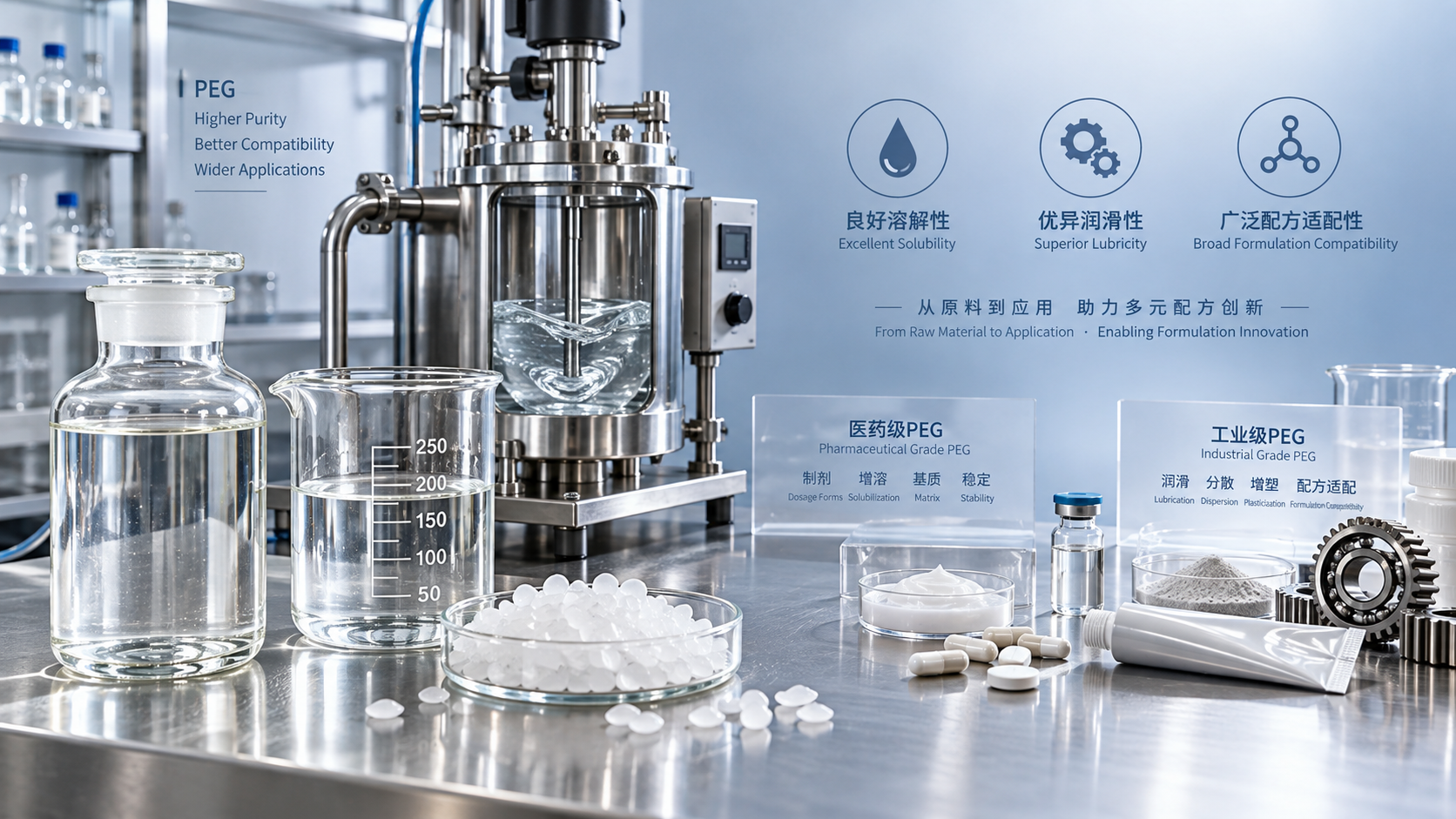
What Is Polyethylene Glycol Used for in Pharmaceutical and Industrial Formulations?
Polyethylene Glycol is used when formulators need a material that can dissolve, lubricate, bind, plasticize, humect, disperse, or modify viscosity without introducing unnecessary formulation complexity.
Its practical value comes from molecular-weight flexibility. Low-molecular-weight PEG grades are usually liquids, while higher-molecular-weight grades become waxy solids suitable for different processing and performance requirements.
For information researchers, the central question is not simply what Polyethylene Glycol does, but which grade, purity level, regulatory status, and supply documentation fit a specific application.
In pharmaceutical products, PEG often supports dosage performance and patient usability. In industrial formulations, it can improve processing, compatibility, moisture control, surface behavior, or material handling efficiency.
Why Polyethylene Glycol Is So Widely Used
Polyethylene Glycol, commonly abbreviated as PEG, is a family of polyether compounds produced in multiple average molecular weights. Its properties change substantially as molecular weight increases.
Lower molecular weights, such as PEG 200, PEG 300, and PEG 400, are generally clear liquids. They are valued as solvents, carriers, lubricants, and moisture-retaining ingredients.
Higher molecular weights, including PEG 1500, PEG 4000, PEG 6000, and PEG 8000, are typically white waxy solids. They can function as binders, coating aids, bases, and processing modifiers.
Many grades dissolve readily in water and have useful compatibility with numerous polar substances. This makes PEG particularly helpful where aqueous processing or controlled ingredient distribution is required.
Its low volatility also matters in practical manufacturing. Compared with highly volatile solvents, Polyethylene Glycol can remain in a formulation longer and provide more stable functional performance.
PEG grades are frequently selected because they have a long history of use, broad commercial availability, and relatively straightforward handling under properly controlled manufacturing conditions.
However, “PEG” is not a single interchangeable material. Molecular-weight range, residual impurities, peroxide content, water content, and applicable monographs can all affect suitability.
A useful starting principle is simple: choose Polyethylene Glycol based on the finished product’s function, processing method, exposure route, regulatory market, and required quality documentation.
Pharmaceutical Uses: More Than a Simple Excipient
In pharmaceutical formulations, Polyethylene Glycol is primarily used as an excipient. It can improve manufacturability, help deliver active ingredients, and influence the physical behavior of finished dosage forms.
Liquid PEG grades are commonly used as solvents or cosolvents for active pharmaceutical ingredients that have limited water solubility. They may support oral, topical, or specialty formulations.
PEG 400, for example, can help dissolve certain hydrophobic ingredients in liquid preparations. The final formulation still requires compatibility, stability, toxicological, and route-specific evaluation.
Solid PEG grades are often used in tablets and capsules as binders, lubricants, coating components, or carriers. Their performance depends on particle characteristics and processing conditions.
During tablet production, an appropriate PEG grade may improve granulation behavior or reduce friction during compression. Excessive levels, however, can affect hardness, disintegration, or dissolution profiles.
Polyethylene Glycol also appears in suppository bases because selected grades can melt, dissolve, or disperse predictably. Formulators balance melting range, drug release, patient comfort, and storage stability.
Topical creams, ointments, and gels may use PEG as a humectant, solvent, or base component. Its water affinity can help create washable products with controlled texture.
For ophthalmic, injectable, or highly sensitive applications, the selection criteria become significantly stricter. Pharmacopoeial compliance alone may not replace application-specific impurity and sterility assessments.
How PEG Supports Oral and Topical Product Development
Oral liquid medicines frequently need a solvent system that remains stable during storage and enables uniform dosing. Liquid Polyethylene Glycol may be one component of that system.
Its use can be particularly relevant when an active ingredient needs better dissolution than water alone can provide. Still, solubility gains must be verified over the product shelf life.
Researchers should examine precipitation risk after dilution, temperature cycling, and exposure to moisture. A drug that appears dissolved initially may crystallize under realistic storage conditions.
In oral solid dosage forms, PEG can be incorporated by dry blending, melt granulation, wet granulation, or coating processes. Each route creates different control points.
Melt processing can reduce solvent use, but it requires attention to temperature exposure. Active ingredients, flavors, colorants, and polymers may have different thermal stability limits.
For topical products, PEG-based systems can help solubilize ingredients while offering a non-greasy feel. They are often easier to rinse away than highly hydrophobic ointment bases.
Yet water affinity can also create limitations. PEG-containing topical products may absorb moisture, alter viscosity, or require packaging that protects the formula from uncontrolled environmental exposure.
The strongest formulation decisions come from testing the entire system, rather than assuming a standard PEG grade will behave identically across different active ingredients and packaging formats.
Industrial Applications of Polyethylene Glycol
Industrial uses of Polyethylene Glycol are broad because its solubility and lubricity can improve both chemical processing and finished-product performance across several manufacturing sectors.
In ceramics, textiles, paper, coatings, rubber, plastics, and metalworking, PEG may act as a dispersant, lubricant, binder, release aid, humectant, or processing additive.
Textile operations may use selected PEG grades to improve fiber handling, reduce static effects, or support dyeing and finishing processes. Performance depends on fiber type and bath chemistry.
In paper manufacturing, Polyethylene Glycol can assist with lubrication, moisture management, and processability. Compatibility with pulp additives, fillers, and coating systems should be confirmed before scale-up.
PEG is also used in certain water-based coatings and inks as a coalescing, flow-modifying, or humectant-type ingredient. Molecular weight influences viscosity and drying behavior.
In metalworking formulations, liquid PEG grades may contribute lubricity and cooling characteristics. They are usually evaluated alongside corrosion inhibitors, surfactants, biocides, and water quality controls.
Polyurethane, resin, and polymer-related applications can use polyether materials as intermediates or performance modifiers. Buyers should distinguish standard PEG products from specialized polyols or block copolymers.
Industrial formulations should be evaluated for temperature stability, water interaction, foaming tendency, compatibility, and downstream effects on surfaces, equipment, and waste-treatment systems.
Choosing the Right Molecular Weight and Grade
Molecular weight is one of the most important selection variables because it changes PEG’s physical form, viscosity, melting behavior, solubility profile, and suitability for manufacturing equipment.
Liquid grades generally offer easier pumping, dosing, and blending. They are often selected for solvent systems, lubricants, liquid cleaners, and formulations requiring a mobile carrier phase.
Solid grades can provide structure, improve binding, adjust melt properties, or contribute controlled dissolution characteristics. They may require melting, flaking, milling, or heated transfer systems.
Average molecular weight is not the only specification to review. Buyers should ask about hydroxyl value, pH, water content, color, ethylene oxide residues, and peroxide levels.
For pharmaceutical and personal-care applications, pharmacopeial conformity may be critical. Relevant standards can include USP-NF, Ph. Eur., BP, JP, or other market-specific requirements.
For industrial uses, technical-grade material may be appropriate where pharmacopoeial standards are unnecessary. Even then, consistent batch quality and traceable certificates remain commercially important.
It is also prudent to confirm packaging format. Drums, IBCs, bags, flakes, and molten bulk deliveries each create different logistics, storage, and handling requirements.
A supplier should provide a current certificate of analysis, safety data sheet, technical data sheet, origin details, and packaging information before a buyer commits to qualification or production planning.
Compatibility, Stability, and Formulation Risks to Check
Polyethylene Glycol is often described as stable, but stable does not mean universally compatible. A responsible evaluation considers active ingredients, polymers, metals, antioxidants, and environmental conditions.
Some sensitive ingredients may be affected by trace peroxides or oxidation products. This issue can be especially important for oxidation-prone pharmaceuticals, fragrances, colors, and specialty chemicals.
Peroxide monitoring may therefore be relevant for long shelf-life formulations or products containing oxidation-sensitive components. Acceptance limits should be based on the complete formulation risk assessment.
PEG is hygroscopic to varying degrees, meaning it can attract water from its surroundings. This may alter viscosity, weight, crystallization behavior, or the moisture balance of adjacent ingredients.
Storage areas should be clean, dry, and protected from excessive heat. Containers should remain tightly closed to minimize contamination, moisture uptake, and avoidable changes during storage.
Compatibility testing should include real manufacturing conditions rather than only laboratory bench tests. Agitation speed, heating cycles, holding time, and packaging contact can change observed performance.
For regulated applications, change control is essential. A shift in PEG manufacturing site, molecular-weight distribution, antioxidant use, or packaging may require formal reassessment by the customer.
For industrial buyers, documentation reduces operational risk. Reliable specifications and responsive technical communication are often as valuable as the material’s initial purchase price.
PEG Compared With Other Plasticizers and Processing Additives
Polyethylene Glycol can provide useful plasticizing or processing effects in selected systems, but it is not a universal replacement for hydrophobic plasticizers used in flexible polymer products.
PEG is generally more water-compatible and polar than common phthalate or terephthalate plasticizers. That distinction affects migration, polymer compatibility, moisture response, and end-use durability.
For PVC formulations requiring heat resistance, long-term flexibility, transparency, and lower water affinity, a dedicated plasticizer may be a more appropriate technical choice than PEG.
For example, Dioctyl terephthalate CAS#6422-86-2 is used in PVC and copolymer processing where thermal stability, clarity, and durable plasticization are important.
This comparison is not about selecting one chemical as universally superior. It is about matching molecular behavior to the polymer, process, compliance requirements, and expected service environment.
PEG can be preferable when water solubility, lubrication, dispersibility, or a pharmaceutical-grade profile is needed. Hydrophobic plasticizers can be preferable for durable flexible polymer applications.
Buyers should avoid relying on product names alone. Reviewing chemical structure, application history, compatibility data, and finished-product testing provides a more reliable basis for substitution decisions.
When an export supplier offers multiple chemical categories, it is easier to compare options through one qualified channel while retaining clear technical boundaries between materials and applications.
What Buyers Should Ask Before Sourcing Polyethylene Glycol
Information researchers can make purchasing discussions more productive by preparing a short technical brief before requesting quotations. The brief should describe application, grade, volume, and destination market.
First, identify the desired molecular weight or viscosity range. A request for “PEG” without a grade can produce quotations for materials that perform very differently.
Second, specify whether pharmaceutical, food-contact, cosmetic, or industrial quality is required. Compliance expectations should be stated before samples, documentation, or commercial terms are finalized.
Third, ask for the latest certificate of analysis and compare it against internal limits. Do not assume that a general technical specification covers every critical formulation parameter.
Fourth, confirm packaging and transport conditions. Liquid PEG may need temperature management in colder climates, while solid grades may require protection from moisture and physical damage.
Fifth, assess supplier continuity. Consistent supply depends on manufacturing capacity, export experience, documentation control, communication speed, and the ability to manage unexpected logistics changes.
For cross-border trade, customs classification, labeling, safety documentation, and local chemical regulations should be reviewed early. Delays often arise from incomplete documents rather than material availability.
Shandong Huafeng Chemical supports overseas chemical sourcing with a broader product portfolio and foreign-trade service capabilities, helping buyers coordinate documentation, product information, and supply communication.
Conclusion: Select PEG by Function, Not by Name Alone
Polyethylene Glycol is valuable because one chemical family can serve many formulation roles, from pharmaceutical solvents and tablet aids to industrial lubricants, dispersants, and processing modifiers.
The correct choice depends on molecular weight, purity, compliance needs, compatibility, storage conditions, and the behavior required in the finished product. Generic assumptions create avoidable formulation risks.
For pharmaceutical applications, prioritize pharmacopoeial status, impurity control, and route-specific suitability. For industrial applications, focus on process performance, material compatibility, handling, and long-term operating reliability.
A well-defined technical request, supported by documentation and formulation testing, gives buyers the clearest path to selecting Polyethylene Glycol that delivers both functional performance and dependable supply.
Send Us Your Inquiry Today
